
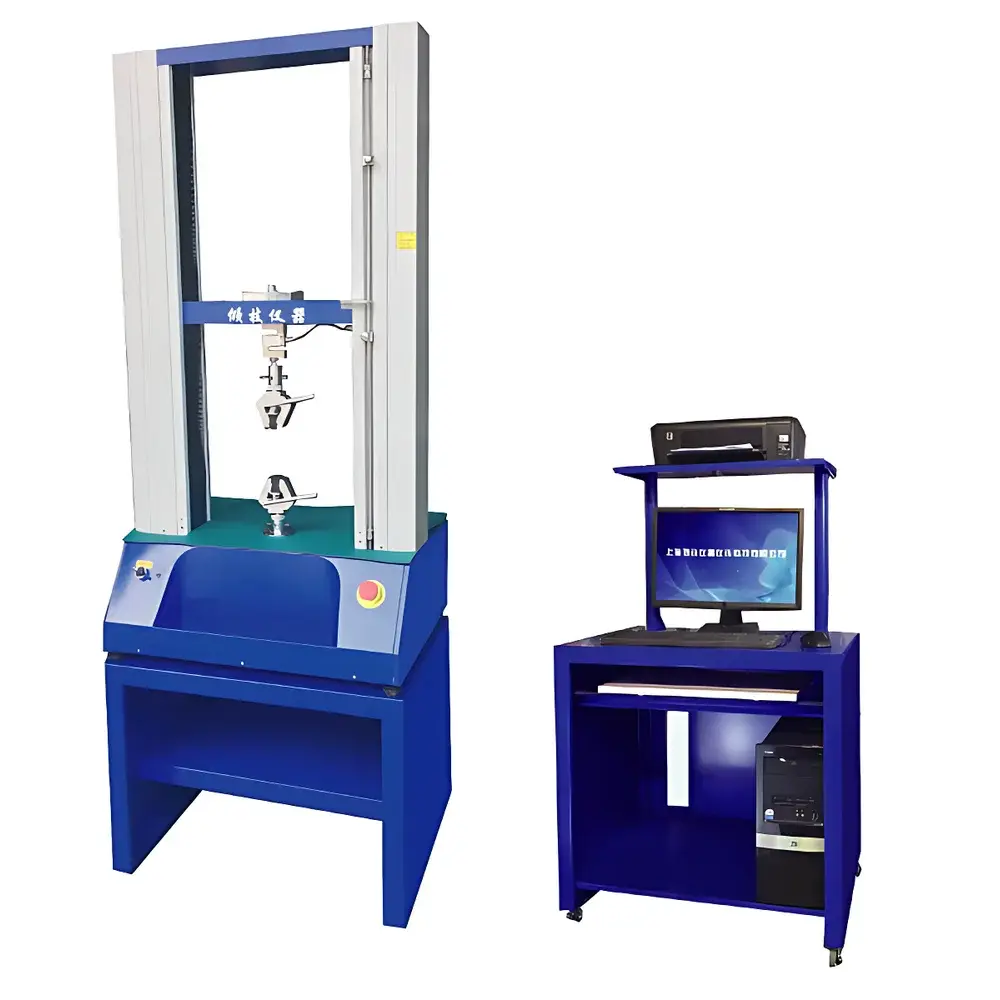
QJ211S Temperature-Controlled Tape Peel Testing Machine
| Origin | Shanghai, China |
|---|---|
| Manufacturer Type | Authorized Distributor |
| Origin Category | Domestic (PRC) |
| Model | QJ211S |
| Instrument Type | Electromechanical Universal Testing Machine |
| Load Capacity | 0–30 kN |
| Temperature Range | −70 °C to +350 °C (isothermal hold at 350 °C) |
| Heating/Cooling Rate | ≥5 °C/mm (axial gradient specification) |
| Temperature Controller Resolution | 0.1 °C |
| Test Speed Range | 0.001–500 mm/min (extendable to 1000 mm/min in select configurations) |
| Speed Accuracy | ±0.5% |
| Load Cell Accuracy | ±0.01% of full scale |
| Measurement Accuracy (Force/Displacement/Strain) | <±1% or <±0.5% (per ASTM E4 and ISO 7500-1 calibration protocols) |
| Effective Test Width | 420 mm |
| Effective Stroke | ~800 mm (extendable) |
| Safety Systems | Dual-channel electronic limit switches, emergency stop circuit per IEC 60204-1 |
| Machine Weight | 135 kg |
Overview
The QJ211S Temperature-Controlled Tape Peel Testing Machine is an electromechanical universal testing system engineered for precise mechanical characterization of pressure-sensitive adhesives (PSAs), laminates, and bonded interfaces under controlled thermal conditions. It operates on the principle of uniaxial force application with synchronized environmental regulation—integrating a high-fidelity load frame with a vertically aligned, actively cooled/heated environmental chamber. This architecture enables standardized peel testing (e.g., 90° and 180° configurations per ASTM D3330, PSTC-101, and ISO 8510-2) across a broad thermal spectrum from cryogenic (−70 °C) to sustained high-temperature (350 °C isothermal) regimes. Unlike ambient-only peel testers, the QJ211S maintains traceable temperature uniformity within the test zone during dynamic loading, ensuring compliance with thermal aging and low-temperature performance evaluation requirements defined in IPC-TM-650 2.4.1, MIL-STD-883 Method 2019, and JIS Z 0237.
Key Features
- Modular thermal chamber design: Removable high/low-temperature enclosure allows rapid reconfiguration for ambient-mode tensile, compression, flexure, and shear testing—maximizing lab floor utilization without hardware duplication.
- High-resolution electromechanical actuation: Precision ball-screw drive with closed-loop servo control delivers stable, repeatable crosshead motion from 0.001 mm/min to 500 mm/min (optionally 1000 mm/min), meeting ASTM D882 and ISO 527 speed fidelity requirements.
- Traceable force measurement: Dual-range, temperature-compensated load cell (0–30 kN capacity) calibrated to ISO 7500-1 Class 0.5, with verified linearity ≤0.01% FS and hysteresis <0.02% FS.
- Thermal performance validation: Chamber equipped with PT100 sensors and PID-controlled heating/cooling elements; temperature stability maintained at ±0.5 °C over 30-minute dwell periods per ASTM E74 and ISO 17025-compliant verification procedures.
- Safety-integrated architecture: Redundant electronic limit switches, hardware-triggered emergency stop (Category 3 per EN ISO 13850), and automatic load cutoff upon displacement threshold violation.
Sample Compatibility & Compliance
The QJ211S accommodates standard peel specimens (e.g., 25 mm wide tapes on stainless steel or aluminum substrates) as well as custom geometries up to 420 mm width and 800 mm stroke. It supports ISO 293, ASTM D903, ASTM D6252 (for film-to-film peel), and TAPPI T494 protocols. All mechanical and thermal subsystems are validated against ISO/IEC 17025:2017 calibration traceability frameworks. The system meets electromagnetic compatibility (EMC) requirements per EN 61326-1 and safety standards per EN 61000-6-2/6-4. Optional documentation packages include IQ/OQ protocols aligned with FDA 21 CFR Part 11 and GMP Annex 15 for regulated pharmaceutical and medical device adhesive qualification.
Software & Data Management
Control and analysis are executed via proprietary Windows-based software compliant with GLP data integrity principles. The interface supports real-time force–displacement–temperature tri-plotting, automated peak detection for peel strength (N/25 mm), and calculation of energy dissipation (J/m²) per ASTM D903 Annex A1. Raw data export is available in CSV, Excel, and XML formats with embedded metadata (operator ID, timestamp, calibration certificate ID, environmental log). Audit trails record all parameter modifications, test start/stop events, and user logins—fully satisfying 21 CFR Part 11 electronic record requirements when configured with digital signature modules and role-based access controls.
Applications
- Quantification of temperature-dependent peel adhesion loss in automotive interior bonding systems (e.g., dash trim, headliner foams).
- Evaluation of thermal cycling durability in flexible printed circuit (FPC) coverlay adhesives per IPC-CC-830B.
- Comparative assessment of acrylic vs. silicone PSA performance at sub-zero temperatures for cold-chain packaging validation.
- Shear creep compliance testing of structural tapes under sustained 350 °C loads for aerospace composite assembly qualification.
- ISO 10365-compliant fatigue testing of adhesive joints using programmed low-cycle stress profiles (1–100 Hz).
FAQ
Does the QJ211S support ASTM D3330 Method A (180° peel) and Method B (90° peel) with thermal conditioning?
Yes—fixture sets for both configurations are included, and the chamber ensures specimen temperature equilibration prior to and during peel initiation per ASTM D3330 Section 7.2.
Can the system be integrated into a LIMS or MES environment?
Yes—OPC UA and Modbus TCP communication protocols are supported for bidirectional data exchange with laboratory information management systems.
Is third-party calibration certification available?
Certified calibration reports traceable to NIM (China) or NIST (USA) are provided upon request, including uncertainty budgets per ISO/IEC 17025 Annex A.
What maintenance intervals are recommended for long-term accuracy retention?
Load cell verification every 6 months, thermal chamber uniformity mapping annually, and mechanical alignment check after 5000 test cycles or 12 months—whichever occurs first.
Are custom grips or environmental fixtures available beyond standard peel jaws?
Yes—custom-designed pneumatic, hydraulic, or heated grips can be supplied with engineering drawings and FEA validation reports.



