
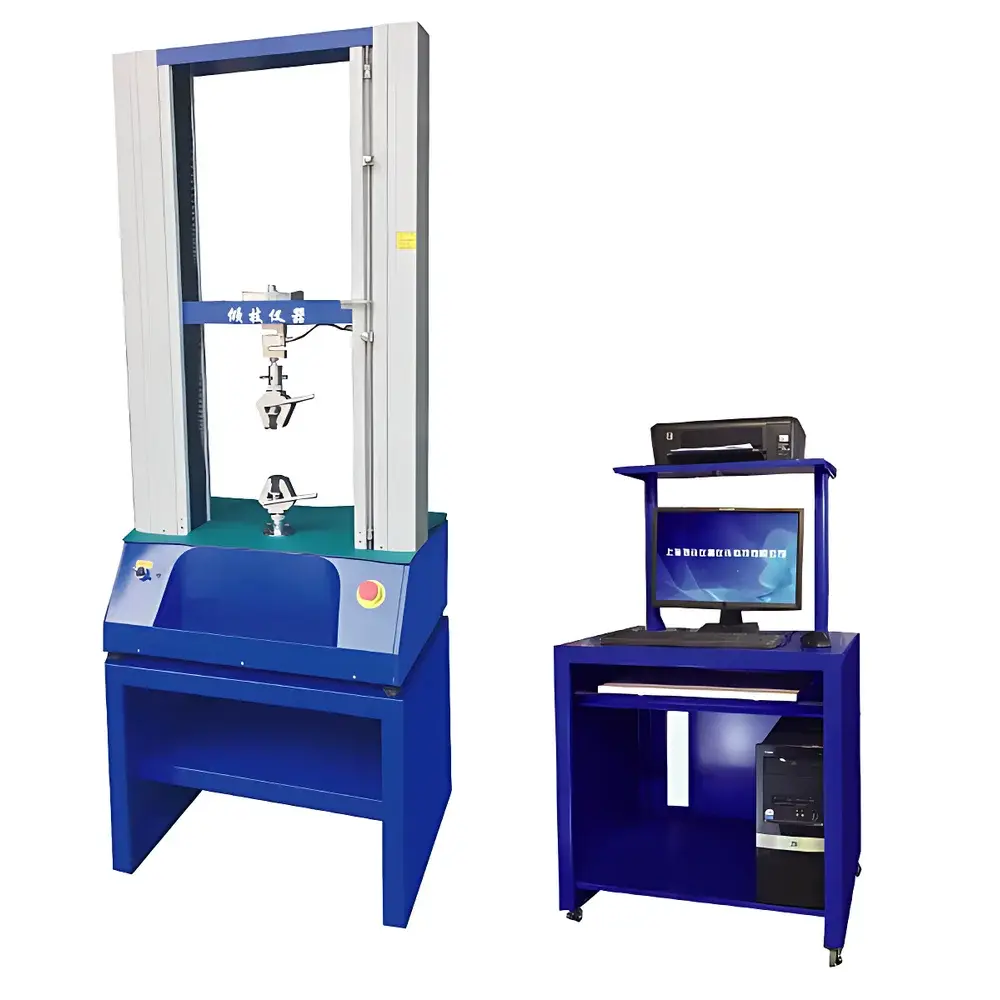
QJ211S Universal Testing Machine for Polymeric Foam Materials
| Origin | Shanghai, China |
|---|---|
| Manufacturer Type | Authorized Distributor |
| Origin Category | Domestic (China) |
| Model | QJ211S |
| Price | ¥30,000 CNY |
| Instrument Type | Electromechanical Universal Testing Machine |
| Load Capacity | 30 kN |
| Load Cell Accuracy | 0.01% FS |
| Test Accuracy | < ±0.5% |
| Control Mode | Full PC-based Windows OS Interface |
| Effective Test Width | ~420 mm |
| Effective Tensile Travel | ~800 mm |
| Test Speed Range | 0.001–500 mm/min |
| Speed Accuracy | ±0.5% |
| Displacement Measurement Accuracy | ±0.5% |
| Strain/Deformation Measurement Accuracy | ±0.5% |
| Safety Features | Electronic Overtravel Limit Protection, Emergency Stop Button |
| Machine Weight | ~140 kg |
Overview
The QJ211S Universal Testing Machine is an electromechanical static testing system engineered for high-reproducibility mechanical characterization of polymeric foam materials—including flexible polyurethane (PU), expanded polystyrene (EPS), ethylene-vinyl acetate (EVA), and cross-linked polyethylene (XLPE) foams. Operating on the principle of controlled displacement-driven force measurement, the system applies precisely regulated axial loads via a servo-controlled AC motor and precision ball-screw actuator assembly. Its modular load frame accommodates interchangeable fixtures to execute standardized uniaxial tests per ISO 1797-2 (foam compression set), ISO 1856 (tensile properties of rigid foams), ASTM D3574 (flexible foam testing), and ASTM D1621 (rigid cellular plastics compression). Designed for laboratory and quality control environments, the QJ211S delivers traceable, repeatable data under ambient conditions without requiring hydraulic infrastructure or environmental chambers.
Key Features
- 30 kN dual-range load cell with 0.01% full-scale resolution and temperature-compensated signal conditioning
- Full PC-integrated control architecture running native Windows OS, supporting real-time multi-channel acquisition (force, displacement, strain)
- Dynamic on-screen visualization of stress–strain, load–displacement, and time-based curves with adjustable scaling, overlay, and annotation tools
- Configurable test sequences with programmable hold steps, cyclic loading profiles, and ramp-to-load/ramp-to-strain modes
- Compliance with mechanical safety standards including ISO 12100 (risk assessment) and IEC 61000-6-2/6-4 (EMC immunity and emissions)
- Integrated emergency stop circuitry, software-enforced travel limits, and hardware-based overload cutoff
- Modular fixture interface compatible with tensile grips, compression platens, 3-point bend fixtures, peel jigs, tear fixtures, and puncture probes
Sample Compatibility & Compliance
The QJ211S supports specimens ranging from low-density open-cell foams (≥10 kg/m³) to high-resilience closed-cell formulations (≤300 kg/m³), accommodating thicknesses from 10 mm to 150 mm and widths up to 400 mm. All test methods align with internationally recognized metrological frameworks: force calibration traceable to NIM (National Institute of Metrology, China); displacement verification per ISO 9513 Class 1; and system-level validation per ISO 7500-1 (static uniaxial testing machines). The instrument satisfies requirements for GLP-compliant data integrity when configured with audit-trail-enabled software—supporting electronic signatures, user access levels, and immutable raw-data archiving per FDA 21 CFR Part 11 guidelines.
Software & Data Management
The proprietary Windows-based testing software provides ISO/IEC 17025-aligned reporting workflows. It enables automated generation of compliant test reports—including specimen ID, environmental conditions (optional humidity/temperature input), operator signature, calibration certificate references, and statistical summaries (mean, SD, CV%). Raw data exports are available in CSV, Excel, and XML formats; curve overlays support comparative analysis across material batches or processing conditions. Version-controlled software updates include enhanced curve manipulation (e.g., tangent modulus calculation at 10%/25%/50% strain), automatic yield point detection using ASTM E111 protocols, and customizable pass/fail thresholds against specification limits.
Applications
- Compression resilience and recovery evaluation of automotive seat foams per SAE J2712
- Tensile strength and elongation-at-break testing of packaging cushioning foams (ASTM D638 modified for low-modulus specimens)
- Creep and stress-relaxation profiling under constant load for medical device packaging validation
- Bending stiffness determination of structural foam cores used in wind turbine blade manufacturing (IEC 61400-23)
- Peel adhesion assessment of laminated foam composites in HVAC duct insulation
- Quality conformance screening in incoming inspection for aerospace interior components (SAE AMS3195)
- Research-grade mechanical mapping of temperature-dependent viscoelastic behavior (when paired with environmental chamber option)
FAQ
Does the QJ211S comply with ISO/IEC 17025 accreditation requirements for testing laboratories?
Yes—when operated with calibrated transducers, documented maintenance logs, and version-controlled software enabling full audit trails, the system meets technical competence criteria for mechanical testing scope accreditation.
Can the machine perform cyclic fatigue tests on foam specimens?
Yes—the software supports low-frequency sinusoidal, triangular, or trapezoidal waveforms with programmable amplitude, frequency (0.01–5 Hz), and cycle count, suitable for evaluating fatigue life per ISO 4665.
Is third-party calibration certification included with purchase?
A factory-issued calibration certificate traceable to national standards is provided; optional UKAS or CNAS-accredited field calibration services are available upon request.
What is the typical lead time for custom fixture design?
Standard fixtures ship with the system; bespoke fixtures (e.g., compression dies with vented surfaces for gas-permeable foams) require 10–15 working days after final drawing approval.
How is firmware updated, and is remote support available?
Firmware upgrades are delivered via secure HTTPS download with digital signature verification; remote desktop assistance is supported through TLS-encrypted TeamViewer sessions during business hours UTC+8.



