
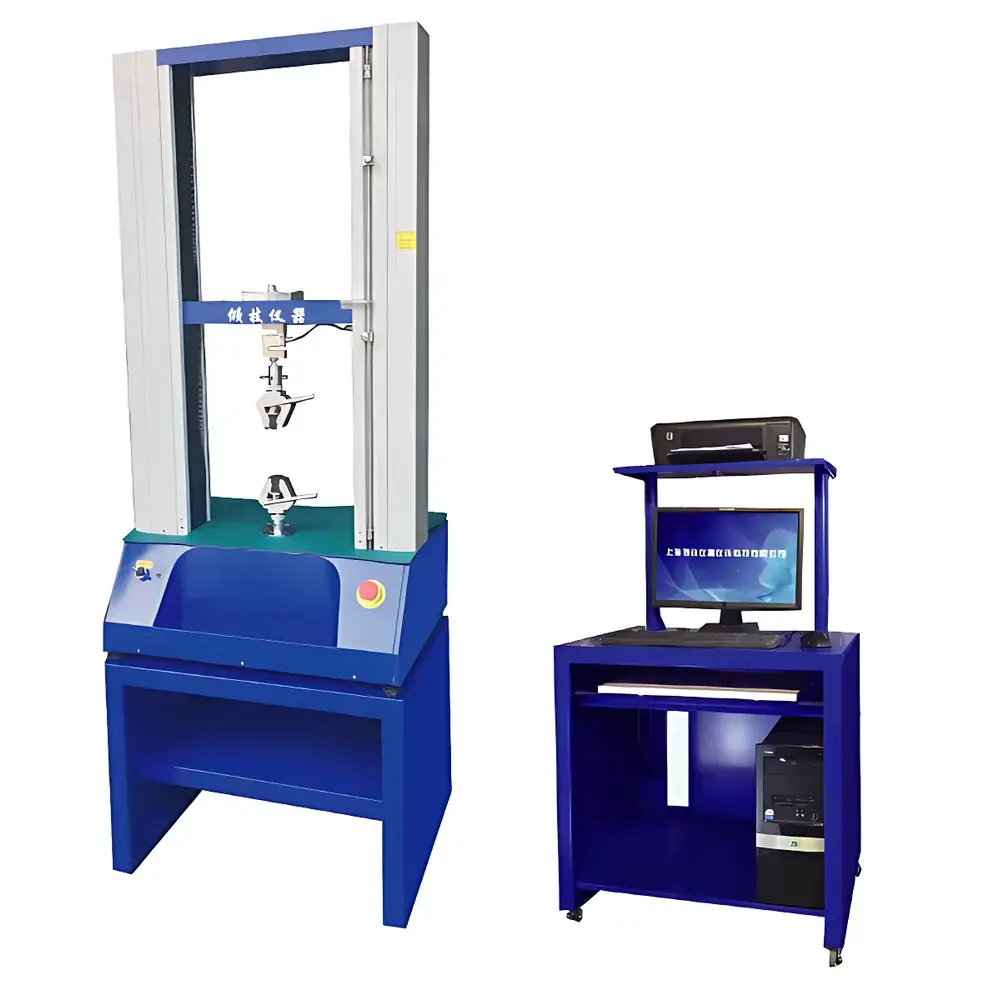
QJ211S Universal Testing Machine for Wood Flexural Modulus of Elasticity
| Origin | Shanghai, China |
|---|---|
| Manufacturer Type | Authorized Distributor |
| Origin Category | Domestic (China) |
| Model | QJ211S |
| Price | USD 6,300 (FOB Shanghai) |
| Instrument Type | Electromechanical Universal Testing Machine |
| Load Capacity | 30 kN |
| Load Cell Accuracy | ±0.01% FS |
| Test Accuracy | ±0.5% |
| Control Mode | Full PC-Based Windows Interface |
| Effective Test Width | 420 mm |
| Effective Tensile Stroke | 800 mm |
| Speed Range | 0.001–500 mm/min |
| Speed Accuracy | ±0.5% |
| Displacement Measurement Accuracy | ±0.5% |
| Strain Measurement Accuracy | ±0.5% |
| Safety Features | Electronic stroke limit, emergency stop button, overload auto-shutdown |
| Machine Weight | ~140 kg |
Overview
The QJ211S Universal Testing Machine is an electromechanical materials testing system engineered for precision mechanical characterization of wood and other structural biomaterials under quasi-static loading conditions. Specifically configured for flexural modulus of elasticity (MOE) determination in accordance with ASTM D143, ISO 3133, and GB/T 1931—standards governing bending stiffness evaluation of solid wood specimens—the instrument employs a dual-column servo-controlled architecture with high-resolution load cell feedback and closed-loop displacement control. Its modular design supports three-point and four-point bending configurations, enabling compliant measurement of elastic behavior in both clear-wood and composite timber samples. Unlike legacy hydraulic or manual testers, the QJ211S integrates real-time force-displacement-strain synchronization via a calibrated 30 kN load cell (0.01% full-scale accuracy), ensuring traceable data acquisition suitable for ISO/IEC 17025-accredited laboratories.
Key Features
- Electromechanical actuation system delivering smooth, noise-free motion across a wide speed range (0.001–500 mm/min) with ±0.5% speed fidelity.
- Auto-zeroing and auto-return functionality triggered upon test initiation and specimen fracture, minimizing operator intervention and enhancing repeatability.
- Multi-range load cell switching ensures optimal signal-to-noise ratio across low-force (e.g., small-dimension sapwood) and high-force (e.g., laminated veneer lumber) applications.
- Real-time dynamic display of force, displacement, and strain curves during testing; all parameters fully configurable via Windows-based software interface.
- Integrated electronic stroke limits and mechanical hard stops provide dual-layer safety compliance per ISO 12100 and EN 61000-6-2.
- Structural frame constructed from extruded aluminum profiles with industrial-grade powder coating, supporting long-term dimensional stability and corrosion resistance in lab environments.
- Modular fixture compatibility—including standard three-point bending jigs, compression platens, and tensile grips—enables rapid reconfiguration for multi-test workflows.
Sample Compatibility & Compliance
The QJ211S accommodates rectangular cross-section wood specimens up to 420 mm in width and 800 mm in effective span length, meeting dimensional requirements for ASTM D143 Type I and Type II bending tests. It supports green, air-dried, and kiln-dried hardwood and softwood species, as well as engineered wood products such as plywood, OSB, and CLT panels (with appropriate support spacing). All test routines comply with GLP documentation standards, and raw data files include embedded metadata (operator ID, timestamp, environmental temperature/humidity if externally logged), facilitating audit readiness per FDA 21 CFR Part 11 when paired with validated software modules. Calibration certificates are traceable to NIM (National Institute of Metrology, China) or equivalent national metrology institutes.
Software & Data Management
The system operates via proprietary Windows-compatible software that supports customizable test templates, automated report generation (PDF/Excel), and curve post-processing (tangent modulus, secant modulus, proportional limit identification). Raw ASCII data exports include time-stamped columns for load (N), displacement (mm), and optional extensometer-derived strain (µm/mm). Audit trails record user login events, parameter modifications, and calibration history. Optional add-ons include password-protected user roles, electronic signatures, and encrypted database storage—features aligned with GMP-aligned quality systems for certified timber product testing labs.
Applications
- Determination of flexural modulus of elasticity (MOE) and modulus of rupture (MOR) in solid-sawn lumber per ASTM D143 and ISO 3133.
- Compression parallel-to-grain testing for strength grading of structural timbers.
- Tensile property evaluation of veneer layers and adhesive bonds in laminated products.
- Bending fatigue pre-screening of modified wood specimens prior to accelerated weathering protocols.
- Quality assurance testing for FSC®-certified timber suppliers requiring documented mechanical performance verification.
- Academic research on moisture–mechanical property relationships in hygroscopic biopolymers.
FAQ
Does the QJ211S meet international standards for wood mechanical testing?
Yes—it is configured to execute ASTM D143, ISO 3133, EN 310, and GB/T 1931 procedures out-of-the-box, with fixture geometry and loading rates programmatically enforced.
Can the system be integrated into a LIMS or enterprise QA platform?
Yes—ASCII data export, OPC UA connectivity (optional), and CSV-based reporting enable seamless integration with laboratory information management systems.
Is third-party calibration and certification available?
Yes—factory calibration includes NIST-traceable load cell verification; on-site ISO 17025-compliant calibration services are offered globally through authorized partners.
What maintenance is required to sustain measurement accuracy?
Annual verification of load cell linearity, crosshead alignment, and encoder resolution is recommended; no routine lubrication or hydraulic fluid changes are needed due to its electromechanical drive architecture.
Are bending fixtures included with the base configuration?
Yes—the standard package includes a three-point bending fixture with adjustable span (200–700 mm), hardened steel rollers (Ø10 mm), and support anvils compliant with ASTM D143 dimensional tolerances.



