
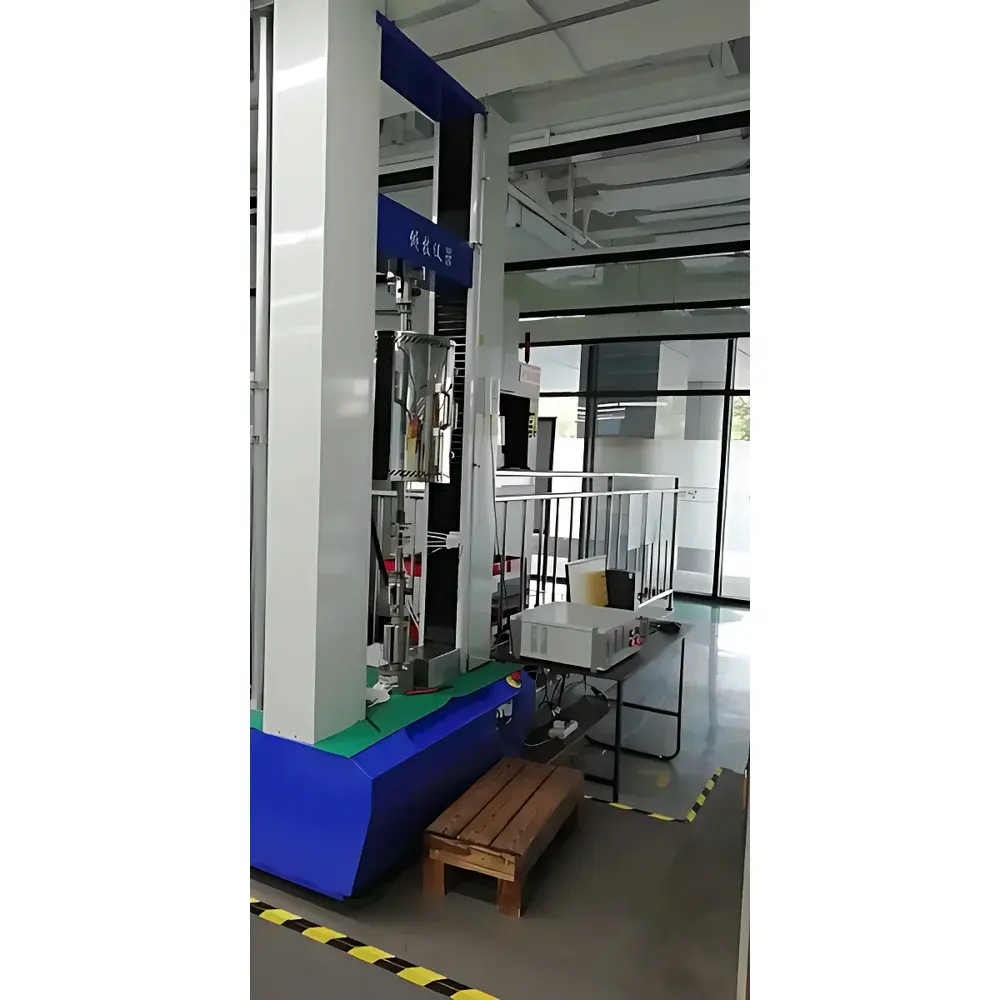
QJ212-100KN Creep and Stress Relaxation Testing Machine
| Origin | Shanghai, China |
|---|---|
| Manufacturer Type | Authorized Distributor |
| Origin Category | Domestic (PRC) |
| Model | QJ212-100KN |
| Max Test Load | 100 kN |
| Crosshead Travel | 200 mm |
| Overall Dimensions | 1 m (L) × 0.8 m (W) × 2.2 m (H) |
| Machine Weight | 850 kg |
| Load Accuracy | ±0.5% of reading (from 1% FS) |
| Load Control Stability | ±1% of set value |
| Crosshead Speed Range | 0.01–180 mm/min |
| Strain Measurement | High-resolution encoder (range: 25 mm, accuracy ±0.5%) |
| High-Temperature Furnace | Φ50 mm bore × 450 mm length |
| Temp Range | RT to 1200 °C |
| Temp Uniformity | ±0.5 °C |
| Isothermal Zone Length | >150 mm |
| Power | 3 kW |
Overview
The QJ212-100KN Creep and Stress Relaxation Testing Machine is a precision-engineered electromechanical system designed for time-dependent mechanical characterization of metallic and alloy materials under sustained load and elevated temperature conditions. It operates on the fundamental principles of uniaxial tensile creep testing—measuring strain evolution as a function of time under constant load (creep), or load decay under constant displacement (stress relaxation)—in accordance with ASTM E139, ISO 204, and GB/T 2039 standards. The system integrates a high-rigidity dual-column frame, servo-controlled loading actuation, and a programmable high-temperature furnace capable of stable operation up to 1200 °C. Its architecture supports both isothermal and ramped-temperature test protocols, enabling evaluation of primary, secondary (steady-state), and tertiary creep stages, as well as stress rupture life prediction in structural alloys used in aerospace propulsion, power generation, and nuclear applications.
Key Features
- Robust mechanical frame with 850 kg mass and optimized structural damping for minimal vibrational interference during long-duration tests (up to 10,000+ hours).
- High-fidelity load control via imported servo drive system, offering continuous adjustable load range from 0–10 kN to 0–100 kN in fine increments (0.1 N resolution), ensuring compliance with JJG 276 calibration requirements.
- Precision crosshead travel (200 mm stroke) with speed control spanning 0.01–180 mm/min—enabling both ultra-slow creep rate measurements and rapid pre-load alignment.
- Dual-mode deformation measurement: high-stability linear encoder (25 mm range, ±0.5% accuracy) mounted directly on the loading train, eliminating extensometer slippage artifacts common in high-temperature environments.
- Integrated high-temperature furnace with Φ50 mm hot zone, 450 mm active length, and certified isothermal zone (>150 mm at ±0.5 °C), validated per HB 5150 and HB 5151 thermal uniformity criteria.
- Modular control architecture supporting future expansion to static tensile, low-cycle fatigue, and creep-fatigue interaction testing via firmware upgrade and accessory integration.
Sample Compatibility & Compliance
The QJ212-100KN accommodates standard cylindrical and flat-bar specimens per ASTM E8/E21 geometry specifications, including gauge lengths from 12.5 mm to 50 mm and diameters up to 12 mm. Specimen gripping utilizes hardened steel wedge-type fixtures with thermal compensation design to maintain clamping force integrity across the full operating temperature range. The system conforms to national and international regulatory frameworks governing material certification: it satisfies metrological verification requirements of JJG 276 (China), meets functional performance criteria outlined in GB/T 2039 (metallic tensile creep and rupture), and aligns with aerospace qualification protocols referenced in AMS 2300 and MIL-HDBK-5H. All temperature and load data streams are timestamped and traceable—supporting GLP-compliant audit trails when paired with optional 21 CFR Part 11–enabled software modules.
Software & Data Management
Bundled PC-based control and analysis software provides real-time monitoring of load, displacement, temperature, and elapsed time, with configurable alarm thresholds for deviation detection (e.g., thermal drift >±1 °C, load deviation >±2%). Raw data is stored in ASCII-delimited format (.csv) with metadata headers—including operator ID, test ID, furnace serial number, and calibration certificate expiry—ensuring full chain-of-custody documentation. Advanced post-processing tools include Burgers model fitting, Larson-Miller parameter calculation, Monkman-Grant relationship plotting, and time-to-rupture extrapolation using Norton-Bailey power-law regression. Export options support ASTM E139-compliant reporting templates and direct integration into LIMS platforms via OPC UA protocol.
Applications
- High-temperature creep life assessment of nickel-based superalloys (e.g., Inconel 718, Waspaloy) for turbine disk and blade qualification.
- Stress relaxation behavior quantification in welded joints and brazed assemblies subjected to thermal cycling in exhaust manifolds and heat exchangers.
- Long-term dimensional stability evaluation of titanium alloys (Ti-6Al-4V) under sustained tensile loads in airframe structural components.
- Creep-rupture mapping for pressure vessel steels (e.g., P91, P92) per ASME BPVC Section II Part D allowable stress tables.
- Fundamental research on dislocation climb kinetics and grain boundary sliding mechanisms via multi-temperature, multi-stress-level testing matrices.
FAQ
What standards does the QJ212-100KN comply with for high-temperature creep testing?
It fully satisfies JJG 276 (China National Verification Regulation), GB/T 2039, HB 5150, and HB 5151, and its measurement uncertainty profile aligns with ISO 204 and ASTM E139 requirements for Class B systems.
Can the system perform stress relaxation tests at constant displacement?
Yes—the closed-loop displacement control mode maintains specimen extension within ±0.005 mm tolerance while recording load decay over time, enabling accurate determination of relaxation modulus and viscoelastic parameters.
Is furnace calibration traceable to national standards?
Each furnace is supplied with a NIST-traceable calibration certificate (valid for 12 months), covering temperature uniformity mapping and thermocouple linearity verification across the full 20–1200 °C range.
What maintenance intervals are recommended for long-term reliability?
Biannual verification of load cell linearity and encoder resolution is advised; furnace insulation integrity and thermocouple drift checks should be performed quarterly under continuous operation.
Does the system support automated test sequencing for unattended operation?
Yes—predefined test sequences (e.g., step-load creep, temperature ramp + hold, multi-stage relaxation) can be scheduled with automatic shutdown, data archiving, and email alert upon completion or fault condition.



