
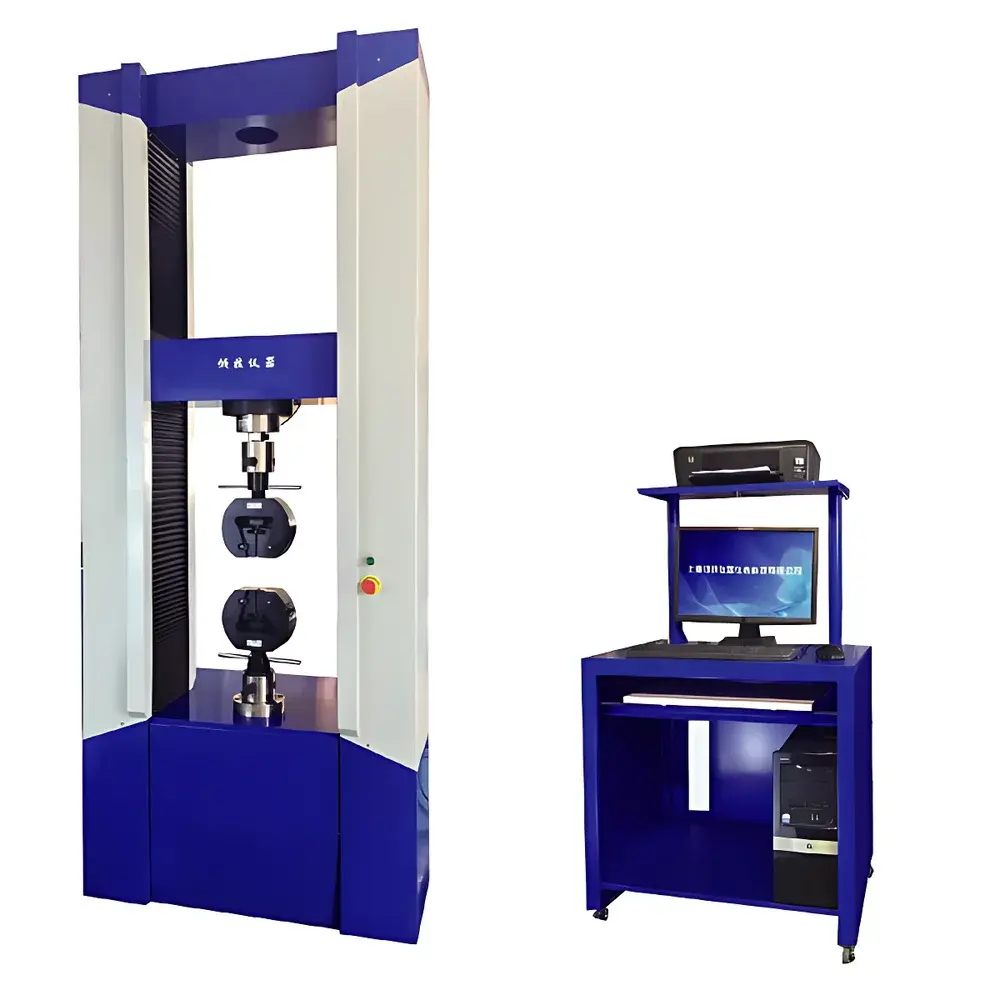
QJ212 Automotive Brake Pad Shear Testing Machine
| Origin | Shanghai, China |
|---|---|
| Manufacturer Type | Authorized Distributor |
| Origin Category | Domestic (PRC) |
| Model | QJ212 |
| Price | ¥68,000 |
| Instrument Type | Electromechanical Universal Testing Machine |
| Maximum Load Capacity | 500 kN (configurable) |
| Load Cell Accuracy | 0.01% FS |
| Test Accuracy | < ±0.5% |
| Control System | Full PC-based Windows OS Interface |
| Effective Test Width | ~420 mm |
| Effective Tensile Stroke | ~800 mm |
| Test Speed Range | 0.001–500 mm/min |
| Speed Accuracy | ±0.5% |
| Displacement Measurement Accuracy | ±0.5% |
| Strain Measurement Accuracy | ±0.5% |
| Safety Protection | Electronic stroke limit, emergency stop button, overload auto-shutdown |
| Machine Weight | ~140 kg |
Overview
The QJ212 Automotive Brake Pad Shear Testing Machine is a high-precision electromechanical universal testing system engineered specifically for the mechanical characterization of friction materials used in automotive braking systems. It operates on the principle of controlled axial force application to induce shear deformation across standardized brake pad specimens—typically mounted between rigid platens or custom-designed shear fixtures per SAE J661, ISO 6310, and GB/T 5763. Unlike general-purpose tensile testers, the QJ212 integrates calibrated shear-specific load train geometry, real-time displacement synchronization, and low-noise servo control to ensure reproducible interfacial shear stress measurement under both static and quasi-dynamic conditions. Its modular architecture supports not only shear mode but also complementary mechanical evaluations—including flexural strength (ASTM D790), compressive modulus (ISO 604), peel adhesion (ASTM D903), and cyclic fatigue (ISO 8564)—making it suitable for R&D validation, production QA/QC, and regulatory compliance testing in Tier-1 suppliers and OEM material labs.
Key Features
- Configurable load capacity up to 500 kN with dual-range high-stability load cells offering 0.01% full-scale accuracy, enabling precise resolution across low-force shear initiation and high-load failure thresholds.
- Full PC-based Windows control interface with real-time dynamic curve plotting—force vs. displacement, stress vs. strain, and time-synchronized load history—with adjustable sampling rates up to 1 kHz.
- Multi-mode test programming: user-defined control loops based on load, displacement, strain, or crosshead speed—critical for simulating real-world brake actuation profiles including ramp-hold-relax sequences.
- Automated sequence functions: auto-zero at start, automatic return-to-initial-position post-fracture, intelligent range switching, and programmable speed ramping without manual intervention.
- Comprehensive safety architecture: dual-redundant electronic stroke limits, hardware-triggered emergency stop, mechanical overload cutoff, and software-enforced parameter boundaries compliant with ISO 12100 risk assessment principles.
- Modular fixture compatibility: standardized M12/M16 mounting interfaces accommodate shear blocks, three-point bending jigs, compression platens, and peel fixtures—all traceably calibrated per ISO/IEC 17025 requirements.
Sample Compatibility & Compliance
The QJ212 accommodates brake pad specimens conforming to ASTM E2821 (shear testing of friction materials), ISO 6310 (brake lining shear strength), and GB/T 5763–2018 (Chinese national standard for automotive brake linings). Specimen dimensions range from 25 × 25 × 10 mm to 50 × 50 × 20 mm, with optional thermal conditioning stages (−40 °C to +250 °C) available via external environmental chambers. All test methods are fully traceable to NIST-traceable force and displacement standards. The system supports audit-ready documentation workflows aligned with GLP, GMP, and IATF 16949 quality management frameworks. Data integrity complies with FDA 21 CFR Part 11 requirements when configured with electronic signature modules and audit trail logging.
Software & Data Management
The embedded TestMaster Pro software (v5.2+) provides ISO 17025-compliant data handling: raw acquisition at ≥1 kHz, lossless binary storage (.tdm format), and export to CSV, Excel, or XML for LIMS integration. Curve analysis tools include tangent modulus calculation, yield point detection (0.2% offset method), fracture energy integration, and hysteresis loop quantification. All test files retain full metadata—operator ID, calibration certificate IDs, environmental conditions, and version-controlled test method parameters. Audit trails record every user action—including data deletion, curve modification, or report regeneration—with immutable timestamps and digital signatures.
Applications
- Shear strength evaluation of bonded ceramic, semi-metallic, and low-metallic brake pad formulations under dry and wet conditions.
- Interfacial adhesion testing between friction material and backing plate substrates (steel, aluminum, or composite).
- Compression set and recovery behavior during repeated loading cycles—simulating fade/recovery performance.
- Comparative benchmarking of friction material batches against OEM specification limits (e.g., Ford WSS-M14P2A, GM 6277M).
- Supporting root-cause analysis of delamination failures through synchronized load-displacement-strain correlation.
- Validation of new binder systems (phenolic resins, elastomers) under elevated temperature preconditioning protocols.
FAQ
What international standards does the QJ212 support for brake pad shear testing?
It natively implements test routines aligned with ISO 6310, SAE J661, GB/T 5763, and ASTM E2821—with customizable method templates for internal OEM specifications.
Can the system perform tests beyond shear mode?
Yes—it functions as a full-capability universal tester supporting tension, compression, flexure, peel, and fatigue modes using interchangeable fixtures and sensor configurations.
Is the software compliant with FDA 21 CFR Part 11 for regulated environments?
When deployed with optional 21 CFR Part 11 add-on module (including role-based access control, electronic signatures, and immutable audit logs), it meets ALCOA+ data integrity principles.
What calibration and traceability documentation is provided?
Each unit ships with NIST-traceable calibration certificates for load cell, displacement encoder, and speed controller—valid for 12 months and renewable through accredited third-party labs.
Does the machine support thermal preconditioning of specimens?
While the base system operates at ambient temperature, it is mechanically and electrically compatible with external environmental chambers (−40 °C to +250 °C) via analog/digital I/O interface for synchronized thermal-mechanical testing.



