
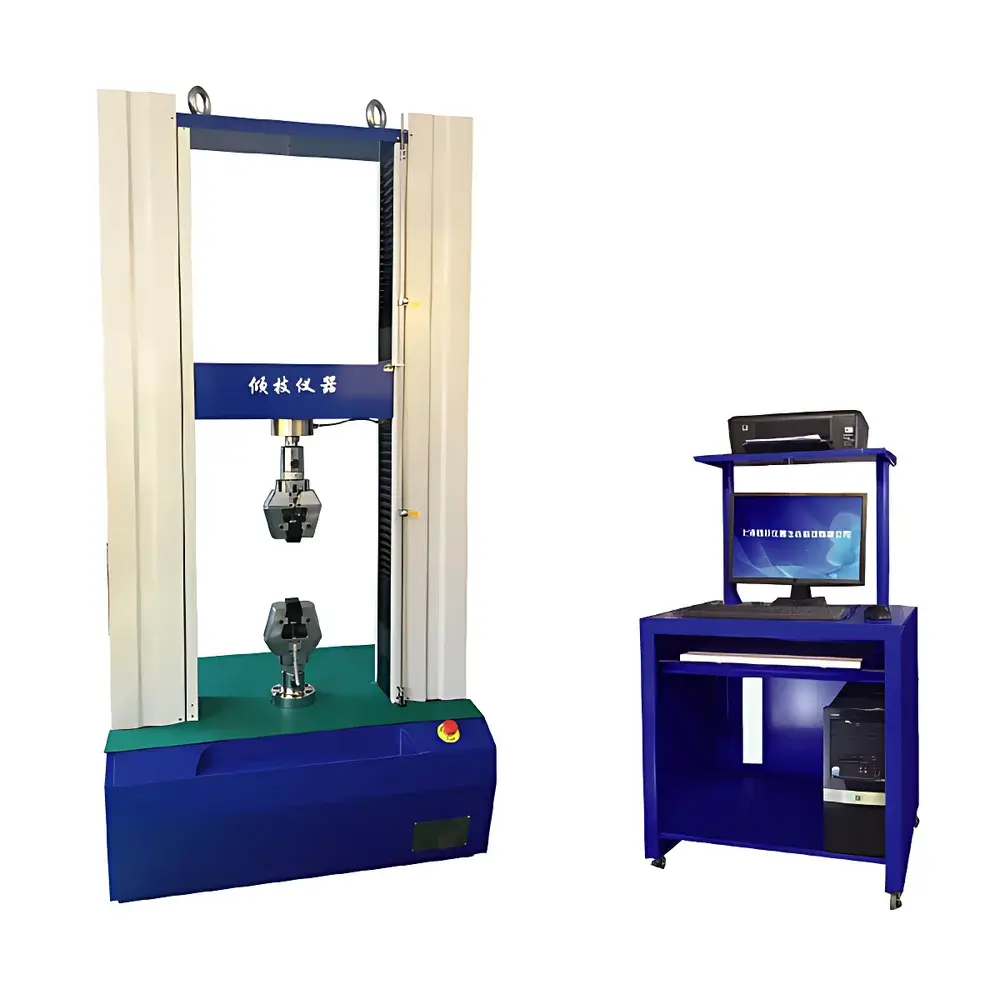
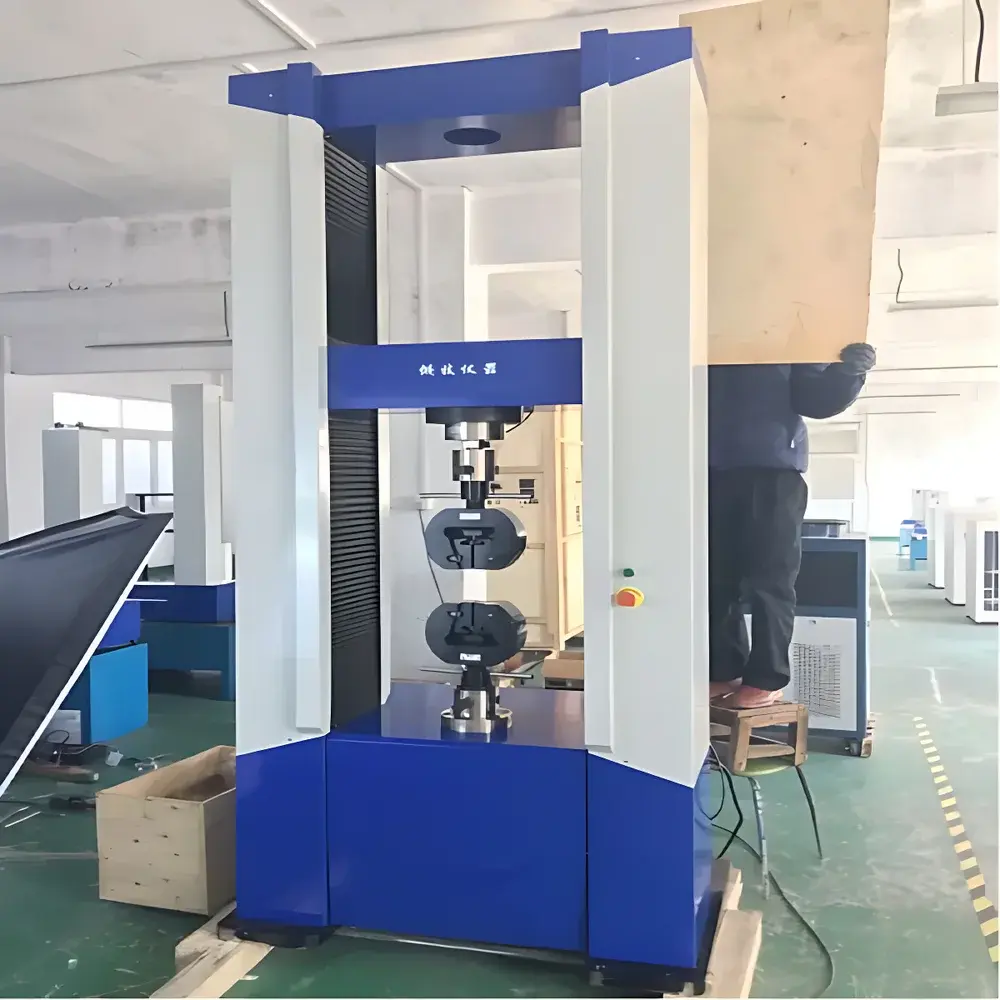
QJ212 Steel Mesh Bending Tester – Universal Electromechanical Testing Machine with Torsion Capability
| Origin | Shanghai, China |
|---|---|
| Manufacturer Type | Authorized Distributor |
| Origin Category | Domestic (China) |
| Model | QJ212 |
| Price | USD 12,300 (FOB Shanghai) |
| Max Torque | 3000 N·m |
| Torque Measurement Range | 0–3000 N·m |
| Torque Resolution | 2 N·m |
| Torsional Angle Range | 0–2000° |
| Motor Power | 500 W |
| Load Capacity Options | 10–500 kN |
| Force Resolution | ±1/250,000 full scale (no range switching) |
| Effective Test Width | 500 mm |
| Effective Tensile Stroke | 600 / 800 mm |
| Test Speed | 5–300 mm/min (adjustable) |
| Accuracy | ±1% of reading (force, displacement, strain) |
| Safety Protection | Electronic limit switches, overload cutoff (>110% capacity), emergency stop |
| Dimensions (W×D×H) | 960 × 650 × 2000 mm |
| Weight | ~85 kg |
Overview
The QJ212 Steel Mesh Bending Tester is a high-precision universal electromechanical testing system engineered for static mechanical characterization of metallic expanded meshes, perforated sheets, and wire-based structural materials. While optimized for bending deformation analysis per ASTM E292 and ISO 7438, the system integrates torsional actuation capability—enabling controlled angular displacement under defined torque to assess rotational stiffness, yield behavior, and post-yield ductility in mesh hinge zones. Its dual-mode architecture supports both axial (tension/compression/bending) and torsional loading paths within a single frame, eliminating cross-machine calibration drift. The machine operates under closed-loop servo control via a Windows-based real-time acquisition platform, delivering synchronized force-torque-displacement-angle data streams compliant with GLP documentation requirements.
Key Features
- Modular load frame with rigid cast-iron base and reinforced steel columns, designed to minimize deflection during high-moment bending tests on large-format steel mesh panels (up to 500 mm width)
- Dual-sensor architecture: high-stability S-type load cell (10–500 kN selectable ranges) + calibrated torque transducer (0–3000 N·m) with 2 N·m resolution and thermal drift compensation
- Precision ball-screw-driven crosshead with dual-speed motor (500 W DC servo) enabling smooth low-velocity bending (<10 mm/min) and rapid repositioning (up to 300 mm/min)
- Integrated angular encoder (0–2000° range, ±0.1° repeatability) co-located with torsion shaft for direct twist-angle feedback without gear backlash error
- Full electronic safety suite: programmable electronic limits, hardware-based overload cutoff (>110% setpoint), mechanical emergency stop, and automatic return-to-home upon test completion
- Real-time dynamic curve visualization with multi-parameter overlay (e.g., torque vs. angle, bending moment vs. deflection), zoom, trace separation, and export to CSV/PDF
Sample Compatibility & Compliance
The QJ212 accommodates standard and custom steel mesh specimens conforming to ASTM A974 (metallic expanded mesh), ISO 9001-certified production batches, and EN 10204 3.1 material certifications. Fixture adaptability includes three-point bending jigs (support span adjustable from 100–400 mm), torsional clamping chucks for edge-mounted mesh strips, and compression platens with anti-slip serration. All test protocols align with ISO 7438 (bending of metallic materials), ASTM E8/E8M (tension), ASTM E292 (bending strength), and ISO 527-4 (rigid plastics — adaptable methodology). Data audit trails meet FDA 21 CFR Part 11 requirements when configured with user-access logging and electronic signature modules.
Software & Data Management
The embedded Windows 10-based control software provides ISO/IEC 17025-aligned test method templates—including preloaded routines for mesh bend radius evaluation, springback measurement, and torsional fatigue cycling (low-cycle mode). Raw data files include metadata stamps (operator ID, environmental temp/humidity, calibration certificate ID, timestamped version history). Export formats support LIMS integration: XML (ASTM E1382-compliant), CSV (tab-delimited with SI units), and PDF reports with embedded digital signatures. Audit trail logs record all parameter modifications, curve edits, and data deletions—retained for ≥10 years per internal QA policy.
Applications
- Quantification of elastic-plastic transition in welded or cold-expanded steel mesh under transverse loading
- Evaluation of bending fatigue resistance in architectural façade mesh subjected to cyclic wind loads
- Torsional rigidity assessment of mesh-reinforced composite panels used in aerospace secondary structures
- Verification of ISO 9001 process consistency across coil-to-mesh conversion lines (batch-to-batch mechanical variance analysis)
- Supporting R&D for corrosion-resistant stainless steel mesh in marine environments—correlating salt-spray exposure duration with retained flexural modulus
- Calibration reference for field-deployable hand-held bend testers used in construction site QA/QC inspections
FAQ
Does the QJ212 comply with ISO/IEC 17025 accreditation requirements for accredited testing laboratories?
Yes—the system’s traceable calibration hierarchy, documented uncertainty budgets (force: ±0.8%, torque: ±0.9%, angle: ±0.15°), and full audit trail functionality satisfy Clause 6.4 and Annex A of ISO/IEC 17025:2017.
Can torsional and bending tests be executed simultaneously on the same specimen?
No—the QJ212 operates in sequential mode: users select either axial (bending/tension/compression) or torsional control prior to test initiation; simultaneous dual-axis loading is not supported.
What is the recommended recalibration interval for the torque transducer?
Annual recalibration is advised per ISO 9001 Clause 7.1.5.2; however, in high-use environments (>200 cycles/week), quarterly verification against NIST-traceable torque standards is recommended.
Is third-party validation support available for 21 CFR Part 11 compliance?
Yes—qualified validation packages (IQ/OQ/PQ protocols, risk assessments, and UAT scripts) are provided by our certified validation partners upon request.
Are custom fixtures for non-standard mesh geometries available?
Yes—fixture engineering services include CAD-based design, FEA stress validation, and machined prototype delivery within 12 business days.



