
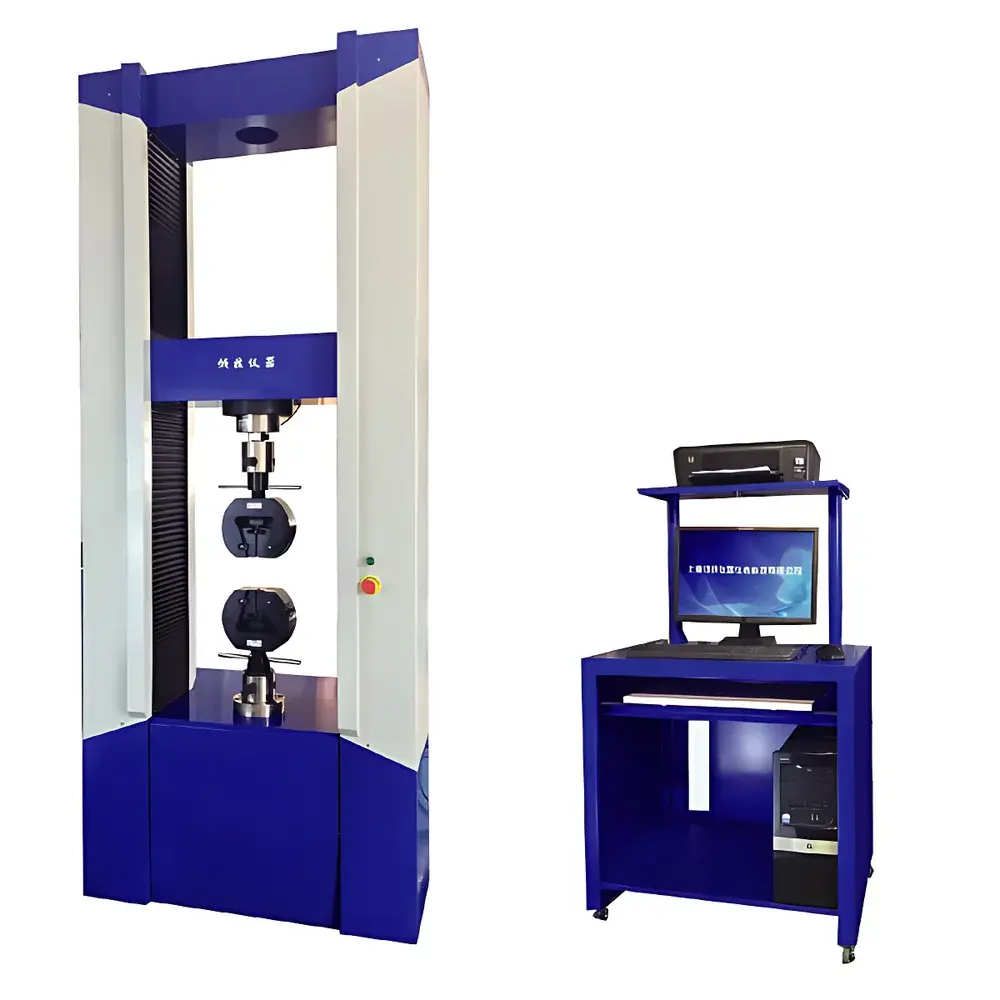
QJ212 Universal Testing Machine for Bending, Tensile, and Compression Tests
| Origin | Shanghai, China |
|---|---|
| Manufacturer Type | Authorized Distributor |
| Country of Origin | China |
| Model | QJ212 |
| Price | USD 8,400 (FOB) |
| Max Torque | 180 N·m |
| Torque Measurement Range | 0–800 N·m |
| Torque Resolution | 0.2 N·m |
| Torsion Angle Range | ±180° |
| Motor Power | 3.8 kW |
| Load Capacity | 50–500 kN (selectable) |
| Force Accuracy | ±0.5% of full scale |
| Force Resolution | 500,000 counts (no range switching) |
| Effective Test Width | 520 mm |
| Effective Stroke | 800 mm |
| Test Speed | 0.01–1000 mm/min (standard max: 300 mm/min) |
| Speed Accuracy | ±0.5% of set value |
| Displacement Accuracy | ±0.5% of reading |
| Strain Measurement Accuracy | ±0.5% of reading |
| Sensor | High-precision load cell (USA-made) |
| Controller | Panasonic全数字交流伺服系统 |
| Control Mode | Full-digital closed-loop control supporting constant load, constant strain, and constant displacement |
| Safety Protection | Software diagnostics, electronic travel limits, overload protection at 110% of rated capacity |
| Dimensions (W×D×H) | 1000 × 680 × 2450 mm |
| Weight | ~1450 kg |
Overview
The QJ212 Universal Testing Machine is an electromechanical static testing system engineered for high-reproducibility mechanical characterization of metallic, polymeric, composite, and ceramic materials under bending, tensile, compression, shear, peel, tear, puncture, and low-cycle fatigue loading conditions. It operates on the principle of controlled displacement or force application via a precision ball-screw-driven crosshead actuated by a high-torque AC servo motor and regulated through a closed-loop digital controller. The system complies with fundamental mechanics-of-materials test methodologies defined in ISO 6892-1 (tensile), ISO 7438 (bend), ASTM E8/E21 (metallic tensile), ASTM D790 (flexural properties of plastics), and ISO 178 (rigidity and flexural strength). Its modular frame architecture supports interchangeable fixtures and extensometers, enabling standardized test execution across R&D labs, QC departments, and third-party certification facilities.
Key Features
- Multi-function mechanical testing platform capable of bending, tensile, compression, shear, peel, tear, puncture, and low-cycle fatigue tests within a single system
- Load capacity selectable from 50 kN to 500 kN — all calibrated to ISO 7500-1 Class 0.5 accuracy
- Full-scale force resolution of 500,000 counts with no internal range switching — ensures consistent resolution across the entire measurement span
- Dual-speed crosshead actuation (fast positioning + fine testing speed) with programmable acceleration/deceleration profiles
- Integrated electronic limit switches and real-time software-based overload detection (triggers at 110% of nominal capacity)
- Panasonic digital AC servo drive system with 3.8 kW continuous output and dynamic response < 20 ms
- High-stiffness dual-column steel frame (1450 kg mass) minimizing deflection during high-load bending tests
- Windows-based proprietary software with real-time curve plotting, post-test data editing, multi-curve overlay, zoom, export (CSV, PDF, XML), and batch report generation
Sample Compatibility & Compliance
The QJ212 accommodates specimens up to 520 mm wide and 800 mm in effective travel length, supporting standard geometries per ASTM D790 (rectangular beams), ISO 178 (3-point/4-point bend), ISO 6892-1 (dog-bone tensile coupons), and ASTM C39 (concrete cylinders). Fixture adaptability includes custom-designed grips, bend jigs, compression platens, peel blocks, and impact anvils — all machined to ISO 2768-mK tolerances. The system meets structural and metrological requirements for GLP-compliant environments and supports audit-ready documentation per FDA 21 CFR Part 11 when paired with optional electronic signature modules and audit trail logging. Calibration certificates traceable to NIM (China) or NIST (USA) are provided with each delivery.
Software & Data Management
The embedded Windows OS interface delivers real-time synchronized acquisition of load, displacement, and strain (when equipped with extensometer input). All test parameters — including ramp rates, hold durations, break detection thresholds, and safety limits — are fully programmable via intuitive GUI. Data files include embedded metadata (operator ID, timestamp, environmental conditions, calibration IDs) and support automated compliance checks against pass/fail criteria per selected standard (e.g., yield strength ≥ X MPa, modulus deviation ≤ ±3%). Export formats include CSV (for statistical analysis in Minitab/JMP), PDF (certified reports with digital seal), and XML (LIMS integration). Optional database connectivity enables centralized test archive management across enterprise QA networks.
Applications
- Mechanical validation of structural composites in aerospace component qualification (e.g., wing spar flexural stiffness, interlaminar shear strength)
- Quality conformance testing of medical device polymers (ISO 10993-12 compliant flexural modulus assessment of catheter shafts)
- Automotive material certification per SAE J211 (crash energy absorption curves of bumper beams)
- Construction material verification including rebar yield strength (GB/T 1499.2), concrete flexural strength (GB/T 50081), and geosynthetic tensile performance (JTGE50)
- Electronics packaging reliability evaluation (PCB board flexural fatigue life, solder joint shear strength)
- Pharmaceutical tablet mechanical integrity testing (USP tablet hardness and breaking force)
FAQ
Does the QJ212 support both open-loop and closed-loop control modes?
Yes — it operates primarily in closed-loop force/displacement/strain control but allows open-loop speed-only mode for pre-test positioning.
Can the system be validated for ISO/IEC 17025 accredited laboratories?
Yes — with documented as-delivered calibration, uncertainty budgets, and traceable reference standards, it satisfies clause 6.4.10 of ISO/IEC 17025:2017 for mechanical testing equipment.
Is torsional testing capability native or requires add-on hardware?
Torsional functionality is enabled via optional torsion module (QJ-TM-180), which includes torque transducer, angular encoder, and dedicated torsion fixture set — not included in base configuration.
What is the maximum sampling rate for real-time data acquisition?
Up to 10 kHz for load and displacement channels; reduced to 1 kHz when strain channel is active.
Are firmware updates and software patches provided post-purchase?
Yes — registered users receive biannual maintenance releases including bug fixes, new standard templates (e.g., ASTM D638-22), and enhanced LIMS interoperability features.



