
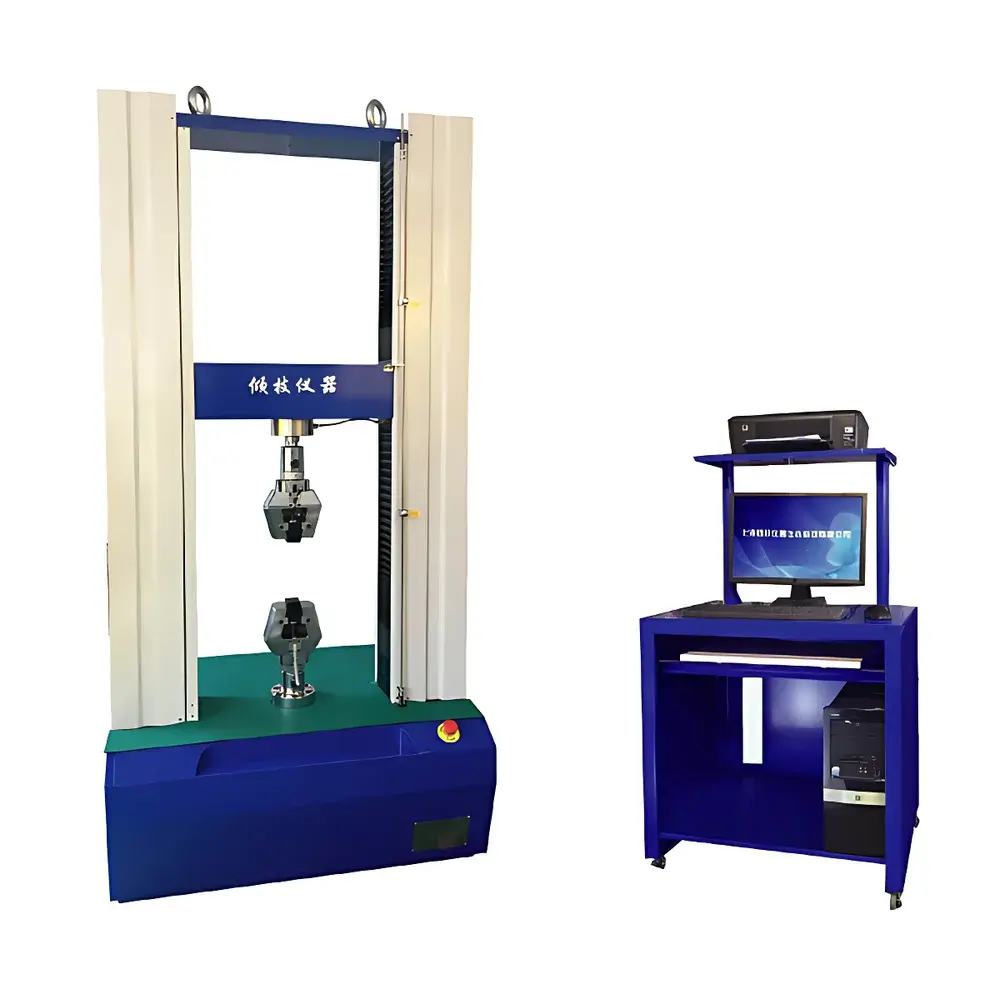
QJ212 Universal Testing Machine for SCR Catalyst Compression and Mechanical Characterization
| Origin | Shanghai, China |
|---|---|
| Manufacturer Type | Authorized Distributor |
| Origin Category | Domestic (China-made) |
| Model | QJ212 |
| Price | USD 7,700 (FOB Shanghai) |
| Load Capacity | 10–500 kN (selectable ranges) |
| Force Resolution | ±1/250,000 full scale, no range switching required |
| Effective Test Width | 500 mm |
| Maximum Tensile Travel | 600 mm or 800 mm (configurable) |
| Crosshead Speed | 5–300 mm/min (continuously adjustable) |
| Force Accuracy | ±1% of reading |
| Displacement Accuracy | ±1% of reading |
| Strain/Deformation Accuracy | ±1% of reading |
| Motor Power | 4 kW |
| Dimensions (W×D×H) | 960 × 650 × 2000 mm |
| Net Weight | ~850 kg |
Overview
The QJ212 Universal Testing Machine is an electromechanical static load frame engineered for high-precision mechanical characterization of selective catalytic reduction (SCR) catalyst monoliths and honeycomb ceramic substrates. Designed to comply with ISO 6892-1 (tensile testing of metallic materials), ASTM C773 (compressive strength of ceramic catalysts), and ISO 10398 (mechanical testing of monolithic catalysts), the system delivers controlled uniaxial compression, flexural bending, and axial fatigue loading up to 500 kN. Its closed-loop servo-hydraulic or electromechanical actuation architecture ensures stable force ramping, dwell control, and load-hold capability—critical for evaluating catalyst crush strength, fracture onset, and structural integrity under simulated reactor thermal cycling and pressure gradients. The machine integrates seamlessly into quality control workflows for catalyst manufacturers, EPC contractors, and emission compliance laboratories requiring traceable, auditable mechanical test data per GLP and ISO/IEC 17025 requirements.
Key Features
- Full-range force transducer with ±1/250,000 resolution—no manual range switching, maintaining consistent accuracy from 0.004% to 100% of full scale (e.g., 20 N to 500 kN)
- Dual-speed crosshead actuation: rapid positioning (up to 300 mm/min) and precision testing speed (5–50 mm/min) with programmable ramp-hold-relax profiles
- Electronic limit switches and overload protection (110% FS cut-off) prevent damage during brittle fracture events typical of cordierite or titania-based monoliths
- Motorized crosshead return with position memory enables repeatable sample alignment across multi-batch validation studies
- Windows-based control software supporting real-time stress–strain curve overlay, hysteresis loop analysis, and modulus calculation per ASTM D695 and ISO 14126
- Rigid C-frame construction (960 × 650 × 2000 mm) with reinforced load train minimizes deflection under peak load, ensuring <0.02% frame compliance error at 500 kN
Sample Compatibility & Compliance
The QJ212 accommodates standard SCR catalyst geometries—including 100 × 100 × 50 mm, 150 × 150 × 100 mm, and 200 × 200 × 150 mm monolith blocks—as well as cylindrical extrudates (Ø2–5 mm, L/D ≥ 3). Custom platens with V-grooved, serrated, or pneumatic-clamping interfaces ensure uniform load distribution without edge chipping. All test protocols adhere to regulatory frameworks governing emissions control hardware: EPA 40 CFR Part 60 Appendix A–2 (performance testing of NOx control systems), ISO 21087 (automotive SCR durability), and IEC 62271-1 (high-voltage switchgear insulation support testing, where applicable). Data audit trails meet FDA 21 CFR Part 11 requirements when paired with optional electronic signature modules.
Software & Data Management
The embedded Windows 10–based control interface provides synchronized acquisition of force, displacement, and optional extensometer or strain gauge signals at 1 kHz sampling rate. Test methods are pre-configured per ISO 10398 Annex B (catalyst crush strength), ASTM D695 (compressive properties), and EN 15306 (ceramic filter mechanical testing). Raw data exports in CSV, XML, and universal .UDF formats enable integration with LIMS platforms (e.g., LabWare, Thermo Fisher SampleManager). Curve manipulation tools include tangent modulus derivation, yield point detection via 0.2% offset method, and automatic fracture energy integration (area under stress–strain curve). All user actions—including method edits, data deletions, and calibration adjustments—are logged with timestamp, operator ID, and IP address for full 21 CFR Part 11 compliance.
Applications
- Quantification of axial crush strength for vanadium–tungsten–titania (V2O5/WO3/TiO2) and zeolite-based SCR monoliths
- Compression-to-failure analysis of cordierite and silicon carbide (SiC) substrates under ambient and elevated temperature conditions (when coupled with environmental chamber)
- Interlaminar shear strength evaluation of coated versus uncoated catalyst layers using ASTM D4897
- Low-cycle fatigue testing (1–100 cycles) simulating thermal expansion mismatch stresses in diesel aftertreatment systems
- Validation of catalyst mechanical robustness per OEM specifications (e.g., Cummins QSK95, MAN D2676, Volvo D13)
FAQ
Does the QJ212 support high-temperature compression testing?
Yes—when integrated with a certified furnace chamber (−70 °C to +1200 °C), the system maintains force accuracy within ±1.5% up to 1000 °C per ISO 204.
Can test data be exported directly to ERP or SAP systems?
Yes—the software supports ODBC connectivity and configurable REST API endpoints for automated data ingestion into enterprise resource planning environments.
Is third-party calibration certification included?
Each unit ships with a NIST-traceable calibration certificate (force, displacement, and speed), valid for 12 months; on-site recalibration services are available globally.
What safety standards does the machine conform to?
Complies with CE Machinery Directive 2006/42/EC, ISO 13857 (safety distances), and EN 61000-6-2/6-4 (EMC immunity and emissions).



