
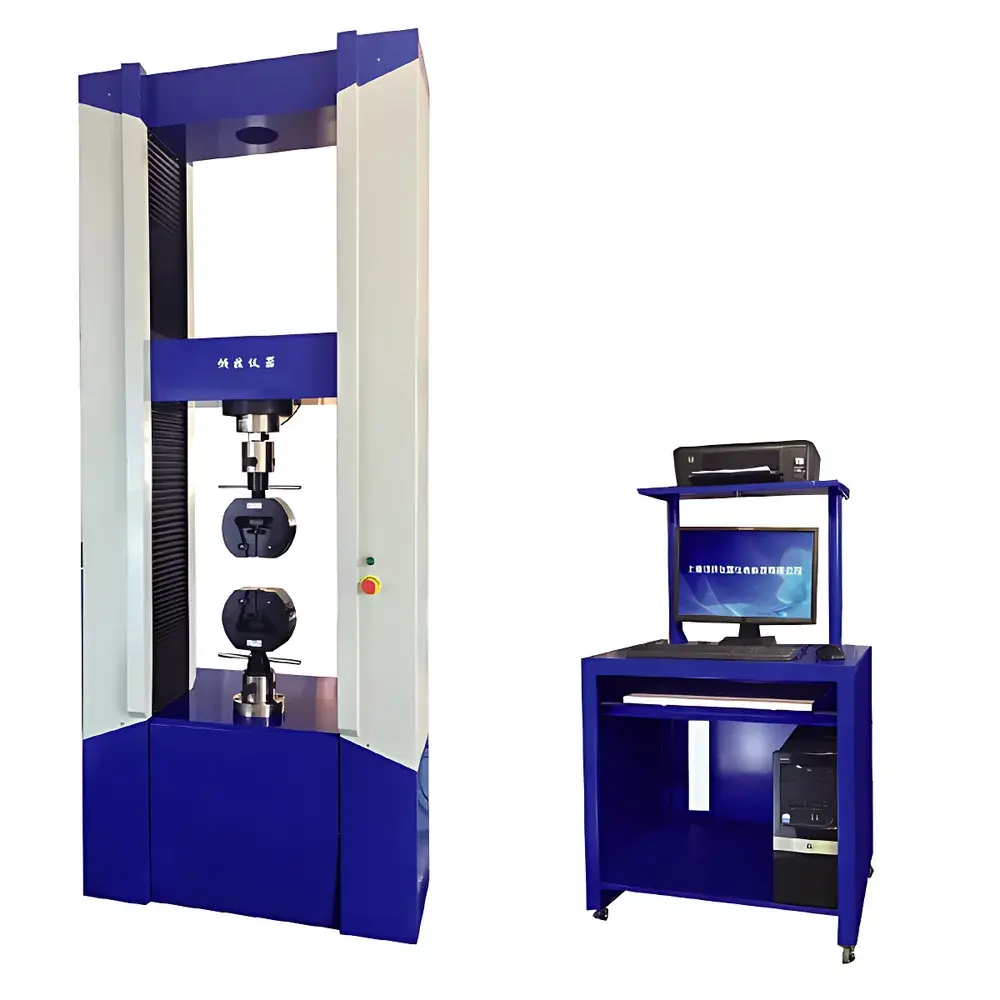
QJ212C Dual-Column Universal Testing Machine
| Origin | Shanghai, China |
|---|---|
| Manufacturer Type | Authorized Distributor |
| Origin Category | Domestic (PRC) |
| Model | QJ212C |
| Price | USD 9,400 (FOB Shanghai) |
| Instrument Type | Electromechanical Universal Testing Machine |
| Load Capacity | 10–500 kN (selectable ranges) |
| Force Resolution | ±1/250,000 full scale, no range switching required |
| Effective Test Width | 500 mm |
| Max. Tensile Travel | 600 mm / 800 mm (configurable) |
| Test Speed | 5–300 mm/min (continuous, closed-loop controlled) |
| Force Accuracy | ±1% of reading |
| Displacement Accuracy | ±1% of reading |
| Strain Measurement Accuracy | ±1% of reading |
| Crosshead Movement | Dual-speed motorized lift (fast/slow + jog control) |
| Safety Protection | Electronic travel limit switches, overload protection at 110% capacity |
| Power Supply | 3-phase 380 VAC, 4 kW |
| Dimensions (W×D×H) | 960 × 650 × 2000 mm |
| Weight | ~1450 kg |
Overview
The QJ212C Dual-Column Universal Testing Machine is an electromechanical static materials tester engineered for high-reproducibility mechanical characterization across tensile, compressive, flexural, peel, tear, shear, puncture, and low-cycle fatigue regimes. Designed in accordance with the fundamental principles of servo-controlled load frame mechanics—featuring a rigid dual-column steel frame, precision-ground ball screws, and closed-loop digital PID control—the system delivers stable force application and displacement tracking under ISO 7500-1 Class 1 calibration compliance. Its architecture supports standardized test execution per ASTM E4, ASTM E8/E8M, ISO 6892-1, ISO 178, ISO 1133, JIS Z2241, DIN 53455, and other internationally recognized physical property testing protocols. The machine operates natively under Windows-based control software, enabling real-time acquisition, visualization, and post-processing of load–displacement, stress–strain, and time-dependent curves without external hardware dependencies.
Key Features
- Rigid dual-column structural frame with high axial stiffness (>2.5 × 10⁶ N/mm), minimizing deflection during high-load testing up to 500 kN
- Force transducer system with ±1/250,000 internal resolution, maintaining consistent accuracy across the entire 10–500 kN range without manual range switching
- Electromechanical crosshead drive with brushless AC servo motor, offering precise speed control from 5 to 300 mm/min (±0.2% setpoint accuracy)
- Integrated electronic travel limit protection and programmable over-travel cutoff, compliant with ISO 12100 mechanical safety requirements
- Dual-mode crosshead positioning: fast jog for rapid sample setup and fine-tune slow mode for alignment-sensitive clamping
- Auto-return function post-test; configurable return speed and position reset logic via software interface
- Overload protection activated at 110% of selected load range, halting motion and preserving transducer integrity
- Thermally stabilized 4 kW drive system with industrial-grade cooling and electromagnetic interference (EMI) shielding
Sample Compatibility & Compliance
The QJ212C accommodates a broad spectrum of specimen geometries—including metallic rods, polymer sheets, composite laminates, elastomeric strips, textile fabrics, adhesively bonded joints, and biomedical sutures—within its 500 mm effective test width and 600/800 mm vertical stroke envelope. Gripping solutions include wedge-action pneumatic, hydraulic, and mechanical jaw systems (optional), as well as custom fixtures for ASTM D638, ISO 527, ISO 37, and EN 14354-compliant configurations. All hardware and firmware comply with CE Machinery Directive 2006/42/EC, RoHS 2011/65/EU, and IEC 61000-6-2/6-4 EMC standards. Calibration traceability follows ISO/IEC 17025-accredited procedures, with optional factory certification to ISO 7500-1 Class 1.
Software & Data Management
Control and analysis are executed through a native Windows 10–compatible application supporting multilingual UI (English, German, French, Japanese). The software provides real-time dynamic curve rendering (load vs. displacement, stress vs. strain, force vs. time), with unlimited data channel logging (up to 10 kHz sampling rate). Users may perform post-test operations including curve overlay, region-of-interest zoom, derivative calculation (modulus, yield point, elongation at break), statistical batch reporting, and export to CSV, Excel, or PDF. Audit trail functionality logs all user actions, parameter changes, and calibration events—supporting GLP/GMP environments requiring 21 CFR Part 11–compliant electronic records when paired with optional digital signature modules.
Applications
- Mechanical validation of structural alloys (e.g., aluminum 6061-T6, stainless steels) per ASTM E8
- Tensile property mapping of thermoplastics (PP, PE, PC) and engineering resins (PA6, PEEK) per ISO 527
- Adhesion strength assessment of pressure-sensitive tapes and laminated packaging per ASTM D3330
- Fatigue life evaluation of rubber compounds under cyclic loading (5–50 Hz equivalent waveform simulation)
- Compression testing of foams, elastomers, and biomedical hydrogels per ISO 3386
- Quality control of welded joints, riveted assemblies, and composite layups in aerospace and automotive supply chains
FAQ
What international standards does the QJ212C support out of the box?
The system includes preconfigured test methods for ASTM E4, E8/E8M, D638, D3330; ISO 6892-1, 178, 527, 37; JIS Z2241; and DIN 53455. Custom method development is supported via scriptable test sequence editor.
Is third-party calibration certification available?
Yes—factory calibration reports traceable to NIM (China National Institute of Metrology) are included. Optional UKAS or DAkkS-accredited calibration certificates can be arranged prior to shipment.
Can the system integrate with LIMS or MES platforms?
Via OPC UA and TCP/IP API, the controller supports bidirectional data exchange with laboratory information management systems and manufacturing execution systems using standard JSON/XML payloads.
What maintenance intervals are recommended for long-term reliability?
Lubrication of ball screws and guideways every 500 operational hours; annual verification of force transducer linearity and displacement encoder performance; biannual inspection of safety interlock circuits per ISO 13857.



