
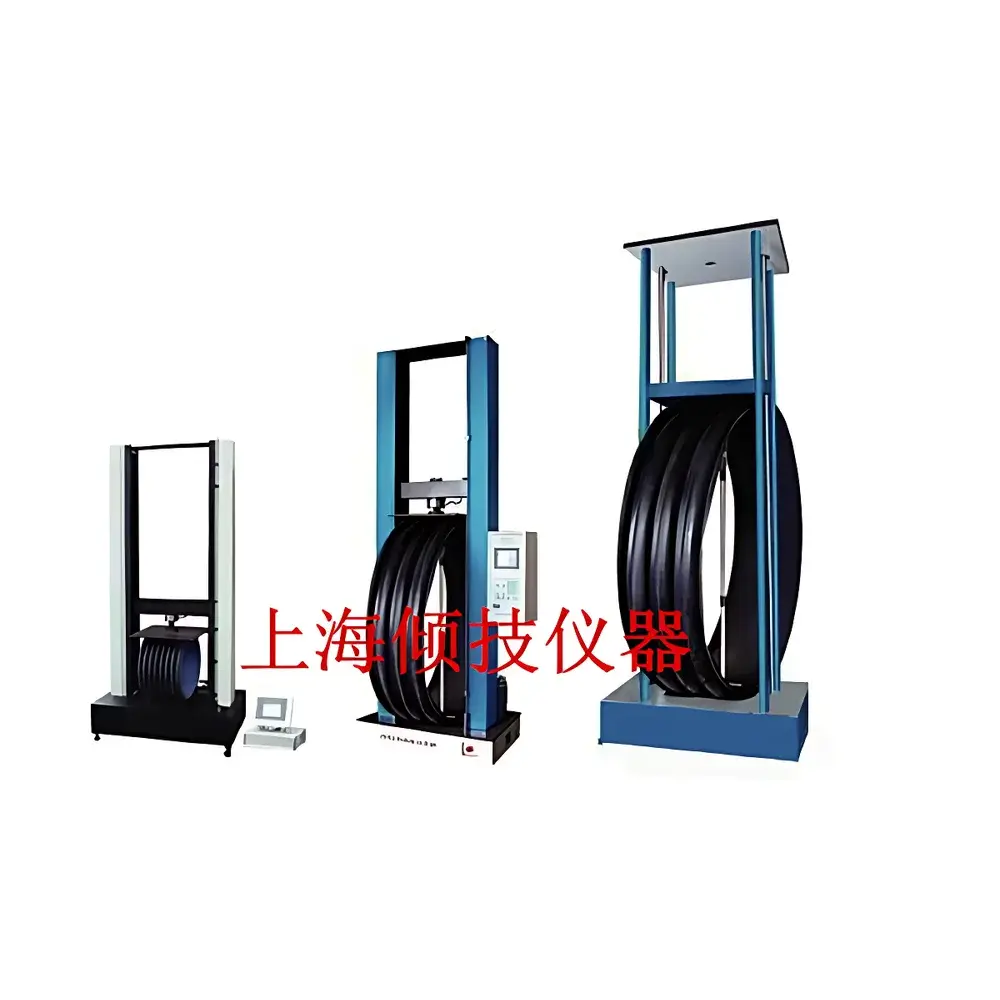
QJ215 Glass Fiber Reinforced Plastic (GRP) Pipe Bending & Ring Stiffness Testing Machine
| Origin | Shanghai, China |
|---|---|
| Manufacturer Type | Authorized Distributor |
| Origin Category | Domestic (China-made) |
| Model | QJ215 |
| Price | USD 11,200 (FOB Shanghai) |
| Load Capacity | 50–500 kN |
| Max. Test Diameter | Φ5000 mm |
| Force Accuracy | ±1.0% (±0.5% optional) |
| Speed Range | 0.01–1000 mm/min |
| Displacement Resolution | 0.01 mm |
| Accuracy Class | Class 1 / Class 0.5 (per GB/T 16491 & ISO 7500-1) |
Overview
The QJ215 Glass Fiber Reinforced Plastic (GRP) Pipe Bending & Ring Stiffness Testing Machine is a dual-mode universal testing system engineered for structural mechanical characterization of rigid and semi-rigid tubular specimens under standardized ring compression (ASTM D2412, ISO 9969, EN 13476-2) and three-point bending configurations (ASTM D1781, ISO 11339). It operates on the principle of controlled displacement-driven loading using a high-rigidity four- or six-column load frame, servo-controlled electromechanical actuation, and closed-loop digital force/displacement feedback. The system complies with national and international metrological standards including GB/T 16491 (China), ISO 7500-1 (Class 1 or Class 0.5 verification), and JJG 139 (verification regulation for material testing machines). Designed specifically for infrastructure-grade GRP, HDPE, PVC-O, and composite pressure pipes, it delivers reproducible measurement of ring stiffness (kN/m²), bending modulus (MPa), yield deflection, and failure mode classification—critical parameters for pipeline design validation, quality assurance in manufacturing, and regulatory compliance documentation.
Key Features
- Modular load frame architecture supporting both ring stiffness (parallel plate compression) and transverse bending (three-point support) test modes without hardware reconfiguration
- High-precision load cell options: 50 kN, 100 kN, 200 kN, 300 kN, or 500 kN full-scale, traceable to NIM (National Institute of Metrology, China) with optional Class 0.5 calibration certificate
- Integrated internal diameter deformation measurement system with linear variable differential transformer (LVDT) sensors for direct radial strain capture during ring compression—enabling accurate calculation per ISO 9969 Annex A
- Wide-speed electromechanical drive (0.01–1000 mm/min), programmable in 0.01 mm/min increments; standard test speed preset at 300 mm/min per ASTM D2412
- Full-travel adaptability: accommodates pipe diameters up to Φ5000 mm via adjustable support cradles and height-variable platens
- Dual-control interface: local 7-inch TFT touchscreen with intuitive Chinese/English toggle + PC-based software with real-time curve plotting, multi-channel data logging, and customizable report templates
Sample Compatibility & Compliance
The QJ215 is validated for testing thermoset and thermoplastic tubular materials including filament-wound GRP, centrifugally cast FRP, HDPE corrugated conduits, PVC-U drainage pipes, and steel-reinforced composite structures. Specimen wall thickness ranges from 3 mm to 120 mm; minimum effective length ≥ 300 mm for ring tests and ≥ 10× outer diameter for bending tests. All test protocols align with mandatory requirements of GB/T 14452 (mechanical testing of plastics), ASTM D2412 (ring stiffness), ASTM D1781 (bending), ISO 9969 (thermoplastic pipes), and EN 13476-2 (structured-wall plastic pipes). The system supports audit-ready documentation compliant with GLP and GMP environments when paired with optional 21 CFR Part 11–enabled software modules.
Software & Data Management
The embedded control software provides synchronized acquisition of force, crosshead displacement, LVDT-derived radial deformation, and time-stamped event markers. Data are stored in IEEE-compliant .csv and proprietary .qdt binary formats with metadata embedding (operator ID, sample ID, test standard, environmental conditions). Reporting templates conform to ISO/IEC 17025 documentation requirements and include automatic calculation of ring stiffness S (kN/m²), bending stress σb, flexural modulus Ef, and deflection ratios. Export options include PDF (with digital signature), Excel, and XML for LIMS integration. Optional audit trail module logs all user actions—including parameter edits, calibration events, and report generation—with immutable timestamps and operator authentication.
Applications
- Validation of GRP pipe ring stiffness for municipal water transmission projects per ISO 10467 and AWWA C950 specifications
- Quality control of factory-produced composite sewer pipes subjected to earth-load simulation
- Comparative mechanical assessment of resin matrix formulations (e.g., vinyl ester vs. polyester) under sustained compressive loading
- Bending fatigue pre-screening of large-diameter conduit sections prior to field installation
- Third-party certification testing for CE marking (EN 13476 series) and CCC certification (GB/T 19472)
- Research-grade evaluation of creep behavior in thermoset composites using step-load protocols
FAQ
What standards does the QJ215 support for ring stiffness testing?
ASTM D2412, ISO 9969, EN 13476-2, GB/T 14452, and GB/T 9647.
Can the system perform both ring compression and bending tests on the same specimen?
No—ring stiffness requires diametral compression between parallel plates; bending uses three-point loading. However, the same machine platform executes both test types via fixture exchange and software mode selection.
Is calibration traceability provided with delivery?
Yes—each unit ships with a factory calibration certificate traceable to NIM, covering force, displacement, and speed channels.
What is the warranty coverage and service response time?
Standard 12-month parts-and-labor warranty; extended service contracts available. On-site technical support within 72 hours in Tier-1 Chinese cities; remote diagnostics supported globally.
Does the software meet FDA 21 CFR Part 11 requirements?
Base software does not include electronic signatures or audit trail; these functions are available as an optional validated add-on module with IQ/OQ documentation.



