
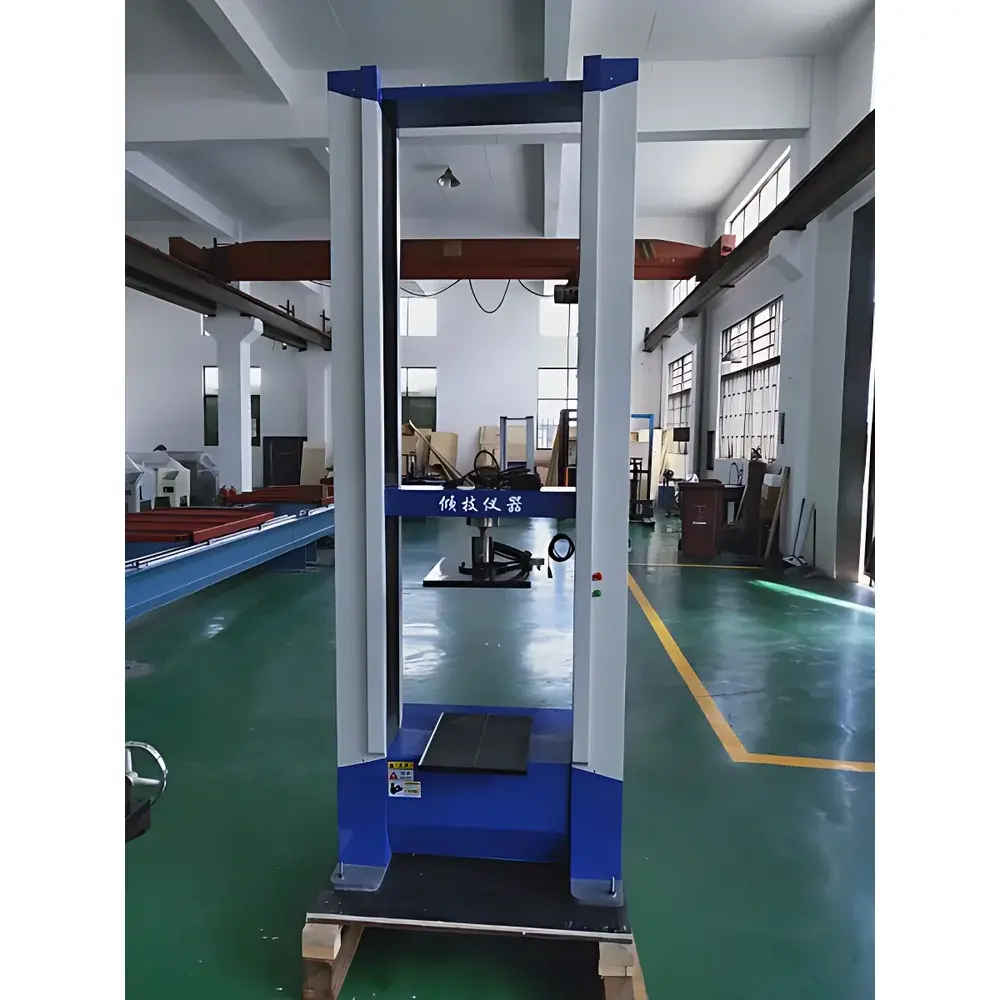
QJ215 Glass-Fiber-Reinforced Plastic (GRP) Sand-Embedded Pipe Ring Stiffness Testing Machine
| Origin | Shanghai, China |
|---|---|
| Manufacturer Type | Authorized Distributor |
| Origin Category | Domestic (China-Made) |
| Model | QJ215 |
| Price | USD 9,400 (FOB Shanghai) |
| Load Capacity | 50 / 100 / 200 / 300 / 500 kN |
| Maximum Test Diameter | ≤ Φ5000 mm |
| Accuracy Class | Class 1 / Class 0.5 (per ISO 7500-1) |
| Test Speed Range | 0.01–1000 mm/min (standard default: 300 mm/min) |
| Load Measurement Accuracy | ±1% (±0.5% optional) of reading |
| Speed Accuracy | ±0.5% (±0.15% optional) of set value |
| Displacement Resolution | 0.01 mm |
Overview
The QJ215 Glass-Fiber-Reinforced Plastic (GRP) Sand-Embedded Pipe Ring Stiffness Testing Machine is a dual-mode universal mechanical testing system engineered for structural integrity assessment of large-diameter thermoset composite pipes—specifically GRP sand-embedded pipes used in municipal drainage, water supply, and industrial conduit applications. It operates on the principle of controlled diametral compression per ASTM D2412 and ISO 9969, applying axial force to a pipe segment supported on two parallel knife-edge supports while measuring load-deflection response to determine ring stiffness (kN/m²). The system integrates high-rigidity frame architecture with precision servo-hydraulic or electromechanical actuation (configurable), enabling compliant evaluation of both short-term elastic deformation and progressive structural yielding under sustained loading. Its design adheres to core metrological standards including ISO 7500-1 (static calibration), ISO 5893 (tensile/compression testing), and EN 1446 (plastic piping systems), ensuring traceable measurement integrity across global infrastructure QA/QC workflows.
Key Features
- Modular dual-function architecture supporting both ring stiffness testing (per ASTM D2412, ISO 9969, GB/T 9647) and conventional uniaxial mechanical tests (tensile, compressive, flexural) on metals, polymers, composites, and geosynthetic-reinforced materials.
- Adjustable three-point support cradle with interchangeable knife-edge rollers accommodating pipe diameters from Φ110 mm up to Φ5000 mm—enabling full-range evaluation without reconfiguration.
- Dual-sensor displacement measurement: integrated linear variable differential transformer (LVDT) for outer surface deflection + optional internal diameter deformation gauge for wall-thickness-corrected ring stiffness calculation on smooth-wall and corrugated GRP pipes.
- Real-time closed-loop control via embedded microprocessor and PC-based software interface, delivering synchronized acquisition of load, displacement, time, and calculated parameters (e.g., ring stiffness S = (0.0186 × F × L) / (Δy × D³), where F = applied load, L = support span, Δy = deflection, D = mean pipe diameter).
- Class 1 or optional Class 0.5 load cell calibration certified per ISO 7500-1; displacement resolution of 0.01 mm ensures compliance with minimum reporting granularity requirements in ISO 9969 Annex B.
Sample Compatibility & Compliance
The QJ215 accommodates rigid and semi-rigid thermoset composite pipes—including filament-wound GRP, centrifugally cast GRP-sand, and resin-rich laminated structures—with wall thicknesses ranging from 6 mm to 120 mm. It accepts standard test specimens per ISO 9969 (minimum length = 300 mm or 3×D, whichever is greater) and supports non-standard lengths via adjustable support spacing. All mechanical measurements comply with ISO/IEC 17025:2017 general requirements for testing laboratories. Data acquisition protocols satisfy audit requirements for GLP and GMP environments, with optional 21 CFR Part 11-compliant electronic signatures, user access controls, and immutable audit trails for raw data files.
Software & Data Management
The system ships with Windows-based test control and analysis software featuring bilingual UI (English/Chinese), configurable test templates, real-time curve overlay (load vs. displacement, stress vs. strain), and automated parameter extraction—including peak load, yield point (upper/lower), modulus of elasticity, and ring stiffness coefficient. Export formats include CSV, PDF, and XML for integration into LIMS or enterprise QA databases. Raw data files are timestamped, digitally signed, and stored with metadata (operator ID, calibration certificate ID, environmental conditions), fulfilling documentation traceability mandates under ISO 17025 Clause 7.7 and ASTM E2917.
Applications
- Verification of ring stiffness compliance for GRP sand-embedded pipes supplied to municipal water authorities (e.g., China’s CJJ 101–2019, UK’s WRc Specification 4202).
- Comparative evaluation of resin matrix formulations (e.g., vinyl ester vs. polyester) and filler distribution effects on structural rigidity.
- Accelerated aging studies correlating hydrolytic degradation with loss of ring stiffness over service life.
- Third-party certification testing for CE marking (EN 1446), AS/NZS 4020 potable water approval, and NSF/ANSI 61 compliance.
- Material qualification per API RP 15S for subsea composite pipelines.
FAQ
Does the QJ215 meet international ring stiffness testing standards such as ISO 9969 and ASTM D2412?
Yes—the machine’s mechanical configuration, sensor accuracy, and software algorithms are validated against ISO 9969:2018 Annex B and ASTM D2412–22 procedures, including support span ratio (L/D = 0.08–0.12), loading rate control, and deflection measurement methodology.
Can it test corrugated GRP pipes with non-circular cross-sections?
Yes—using the optional internal deformation gauge and custom support fixtures, the system measures true radial displacement at multiple angular positions, enabling stiffness calculation per ISO 9969 Section 6.3 for structured-wall pipes.
Is calibration traceability provided with the system?
All load cells and displacement transducers are supplied with NIST-traceable calibration certificates (ISO/IEC 17025 accredited), valid for 12 months; recalibration services are available globally through authorized service partners.
What maintenance intervals are recommended for long-term reliability?
Preventive maintenance is advised every 6 months or after 500 test cycles—covering hydraulic oil filtration (if applicable), roller alignment verification, LVDT zero-drift check, and firmware updates aligned with ISO/IEC 17025 revision cycles.



