
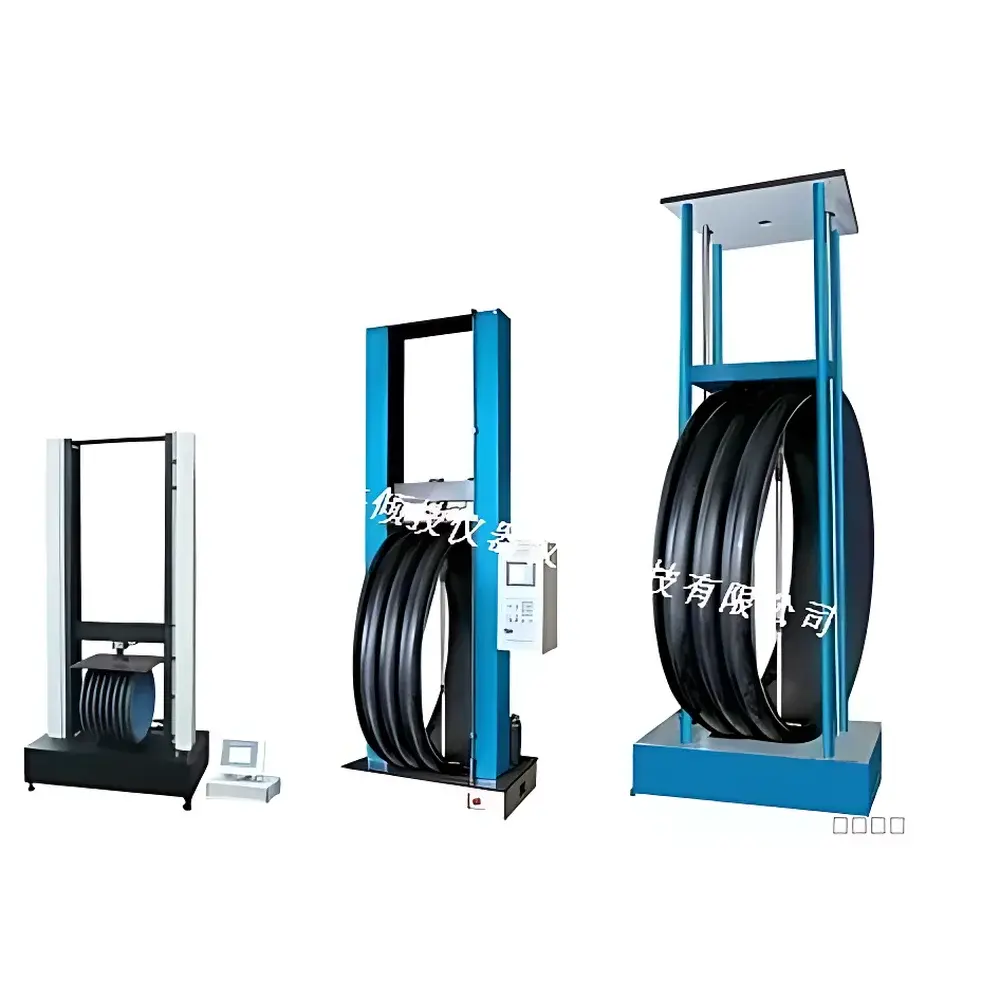
QJ215 Pipe Ring Stiffness Tester by Qingji
| Brand | Qingji |
|---|---|
| Origin | Shanghai, China |
| Model | QJ215 |
| Max Load Capacity | 50–500 kN (configurable) |
| Maximum Test Pipe Diameter | ≤ Φ5000 mm |
| Accuracy Class | Class 1 / Class 0.5 |
| Test Speed Range | 0.01–1000 mm/min (standard speed: 300 mm/min) |
| Load Accuracy | ±1% (±0.5%) of reading |
| Speed Accuracy | ±0.5% (±0.15%) of reading |
| Displacement Resolution | 0.01 mm |
| Control Interface | Full Chinese GUI with PC-integrated real-time curve display, data auto-storage, and report printing capability |
| Structural Configuration | Four-column or six-column universal testing frame |
| Compliance | Designed to meet ISO 9969, ASTM D2412, EN 1446, GB/T 9647, and GB/T 18477 test standards for ring stiffness evaluation |
Overview
The QJ215 Pipe Ring Stiffness Tester is a high-precision universal mechanical testing system engineered specifically for the quantitative assessment of ring stiffness in thermoplastic, thermoset, fiber-reinforced polymer (FRP), glass-fiber reinforced plastic (GRP), and composite pipes—per ISO 9969, ASTM D2412, EN 1446, and national standard GB/T 9647. Ring stiffness (SN, expressed in kN/m²) is a critical structural parameter reflecting a pipe’s resistance to diametral deformation under external compressive loading—directly influencing long-term performance in buried infrastructure applications such as stormwater drainage, sewage conveyance, and utility conduit systems. Unlike generic compression testers, the QJ215 integrates a dedicated radial deformation measurement subsystem—including internal diameter displacement transducers compatible with both smooth-wall and corrugated profiles—to ensure traceable, geometry-aware compliance with standardized three-point saddle loading configurations. Its modular four- or six-column frame architecture supports scalable load capacities (50 kN to 500 kN), enabling validation across small-diameter service lines and large-diameter trunk mains up to Φ5000 mm.
Key Features
- Configurable load capacity options (50, 100, 200, 300, or 500 kN) accommodate diverse pipe geometries and material classes—from HDPE pressure pipes to reinforced concrete composite conduits.
- Dual-accuracy calibration modes: Class 1 (±1% load accuracy) for routine QC testing; Class 0.5 (±0.5% load accuracy) for R&D-grade validation and certification labs requiring higher metrological rigor.
- Wide-speed actuation range (0.01–1000 mm/min) enables precise control over deformation rate—critical for observing time-dependent viscoelastic behavior in polymeric pipes per ISO 11472 Annex A.
- Integrated internal deformation measurement module with 0.01 mm displacement resolution provides direct, non-contact (or contact-based, depending on sensor configuration) monitoring of inner diameter contraction during loading—essential for accurate SN calculation per ASTM D2412 Section 7.3.
- Full Chinese graphical user interface (GUI) with real-time force–displacement curve plotting, automated peak detection (e.g., maximum load, yield point, inflection points), and programmable test sequences—including multi-step ramp-hold cycles for creep compliance analysis.
- Universal frame design allows seamless reconfiguration with optional accessories (e.g., tensile grips, bending fixtures, compression platens) to perform full-spectrum mechanical tests: tensile strength (ISO 527), flexural modulus (ISO 178), compressive yield (ISO 604), and ring deflection ratio (RDR) determination.
Sample Compatibility & Compliance
The QJ215 accommodates pipe specimens with outer diameters up to 5000 mm and wall thicknesses ranging from 2 mm to 200 mm—covering common product families including PE80/PE100, PVC-U, PP-R, GRP, and multi-layer structured wall pipes (e.g., profile-wall HDPE). Its loading platen geometry and support saddle dimensions conform to ISO 9969 Figure 2 and ASTM D2412 Figure 1 specifications, ensuring geometric fidelity in boundary conditions. All test routines are pre-configured to enforce mandatory dwell times, displacement limits (typically 3% OD reduction for SN classification), and data sampling intervals required by EN 1446 Clause 6. The system supports audit-ready documentation generation compliant with GLP and GMP environments—including timestamped raw data export (CSV, XML), electronic signature-capable report templates, and metadata logging (operator ID, environmental conditions, calibration status).
Software & Data Management
Built-in PC-based control software provides ISO/IEC 17025-aligned data integrity safeguards: automatic version-stamped test logs, immutable raw data archives, and configurable audit trails tracking all parameter modifications, calibration events, and user actions. Reports comply with ISO/IEC 17025 Clause 7.8.2 and include mandatory fields—test standard reference, specimen identification, environmental temperature/humidity, machine serial number, certified calibration certificate IDs, and uncertainty budget annotations (where applicable). Export formats include PDF (print-ready), CSV (for LIMS integration), and XML (compatible with ELN platforms). Optional 21 CFR Part 11 compliance package available upon request—featuring role-based access control, electronic signatures, and operation-level audit logs.
Applications
- Ring stiffness certification of PE, PVC, and PP pipes for municipal water and wastewater projects.
- Quality conformance testing per GB/T 18477 (buried drainage pipes) and GB/T 19472 (reinforced thermoplastic pipes).
- Comparative evaluation of alternative materials (e.g., recycled-content HDPE vs. virgin resin) under identical loading protocols.
- Validation of long-term structural performance models using accelerated deformation data at elevated temperatures (when paired with environmental chamber).
- Failure mode analysis—including buckling onset, localized wall collapse, and interlaminar shear in FRP composites—via synchronized high-resolution displacement mapping.
- Multi-functional mechanical characterization: tensile testing of pipe extrusion strips, flexural testing of pipe segments, and compressive strength verification of pipe bedding materials.
FAQ
What international standards does the QJ215 support for ring stiffness testing?
The system natively implements test protocols aligned with ISO 9969, ASTM D2412, EN 1446, GB/T 9647, and GB/T 18477—including automatic calculation of ring stiffness (SN) and ring flexibility (SF) values.
Can the QJ215 measure both smooth-wall and corrugated pipes?
Yes—its optional internal deformation sensor kit includes interchangeable probes and mounting brackets optimized for flat inner surfaces and sinusoidal/annular corrugation profiles, ensuring accurate displacement capture across geometry variants.
Is third-party calibration and certification available?
Qingji provides factory calibration certificates traceable to NIM (National Institute of Metrology, China); accredited third-party calibration services (e.g., CNAS-certified labs) are supported via documented procedures and calibration artifact compatibility.
How is data integrity maintained during regulatory audits?
All test sessions generate tamper-evident digital records with embedded hash signatures; optional 21 CFR Part 11 add-on enables electronic signatures, audit trail review, and secure user authentication per FDA requirements.
What maintenance is required to sustain measurement accuracy over time?
Annual recalibration of load cell and displacement encoder is recommended; daily verification using certified reference load blocks and gauge blocks ensures ongoing compliance with ISO 7500-1 Class 1/0.5 tolerances.



