
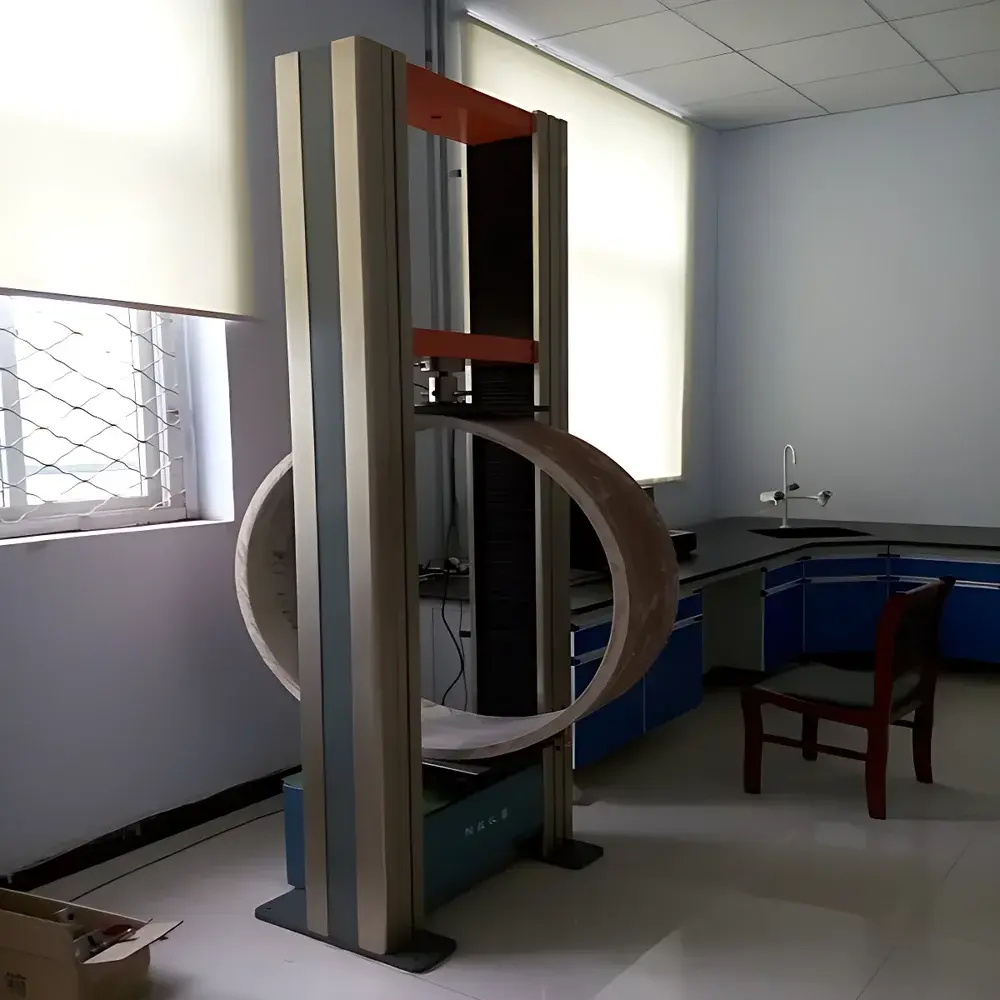
QJ215 Thermoplastic Pipe Ring Stiffness Testing Machine
| Origin | Shanghai, China |
|---|---|
| Manufacturer Type | Authorized Distributor |
| Origin Category | Domestic (China) |
| Model | QJ215 |
| Load Capacity | 50/100/200/300/500 kN |
| Maximum Test Diameter | ≤ Φ5000 mm |
| Accuracy Class | Class 1 / Class 0.5 |
| Test Speed Range | 0.01–1000 mm/min (standard speed: 300 mm/min) |
| Load Accuracy | ±1% (±0.5%) of indicated value |
| Speed Accuracy | ±0.5% (±0.15%) of indicated value |
| Displacement Resolution | 0.01 mm |
Overview
The QJ215 Thermoplastic Pipe Ring Stiffness Testing Machine is a precision universal testing system engineered for structural mechanical characterization of rigid and semi-rigid tubular products under controlled compressive loading conditions. It operates on the principle of ring compression testing per ISO 9969, ASTM D2412, and GB/T 9647—standards that define ring stiffness (kN/m²) as the ratio of applied load to relative deformation (ΔD/D₀) measured at a specified deflection (typically 3% of the mean diameter). The machine applies axial compression to a pipe segment supported on two parallel knife edges, inducing ovalization; simultaneous measurement of force and radial deformation enables calculation of ring stiffness, a critical design parameter for buried plastic pipes subjected to soil loading. Its robust four- or six-column frame architecture ensures high rigidity and minimal deflection during high-load tests up to 500 kN, supporting compliance with international infrastructure specification requirements for PE, PVC-U, GRP, and composite conduit systems.
Key Features
- Modular load frame available in four- or six-column configurations to accommodate large-diameter specimens up to Φ5000 mm while maintaining column alignment and load train stability.
- Dual-accuracy calibration options: Class 1 (±1% load accuracy) for routine quality control and Class 0.5 (±0.5% load accuracy) for R&D-grade validation and accreditation-critical testing.
- High-resolution displacement sensing with 0.01 mm resolution, synchronized with real-time load acquisition at ≥1 kHz sampling rate to capture transient deformation behavior during creep or relaxation phases.
- Integrated internal diameter deformation measurement kit—including linear variable differential transformers (LVDTs) or digital dial indicators—enabling precise ΔD tracking for both smooth-wall and corrugated thermoplastic pipes without external optical alignment.
- Full-range programmable crosshead speed from 0.01 to 1000 mm/min, with closed-loop servo control ensuring ±0.5% speed fidelity across the entire range—critical for standardized test rates (e.g., 300 mm/min per ISO 9969) and non-standard creep protocols.
- Universal functionality via interchangeable fixtures: equipped with standard ring stiffness supports, plus optional tensile grips, compression platens, and three-point bending assemblies to perform ASTM D638, D695, and D790 tests on bulk materials and composites.
Sample Compatibility & Compliance
The QJ215 accommodates thermoplastic pipes (PE80/PE100, PVC-U, PP-R), glass-reinforced plastic (GRP) conduits, and fiber-reinforced polymer (FRP) composite tubes with outer diameters from 50 mm to 5000 mm. Specimen wall thickness is unrestricted by the base system, though fixture selection must match nominal diameter and stiffness class. All test procedures conform to mandatory regulatory frameworks including ISO 9969 (thermoplastics), EN 1446 (buried drainage pipes), ASTM D2412 (ring-bending), and Chinese national standards GB/T 9647 and CJJ 101. Data acquisition and reporting meet GLP audit requirements, with timestamped metadata, operator ID logging, and electronic signature support compatible with FDA 21 CFR Part 11–enabled software modules.
Software & Data Management
The system runs on Windows-based control software with bilingual (English/Chinese) GUI, offering real-time force–displacement curve plotting, automatic yield point detection per ISO 6892-1, and batch report generation in PDF, Excel, and XML formats. All raw data—including load, displacement, time, and calculated ring stiffness (kN/m²)—are stored in encrypted binary archives with SHA-256 checksum verification. Audit trails record every parameter change, test initiation, result export, and user login event. Exported reports include full traceability: instrument ID, calibration certificate number, environmental temperature/humidity logs (when interfaced with optional sensors), and uncertainty budget per ISO/IEC 17025 Annex A.3.
Applications
- Validation of ring stiffness values for HDPE sewer pipes prior to municipal procurement approval.
- Comparative evaluation of long-term creep resistance between multi-layer PE-RT and single-wall corrugated PP pipes under sustained 3% deflection loads.
- Quality assurance testing of GRP pressure pipes per ISO 14692, including post-cure mechanical verification after filament winding.
- Mechanical screening of recycled-content PVC compounds used in non-pressure conduit applications.
- Research into temperature-dependent ring stiffness degradation using integrated environmental chamber interfaces (optional).
- Multi-standard compliance testing for export markets requiring simultaneous adherence to ASTM, EN, and GB specifications.
FAQ
What standards does the QJ215 comply with for ring stiffness testing?
ISO 9969, ASTM D2412, EN 1446, GB/T 9647, and CJJ 101.
Can the system measure ring stiffness for corrugated pipes with complex profiles?
Yes—the included internal deformation measurement kit uses contact LVDTs positioned at quadrants to resolve localized wall buckling and maintain accuracy across wave geometry.
Is the software compliant with FDA 21 CFR Part 11 for regulated laboratories?
Yes—when configured with electronic signatures, audit trail logging, and role-based access control, it satisfies Part 11 requirements for electronic records and signatures.
What is the maximum specimen weight the machine can support during setup?
The standard base frame supports static loads up to 2500 kg; optional heavy-duty cradles and roller guides facilitate safe positioning of large-diameter concrete-lined composite pipes.
Does the system provide uncertainty analysis for reported ring stiffness values?
Yes—software calculates combined standard uncertainty per GUM (JCGM 100:2008), incorporating contributions from load cell calibration, displacement sensor resolution, specimen dimensional measurement error, and environmental drift compensation.



