
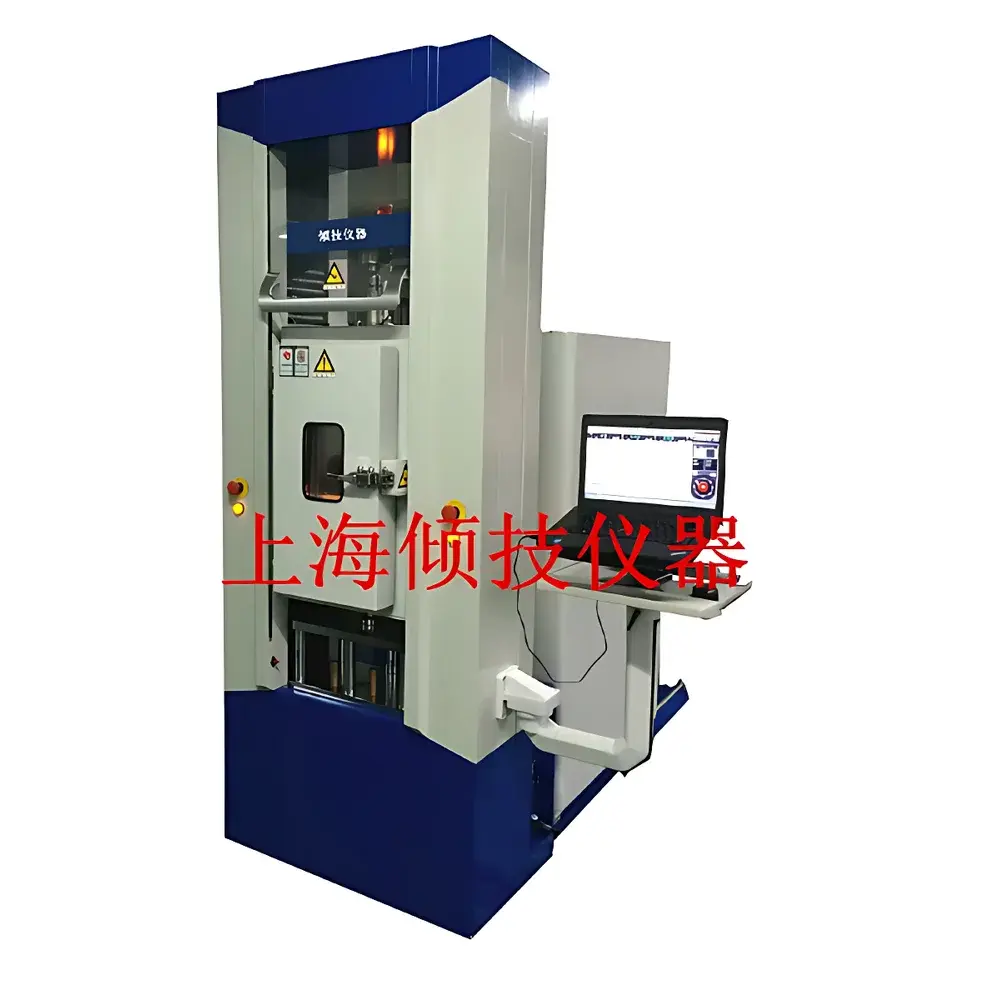
QJ216 Universal Testing Machine with Integrated Environmental Chamber (–70°C to +150°C)
| Key | Load Capacity: 40 kN |
|---|---|
| Force Resolution | ±1/250,000 full scale (constant across range) |
| Effective Test Width | 500 mm |
| Max. Tensile Travel | 600–800 mm (configurable) |
| Speed Range | 0.001–1000 mm/min |
| Speed Accuracy | ±1% of indicated value |
| Displacement Accuracy | ±0.2% of indicated value |
| Strain Measurement Accuracy | ±0.2% of indicated value |
| Power Supply | 1.5 kW |
| Dimensions (W×D×H) | 960 × 650 × 2000 mm |
| Weight | 1200 kg |
| Temperature Range | –70°C to +150°C |
| Compliance | ISO 7500-1, ASTM E4, ASTM D638, ASTM D790, ISO 527, ISO 178, JIS Z2241, DIN 50125 |
Overview
The QJ216 Universal Testing Machine with Integrated Environmental Chamber is a dual-function electromechanical system engineered for high-precision mechanical property characterization of materials under controlled thermal conditions. It combines a 40 kN load frame with a fully integrated, independently controlled temperature chamber capable of operating from –70°C to +150°C—enabling static and dynamic mechanical testing across extreme thermal gradients. The system operates on the principle of servo-controlled displacement actuation, where a precision ball-screw-driven crosshead applies calibrated axial force while synchronized sensors continuously acquire load, displacement, and strain data. All control logic, closed-loop feedback, and real-time curve rendering are executed via a dedicated Windows-based host application compliant with IEEE 12207 software lifecycle standards. Designed for R&D laboratories, quality assurance departments, and third-party testing facilities, the QJ216 supports standardized test execution per ISO 7500-1 (static calibration), ASTM E4 (load verification), and material-specific protocols including ASTM D638 (tensile), ASTM D790 (flexural), ISO 527 (plastics tensile), and ISO 178 (flexural rigidity).
Key Features
- Integrated environmental chamber with independent refrigeration and heating circuits, achieving stable thermal control within ±1.0°C over the full –70°C to +150°C range
- High-resolution force measurement system with ±1/250,000 full-scale resolution maintained uniformly across the entire 0.4–40 kN operational range—no range switching or recalibration required
- True constant-rate and constant-stress-rate control modes, supporting both open-loop speed programming and closed-loop load/displacement/strain regulation
- Dual-speed crosshead actuation: rapid positioning (up to 500 mm/min) and precision testing (0.001–1000 mm/min) with ±1% speed accuracy per ASTM E251
- Electronic limit switches and hardware-based overload protection (triggered at 110% of full-scale load) ensure mechanical integrity during unexpected failure events
- Modular extensometer interface supporting contact and non-contact strain measurement options—including digital video extensometry (DVE) compatibility
- Self-aligning load train with preloaded linear guides and zero-backlash ball screws to minimize off-axis loading errors per ISO 204
Sample Compatibility & Compliance
The QJ216 accommodates standard and custom specimens up to 500 mm wide and 600–800 mm in active gauge length—including metallic tensile bars, polymer sheets, composite laminates, elastomeric strips, adhesively bonded joints, and textile fabrics. Gripping systems include pneumatic wedge grips, hydraulic vise grips, and specialized fixtures for peel, shear, and puncture testing. All mechanical and thermal subsystems are designed and verified to meet ISO/IEC 17025:2017 requirements for testing laboratories. Calibration traceability is maintained to NIST-traceable force standards, and thermal uniformity within the chamber is validated per IEC 60068-3-5. The system supports audit-ready documentation for GLP and GMP environments, including electronic signatures, user access levels, and 21 CFR Part 11–compliant audit trails when configured with optional validation packages.
Software & Data Management
The embedded Windows-based control software provides real-time acquisition at up to 1 kHz sampling rate, with synchronized storage of load, displacement, strain, temperature, and time channels in HDF5 format—a self-describing, platform-independent binary standard widely adopted in scientific computing. Curve manipulation tools include point-wise data editing, multi-curve overlay, derivative calculation (e.g., modulus from stress–strain slope), automatic yield point detection per ASTM E8/E21, and customizable report generation with embedded metadata (operator ID, sample ID, environmental conditions, calibration dates). Raw data exports support CSV, XML, and MDF4 formats for downstream analysis in MATLAB, Python (via h5py), or commercial CAE platforms. Software updates are delivered via secure HTTPS with SHA-256 signature verification; no cloud dependency or telemetry is enabled by default.
Applications
- Low-temperature ductility assessment of aerospace alloys and cryogenic composites
- Thermal expansion coefficient (CTE) derivation via constrained tensile testing across temperature ramps
- Creep and stress-relaxation behavior of thermoplastics and thermosets at elevated service temperatures
- Adhesive bond strength evaluation under thermal cycling (e.g., automotive module qualification)
- Validation of finite element models using experimentally derived stress–strain curves at multiple thermal states
- Quality conformance testing per automotive OEM specifications (e.g., GMW14872, Ford WSS-M99P1111-A)
FAQ
Does the QJ216 comply with ISO 17025 calibration requirements?
Yes—the system’s force and displacement transducers are calibrated per ISO 7500-1 Class 0.5, and chamber thermal uniformity is certified per IEC 60068-3-5. Full calibration certificates with uncertainty budgets are provided upon installation.
Can third-party extensometers be integrated?
Yes—standard analog (±10 V) and digital (RS-422, TTL) interfaces are available; compatibility with industry-standard devices from ZwickRoell, MTS, and Instron is confirmed and documented.
Is remote operation supported?
Local network (LAN) remote control is supported via TCP/IP API; however, internet-based remote access is disabled by default for cybersecurity compliance (per IEC 62443-3-3). Optional secure VPN integration can be implemented on-site.
What maintenance intervals are recommended?
Preventive maintenance is scheduled every 12 months or 2000 operational hours—whichever occurs first—including ball-screw lubrication, thermal chamber seal inspection, load cell zero-drift verification, and safety interlock functional testing.
Are validation documents (IQ/OQ/PQ) available?
Yes—fully customizable GxP-compliant validation protocols and reports are available as an optional service, aligned with FDA guidance for computerized systems used in regulated environments.



