
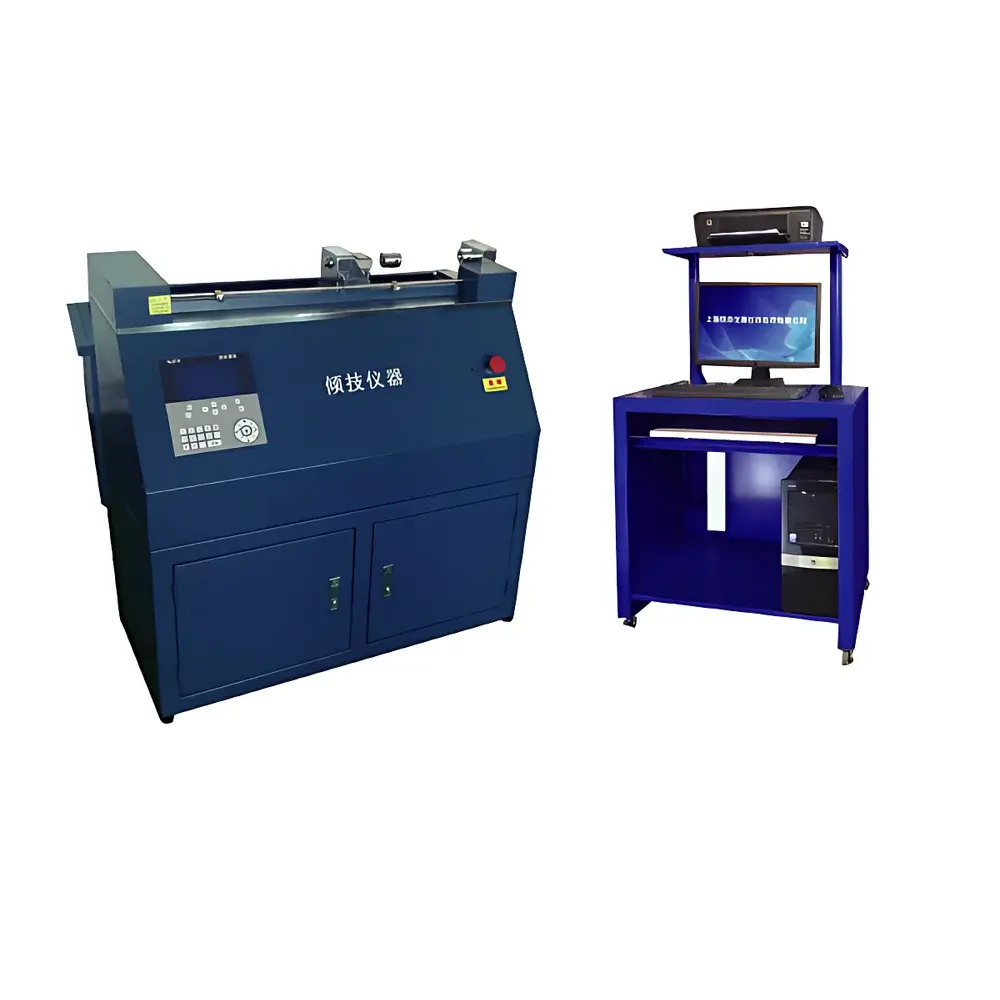
QJ310 Horizontal Wire Harness Peel & Pull-Off Tester
| (Origin | Shanghai, China |
|---|---|
| Manufacturer Type | Authorized Distributor |
| Origin Category | Domestic (China) |
| Model | QJ310 |
| Price | USD 4,200 approx.) |
Overview
The QJ310 Horizontal Wire Harness Peel & Pull-Off Tester is an engineered mechanical testing system designed specifically for evaluating the interfacial bond integrity and mechanical retention strength of wire harness assemblies, crimped terminals, connectors (plugs and sockets), adhesive-bonded components, lamp bases, and other electro-mechanical subassemblies. Operating on the principle of controlled uniaxial tensile separation, the instrument applies calibrated axial force to simulate real-world disengagement or delamination conditions—such as connector unmating, terminal pull-out, or adhesive debonding—while precisely measuring load-displacement response in real time. Its horizontal configuration minimizes gravitational interference on delicate specimens and ensures consistent alignment during peel or pull-off tests, critical for repeatable results in QC laboratories and R&D environments serving automotive, aerospace, and consumer electronics supply chains.
Key Features
- High-precision ball screw actuation system with backlash-free motion transmission and long-term dimensional stability
- Robust structural frame fabricated from high-grade cold-rolled steel with powder-coated enclosure for corrosion resistance and operational safety
- Large-format LCD touchscreen interface enabling real-time dynamic display of load (N), displacement (mm), test speed (mm/min), and stress–strain curves
- Integrated USB and RS232 communication ports for seamless data export and bidirectional control via Windows-based PC software
- Dual-range load cell options: 2500 N or 5000 N full-scale capacity, both calibrated to ISO 7500-1 Class 0.5 accuracy
- Load cell resolution: 0.01% of full scale; overall system measurement uncertainty: ≤ ±0.5% of reading (per ASTM E4 and ISO 7500-1)
- Adjustable crosshead travel: ≥200 mm, accommodating diverse specimen lengths and fixture configurations
- Programmable speed range: 0.001–300 mm/min (standard); optional high-speed mode: 5–300 mm/min for rapid qualification testing
Sample Compatibility & Compliance
The QJ310 accommodates a broad spectrum of low-to-medium-force mechanical interface tests—including 90° and 180° peel tests per ASTM D903 and ISO 8510-2, crimp retention force tests per USCAR-21 and SAE J2242, and axial pull-off verification for molded-in connectors per IEC 60512-2-1. Fixture adaptability supports standardized grips (pneumatic, wedge, and custom jaw sets) and modular tooling for automotive FAKRA, HSD, and Mini-USB connectors. The system meets electromagnetic compatibility requirements per EN 61326-1 and electrical safety standards per EN 61010-1. All firmware and calibration records comply with GLP documentation practices and support audit-ready traceability for ISO/IEC 17025-accredited labs.
Software & Data Management
The included PC software provides full test method scripting (tensile, peel, pull-off, hold), real-time curve overlay, automatic peak detection, and customizable report generation (PDF, Excel, CSV). Data logs include timestamped metadata, operator ID, environmental conditions (if external sensors are connected), and digital signature fields. Audit trail functionality satisfies FDA 21 CFR Part 11 requirements for electronic records and signatures when configured with user-level access controls and password-protected calibration locks. Raw data files are stored in open binary format (.tdms) for third-party analysis in MATLAB, Python, or LabVIEW environments.
Applications
- Verification of crimp joint integrity in automotive wiring harnesses per OEM specifications (e.g., GMW3172, Ford WERCS)
- Quantitative assessment of adhesive bond strength in LED lamp modules and sensor housings
- Quality gate testing of USB-C and HDMI connector retention force prior to final assembly
- Process validation for automated terminal insertion equipment across Tier-1 suppliers
- Failure mode analysis (FMA) of insulation displacement contacts (IDCs) under thermal cycling preconditioning
- Supporting root cause investigations in field return analysis (FRA) programs for intermittent electrical faults
FAQ
What standards does the QJ310 comply with for crimp pull testing?
It supports test execution per USCAR-21 Rev 5, SAE J2242, and VW 60330, with configurable dwell times and ramp rates aligned to these specifications.
Can the system be integrated into an automated production line?
Yes—via digital I/O signals (start/stop, pass/fail output) and Modbus TCP protocol for PLC synchronization.
Is calibration certification included with shipment?
Each unit ships with a factory-issued calibration certificate traceable to NIM (National Institute of Metrology, China) and valid for 12 months.
What maintenance intervals are recommended?
Lubrication of the ball screw every 6 months and annual load cell verification using certified deadweight standards are advised for sustained metrological performance.



