
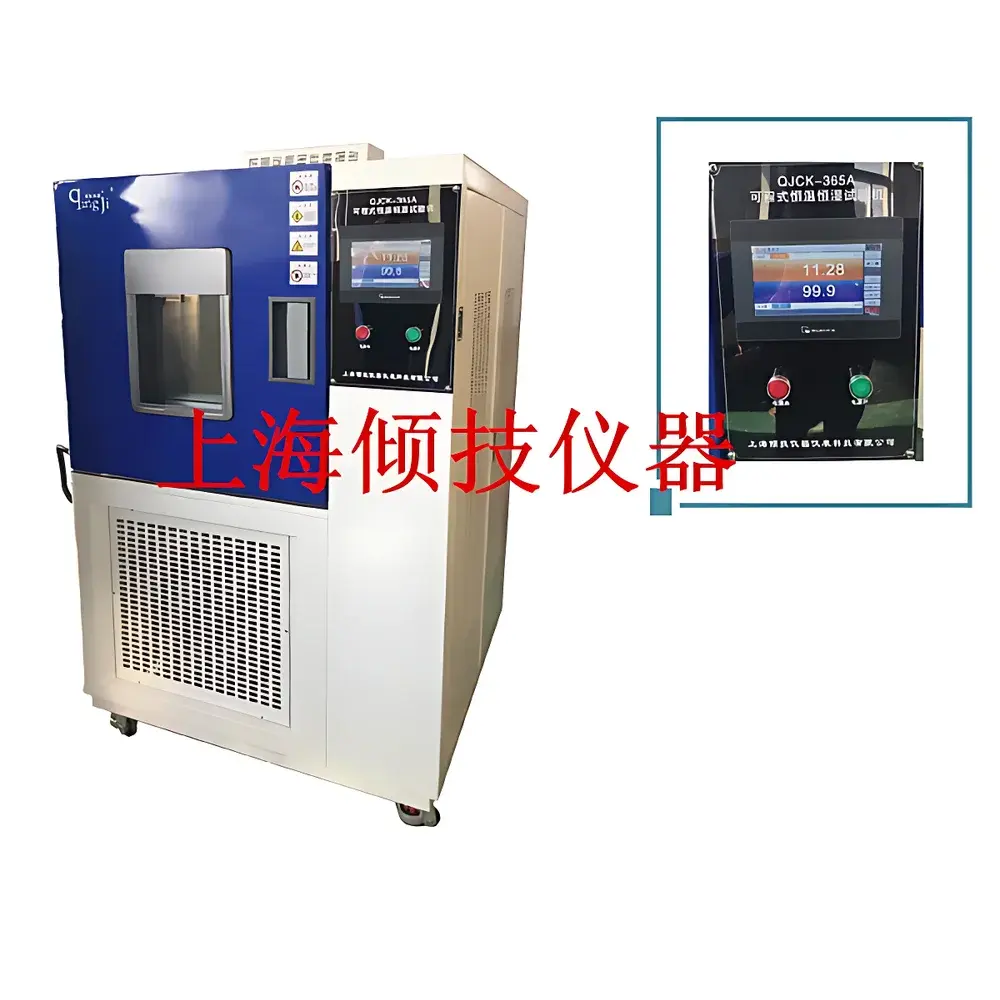
QJCK High-Low Temperature Compression Testing Chamber
| (Origin | Shanghai, China |
|---|---|
| Manufacturer Type | Authorized Distributor |
| Origin Category | Domestic (PRC) |
| Model | QJCK |
| Price | USD 7,000 approx.) |
Overview
The QJCK High-Low Temperature Compression Testing Chamber is an integrated electromechanical testing system engineered for precise mechanical property evaluation of materials under controlled thermal environments. It combines a high-capacity universal testing frame (up to 30 kN) with a fully insulated environmental chamber capable of maintaining stable temperatures from –70 °C to +350 °C. The system operates on the principle of servo-controlled hydraulic or electromechanical actuation, enabling quasi-static and low-cycle fatigue loading protocols—including compression, tension, bending, shear, peel, tear, and puncture—while simultaneously subjecting specimens to programmable thermal profiles. Designed for compliance-driven laboratories, it supports standardized test execution per ISO 6892-1 (tensile), ASTM D695 (compressive strength), ISO 178 (flexural), and GB/T 228.1, making it suitable for R&D, quality assurance, and certification testing in aerospace composites, polymer engineering, battery cell packaging, and high-performance elastomers.
Key Features
- Thermally isolated dual-zone architecture: Independent chamber and loadframe design permits rapid removal of the environmental enclosure for ambient-temperature testing—maximizing lab flexibility and throughput.
- Wide thermal operating range: Stable temperature control from –70 °C to +350 °C with ramp rates ≥5 °C/min and temperature resolution of 0.1 °C via PID-regulated digital controller.
- High-fidelity force measurement: Load cell accuracy of ±0.01% of full scale, supported by real-time calibration traceability and auto-zero compensation.
- Precision motion control: Crosshead speed adjustable from 0.001 to 500 mm/min (extendable to 1000 mm/min upon configuration), with speed accuracy maintained within ±0.5% of setpoint.
- Robust mechanical construction: 420 mm effective test width, ~800 mm standard stroke (extendable), and 135 kg total mass ensure structural rigidity and minimal deflection during high-load compression tests.
- Dual-mode operation interface: Full PC-based control via dedicated software platform, with optional local digital panel for manual override and emergency intervention.
- Comprehensive safety integration: Dual-channel electronic limit switches, hardware-based emergency stop circuitry, and over-travel protection conforming to IEC 61508 SIL 2 functional safety requirements.
Sample Compatibility & Compliance
The QJCK chamber accommodates flat, cylindrical, prismatic, and irregularly shaped specimens up to 420 mm wide and 800 mm tall (custom height extensions available). Compatible with metallic alloys (e.g., Ti-6Al-4V, Inconel 718), thermoplastics (PEEK, PPS), thermosets (epoxy composites), ceramics, and laminated battery electrode stacks. All test sequences adhere to GLP and GMP documentation standards; audit trails, user access logs, and electronic signatures comply with FDA 21 CFR Part 11 when configured with validated software modules. System validation packages support IQ/OQ/PQ execution per ISO/IEC 17025 and ASTM E2586 guidelines.
Software & Data Management
Control and analysis are executed through a Windows-based application supporting multi-step thermal-mechanical profiles (e.g., “hold at –40 °C → compress at 2 mm/min → heat to 150 °C at 3 °C/min → hold → unload”). Raw data—including force, displacement, strain, temperature, and time—is captured at ≥1 kHz sampling rate and stored in vendor-neutral .csv and .tdms formats. Built-in statistical tools compute modulus, yield point, ultimate strength, elongation at break, and hysteresis area. Data export supports direct integration with LIMS platforms and third-party analysis suites (MATLAB, Python Pandas, OriginLab). Software version history, change logs, and cryptographic hash verification ensure data integrity across instrument lifecycle.
Applications
- Evaluation of thermal expansion mismatch in bonded dissimilar materials (e.g., Cu/Al interconnects in power electronics).
- Compression creep and stress relaxation behavior of polymeric seals under elevated temperature cycling.
- Mechanical stability assessment of lithium-ion battery jelly rolls during thermal runaway simulation.
- High-temperature compressive strength mapping of carbon-carbon composites for brake disc qualification.
- Low-temperature embrittlement testing of cryogenic pipeline gasket materials per ASTM F1367.
- ISO 1133 melt flow index correlation studies under non-standard thermal gradients.
FAQ
Does the QJCK system support ASTM E8/E21 tensile testing at elevated temperatures?
Yes—equipped with high-temperature extensometers and furnace-compatible grips, it meets all dimensional and thermal uniformity requirements specified in ASTM E21 Annex A1 for temperatures up to 350 °C.
Can the environmental chamber be retrofitted to an existing universal testing machine?
No—the QJCK is a purpose-integrated platform; chamber geometry, loadframe stiffness, and thermal shielding are co-engineered and not modularly interchangeable.
Is calibration certificate included with delivery?
A factory-issued as-found/as-left calibration report traceable to NIM (National Institute of Metrology, China) is provided; ISO/IEC 17025-accredited third-party calibration is available upon request.
What maintenance intervals are recommended for long-term reliability?
Preventive maintenance is advised every 12 months or 2,000 operational hours—covering load cell verification, thermal sensor recalibration, lubrication of lead screws, and vacuum seal inspection for sub-zero operation.



