
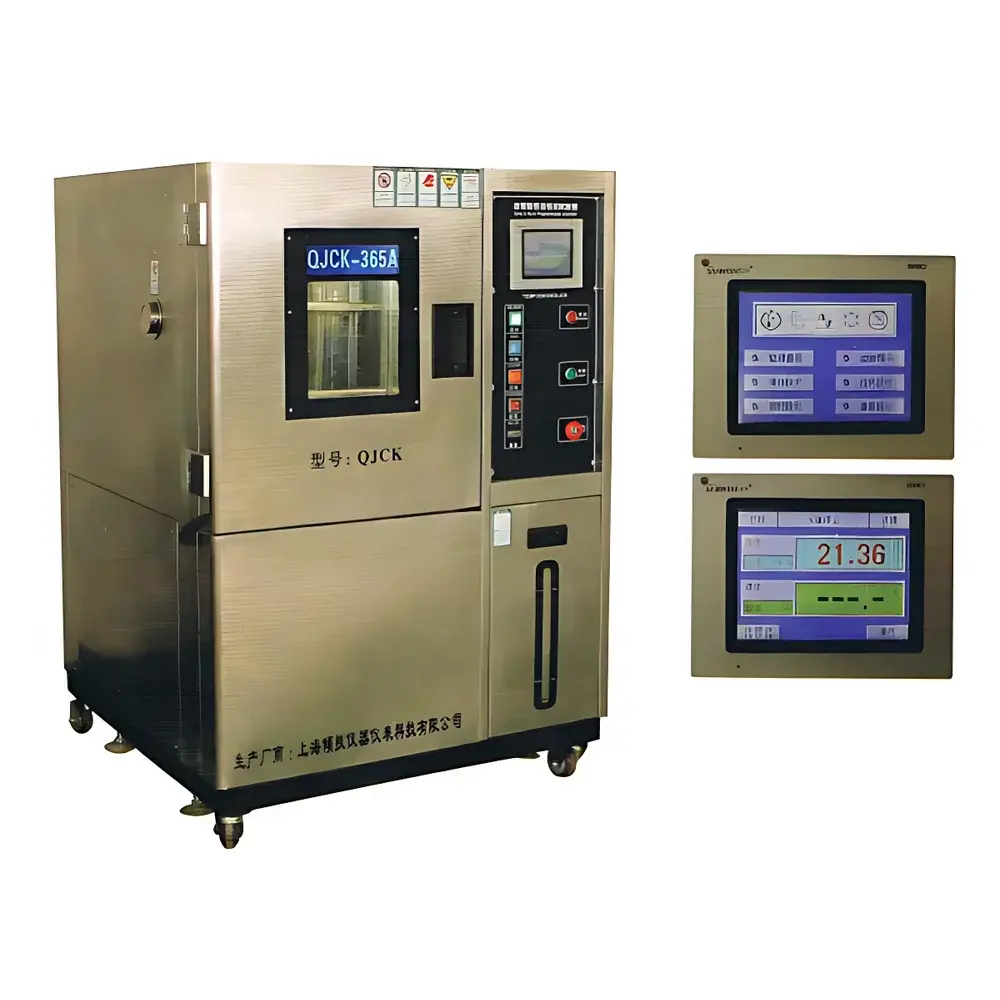
QJCK Photovoltaic High-Low Temperature Environmental Test Chamber with Integrated Universal Testing Machine
| Brand | Qingji |
|---|---|
| Origin | Shanghai, China |
| Model | QJCK |
| Temperature Range | -70 °C to +350 °C (steady-state at 350 °C) |
| Ramp Rate | ≥5 °C/min |
| Temperature Resolution | 0.1 °C |
| Load Capacity | up to 30 kN |
| Load Cell Accuracy | ±0.01% FS |
| Force Measurement Uncertainty | <±1% or <±0.5% |
| Displacement Accuracy | ±0.5% |
| Strain/Deformation Accuracy | ±0.5% |
| Speed Range | 0.001–500 mm/min (extendable to 1000 mm/min) |
| Speed Accuracy | ±0.5% |
| Effective Width | 420 mm |
| Effective Stroke | ~800 mm (height-adjustable) |
| Safety Features | Electronic travel limit switches, emergency stop circuit |
| Net Weight | 135 kg |
Overview
The QJCK Photovoltaic High-Low Temperature Environmental Test Chamber is a purpose-engineered integrated system combining a precision climate-controlled chamber with a high-fidelity universal testing machine (UTM). Designed specifically for photovoltaic (PV) module and material qualification, it enables real-time mechanical property evaluation—tensile, peel, tear, compression, flexural, shear, puncture, and low-cycle fatigue—under dynamically controlled thermal conditions ranging from -70 °C to +350 °C. Unlike conventional standalone environmental chambers, the QJCK integrates thermal control and mechanical actuation within a single rigid frame, eliminating thermal drift-induced misalignment and ensuring sub-millimeter positional stability during temperature transitions. Its architecture adheres to ASTM E1823 (Standard Terminology Relating to Fatigue and Fracture Testing), ISO 178 (Plastics — Determination of Flexural Properties), and IEC 61215-2 (Terrestrial Photovoltaic (PV) Modules — Design Qualification and Type Approval), supporting full compliance workflows for PV component certification.
Key Features
- Modular dual-function design: The environmental chamber can be physically decoupled from the UTM base for ambient-temperature-only testing, optimizing lab floor space and enabling rapid reconfiguration for non-thermal mechanical tests.
- High-stability thermal chamber: Constructed with double-wall vacuum-insulated stainless steel housing, PID-controlled forced-air convection, and multi-zone heating/cooling elements to ensure uniformity ≤±1.5 °C across the test zone (per IEC 60068-3-5).
- Load frame with precision crosshead guidance: Dual-column rigid steel frame with preloaded linear bearings ensures minimal deflection (<0.02 mm/kN) under full 30 kN load, critical for maintaining alignment during thermal expansion of specimens.
- High-resolution force measurement: Digitally compensated 30 kN load cell with 0.01% full-scale accuracy and integrated temperature compensation eliminates thermal zero-drift during ramp cycles.
- Multi-mode motion control: Closed-loop servo-hydraulic or electromechanical drive (configurable) delivering speed resolution down to 0.001 mm/min and repeatability ≤±0.5% across the full 0.001–500 mm/min range.
- Comprehensive safety architecture: Redundant electronic limit switches, hardware-based emergency stop circuitry compliant with ISO 13850, and automatic thermal overload cut-off prevent operational hazards during extended thermal cycling.
Sample Compatibility & Compliance
The QJCK accommodates standard PV laminate coupons (e.g., 100 × 100 mm, 150 × 150 mm), encapsulant strips (EVA, POE), backsheet films, and interconnect ribbons per IEC 61215-2 MQT 11 (Thermal Cycling), MQT 12 (Humidity Freeze), and UL 1703 Annex B (Temperature Cycling). Specimen fixtures include pneumatic tensile grips, peel jigs, and three-point bending fixtures—all compatible with chamber interior dimensions (W420 × D450 × H800 mm, extendable). System validation documentation supports IQ/OQ protocols aligned with GLP and GMP environments. Calibration traceability follows ISO/IEC 17025 via NIST-traceable standards for force, displacement, and temperature.
Software & Data Management
Control and analysis are performed via Qingji’s QTest Pro v4.2 software—a Windows-based platform supporting synchronized acquisition of force, displacement, strain, and chamber temperature at up to 1 kHz sampling rate. Software modules include automated test sequencing (ASTM D638, ISO 527), real-time stress-strain overlay during thermal ramps, and pass/fail logic based on user-defined thresholds (e.g., “failure if elongation >15% at -40 °C”). Audit trails, electronic signatures, and 21 CFR Part 11-compliant user access controls are enabled by default. Export formats include CSV, XML, and PDF reports with embedded metadata (test ID, operator, calibration dates, environmental logs).
Applications
- Photovoltaic module reliability assessment: Quantifying delamination onset, solder joint fatigue, and encapsulant embrittlement across thermal cycling profiles (-40 °C ↔ +85 °C, 200 cycles).
- Encapsulant material characterization: Measuring modulus shift, creep compliance, and fracture energy of EVA/POE under isothermal holds at 85 °C, 120 °C, and 150 °C.
- Backsheet thermo-mechanical stability: Evaluating dimensional stability, tensile retention, and crack propagation resistance in fluoropolymer and PET-based backsheets.
- Interconnect ribbon bond integrity: Performing peel and shear tests on cell-to-ribbon interfaces at elevated temperatures simulating field operating conditions.
- Accelerated aging correlation studies: Supporting development of Arrhenius-based lifetime models by correlating mechanical degradation rates with temperature history.
FAQ
What standards does the QJCK system support for PV module qualification?
It natively supports IEC 61215-2 (MQT 11, MQT 12, MQT 19), UL 1703, GB/T 25075, and ASTM E1591 for thermal-mechanical stress evaluation.
Can the chamber operate independently of the UTM frame?
Yes—the chamber is mechanically and electrically decoupled; it may be removed and used as a standalone thermal chamber for non-mechanical applications.
Is temperature uniformity validated across the full test volume?
Yes—uniformity mapping per IEC 60068-3-5 is provided in the factory acceptance test report, with typical deviation ≤±1.2 °C at steady state.
What maintenance intervals are recommended for long-term accuracy?
Load cell recalibration every 12 months; chamber sensor verification every 6 months; full system performance verification annually per ISO 17025 guidelines.
Does the system support third-party software integration?
Yes—via TCP/IP API and OPC UA protocol, enabling integration with LIMS, MES, and enterprise data platforms.



