
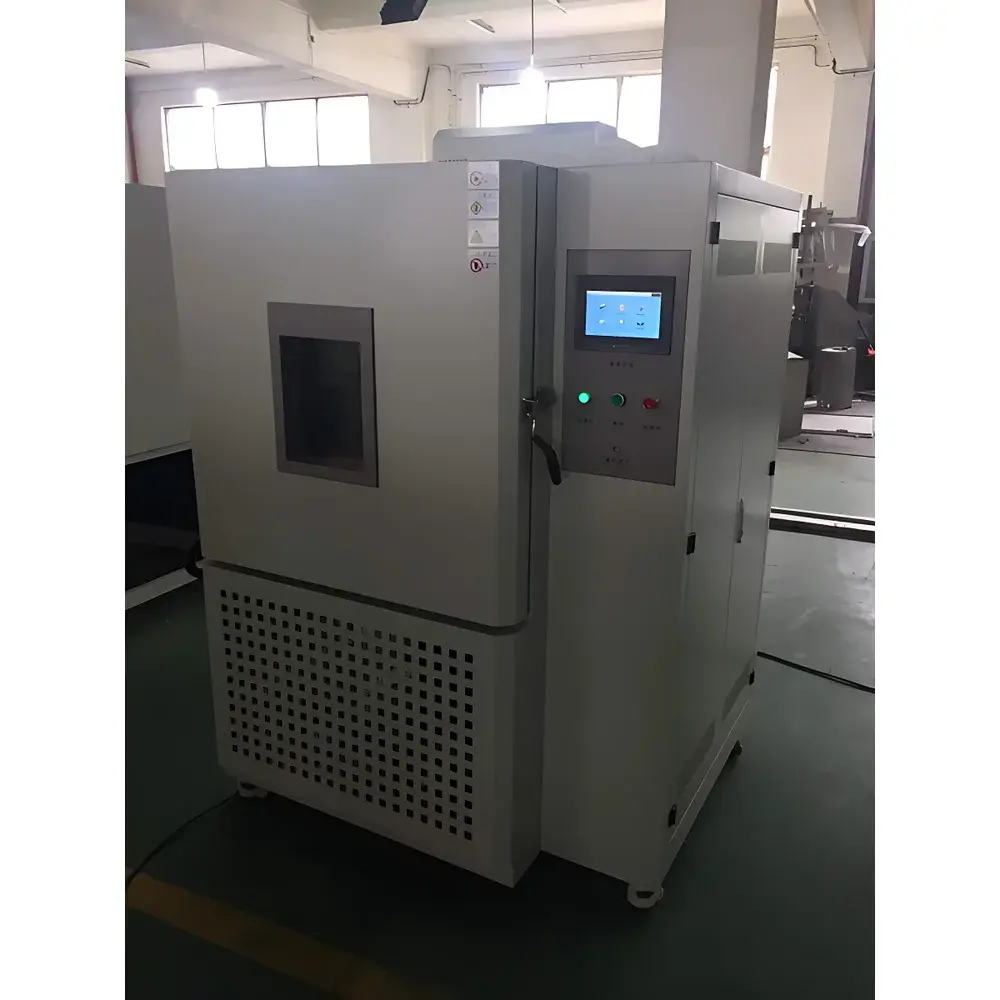
QJCLR8731 Shanghai QJCLR Three-Zone Thermal Shock Test Chamber
| Origin | Shanghai, China |
|---|---|
| Manufacturer Type | Authorized Distributor |
| Origin Category | Domestic (PRC) |
| Model | QJCLR8731 |
| Price | USD 6,300 (FOB Shanghai) |
| High-Temperature Zone Range | +80 °C to +200 °C |
| Low-Temperature Zone Range | −10 °C to −70 °C |
| Thermal Shock Exposure Range | −40 °C to +180 °C |
| Temperature Stability | ≤ ±2 °C |
| Heating Rate | 1–3 °C/min |
| Cooling Rate | 0.7–1 °C/min |
| Temperature Uniformity | ±2 °C |
| Recovery Time | ≤ 5 min |
| Heating Time (RT to +200 °C) | ≤ 40 min |
| Cooling Time (RT to −70 °C) | ≤ 60–90 min |
| Controller | 7.5″ color LCD touchscreen (256-color, wide viewing angle, adjustable backlight), bilingual (English/Chinese) interface |
| Safety Protections | Fuseless circuit breaker, compressor high-pressure/overheat/overcurrent protection, overtemperature cutoff, fan overload protection |
| Standard Accessories | Two sample racks, one Ø50 mm cable port |
Overview
The QJCLR8731 Three-Zone Thermal Shock Test Chamber is an engineered environmental simulation system designed for accelerated reliability assessment of materials and electronic components under rapid, repetitive transitions between extreme temperature extremes. Unlike single- or dual-zone chambers, this tri-compartment architecture physically isolates the high-temperature zone (+80 °C to +200 °C), low-temperature zone (−10 °C to −70 °C), and test zone—enabling true thermal shock exposure via rapid specimen transfer rather than air-based ramping. This methodology conforms to the fundamental principle of thermal shock testing defined in IEC 60068-2-14, ASTM D5229/D5229M, and MIL-STD-810H Method 503.5, where thermal gradients induce mechanical stress through differential expansion coefficients across heterogeneous interfaces (e.g., solder joints, encapsulants, PCB laminates, or polymer-metal assemblies). The chamber delivers a verified exposure range of −40 °C to +180 °C with ≤ ±2 °C stability and uniformity—critical for evaluating microstructural integrity, interfacial delamination, solder joint fatigue, and glass transition-related embrittlement in aerospace, automotive electronics, and medical device packaging.
Key Features
- Three-compartment physical isolation design eliminates cross-contamination of thermal zones and ensures repeatable, non-ramped shock profiles
- High-fidelity temperature control using PID-regulated refrigeration (cascade two-stage R404A/R23 system) and electric heating with redundant thermocouple feedback
- 7.5-inch industrial-grade color LCD touchscreen controller with real-time data logging, programmable profile sequencing (up to 99 cycles, 99 segments), and bilingual English/Chinese UI
- Automated specimen transfer mechanism with pneumatic actuation and position-sensor verification (cycle time < 5 seconds)
- Comprehensive safety architecture: dual-stage overtemperature cutoff, compressor discharge pressure monitoring, phase failure detection, and fan motor thermal overload protection
- Structural insulation using 150 mm thick polyurethane foam (thermal conductivity ≤ 0.022 W/m·K) with vacuum-degassed pour process to minimize thermal bridging
Sample Compatibility & Compliance
The QJCLR8731 accommodates standard test specimens up to 400 mm × 400 mm × 400 mm (W×D×H) on two removable stainless-steel sample racks. A Ø50 mm cable/port access facilitates in-situ electrical biasing or sensor integration during cycling. The chamber meets structural and operational requirements of GB/T 2423.1–2021 (cold testing), GB/T 2423.2–2008 (dry heat), GJB 150.5A–2009 (military thermal shock), and GB 10592–2008 (temperature chamber performance criteria). While not certified to ISO/IEC 17025, its calibration traceability supports GLP-compliant test reporting when operated with NIST-traceable reference thermometers (e.g., Fluke 1523/1524) and validated procedures per ISO 17025 Clause 6.4.2.
Software & Data Management
The embedded controller logs timestamped temperature readings from three independent PT100 sensors (high zone, low zone, test zone) at user-selectable intervals (1–60 s). Export formats include CSV and PDF reports with cycle summary statistics (min/max/mean deviation, dwell compliance, transfer timing). Optional Ethernet connectivity enables remote monitoring via Modbus TCP or HTTP API for integration into centralized lab management systems (LIMS). Audit trail functionality records operator logins, parameter changes, and alarm events—supporting basic FDA 21 CFR Part 11 readiness when paired with institutional electronic signature policies.
Applications
- Evaluation of solder joint reliability in lead-free PCB assemblies subjected to JEDEC JESD22-A104 thermal cycling profiles
- Qualification of conformal coatings and potting compounds for automotive ECUs operating across −40 °C to +125 °C ambient envelopes
- Accelerated aging studies of lithium-ion battery cell housings and thermal interface materials (TIMs)
- Validation of hermetic seal integrity in MEMS packages and optoelectronic modules
- Material screening for coefficient of thermal expansion (CTE) mismatch in multilayer ceramic capacitors (MLCCs) and advanced packaging substrates
FAQ
What standards does the QJCLR8731 comply with?
It is designed and verified to meet GB/T 2423.1–2021, GB/T 2423.2–2008, GJB 150.5A–2009, and GB 10592–2008. Full certification to IEC 60068-2-14 requires third-party validation per test plan.
Can the chamber operate continuously for extended qualification tests?
Yes—the refrigeration system features oil-level monitoring, condenser fouling detection, and automatic defrost scheduling. Recommended maximum continuous operation: 72 hours per cycle block, with ≥2-hour stabilization intervals between blocks.
Is remote diagnostics supported?
Basic remote status polling is available via Ethernet; full remote control and firmware updates require optional service contract and secure VPN configuration.
What maintenance intervals are recommended?
Compressor oil analysis every 2,000 operating hours; refrigerant leak check annually; door gasket integrity verification quarterly; sensor calibration traceable to NIST standards every 12 months.
Does the system support custom thermal profiles beyond standard shock sequences?
Yes—the controller allows user-defined multi-segment profiles with variable dwell times, ramp rates, and conditional branching based on zone temperature thresholds.



