
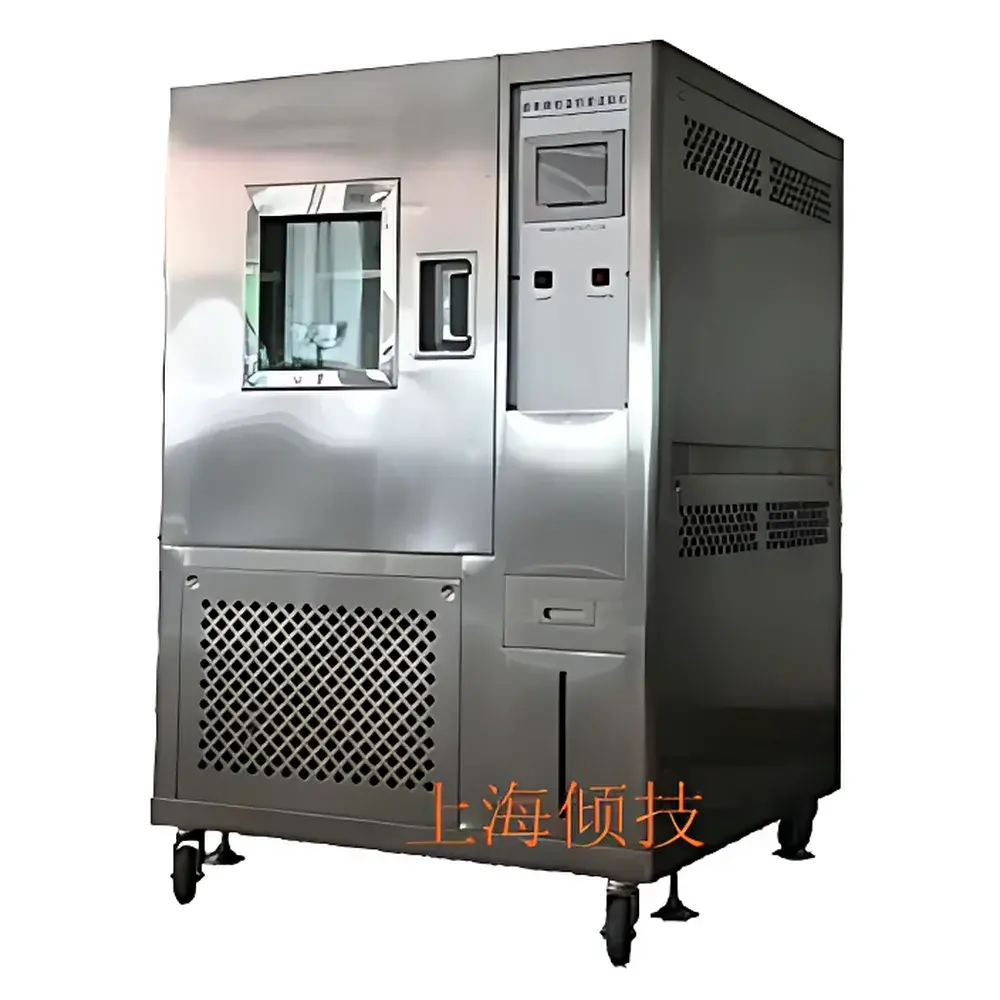
QJCLR8731 Thermal Shock Test Chamber by Qingji
| Brand | Qingji |
|---|---|
| Model | QJCLR8731 |
| Temperature Range (High Zone) | 60–200 °C |
| Temperature Range (Low Zone) | –10 to –65 °C (standard), optional –75 °C |
| Test Chamber Operating Range | –10 to –60 °C |
| Temperature Stability | ±1 °C |
| Temperature Uniformity | ±2 °C |
| Recovery Time | ≤5 min |
| Heating Rate (Typical) | 40 min (from –40 °C to +150 °C) |
| Cooling Rate (Typical) | 60–90 min (from +150 °C to –40 °C) |
| Controller | 7.5″ color LCD touchscreen with bilingual (English/Chinese) interface, 256-color display, adjustable backlight, direct-key operation |
| Safety Protections | Fuseless circuit breaker, compressor high-pressure/overheat/overcurrent protection, chamber overtemperature cutoff, fan overload protection |
| Standard Accessories | Two sample racks, one 50 mm diameter cable port |
| Compliance | GB/T 2423.1–2021, GB/T 2423.2–2001, GJB 150.5A–2009, GB 10592–2008 |
Overview
The QJCLR8731 Thermal Shock Test Chamber is an engineered environmental stress screening (ESS) system designed for rapid, repeatable transitions between extreme high- and low-temperature environments. It operates on a dual-chamber (hot/cold) gas-transfer principle: test specimens are mechanically transferred—via a lift-and-shift elevator mechanism—between thermally isolated zones, enabling abrupt thermal transitions without residual heat exchange from the chamber walls. This architecture ensures high-fidelity simulation of real-world thermal shock conditions encountered during aerospace component deployment, automotive electronics lifecycle exposure, or semiconductor packaging qualification. The system meets the fundamental requirements of MIL-STD-810H Method 503.5, IEC 60068-2-14, and corresponding national standards (GB/T 2423.1–2021, GB/T 2423.2–2001, GJB 150.5A–2009), making it suitable for reliability validation under GLP-compliant laboratory workflows.
Key Features
- Dual-zone independent temperature control: High-temperature zone (60–200 °C) and low-temperature zone (–10 to –65 °C, optionally –75 °C) operate simultaneously with PID-regulated refrigeration and heating circuits.
- Precision mechanical transfer system: Stainless-steel lift platform with position feedback sensors ensures reproducible specimen movement in ≤5 seconds; transfer cycle time contributes directly to total recovery time specification (≤5 min).
- Industrial-grade 7.5″ color LCD touchscreen controller: Supports English/Chinese language switching, real-time trend graphing, programmable multi-step profiles (up to 99 segments), and event logging with timestamped alarms.
- Robust safety architecture: Integrated protections include compressor discharge pressure monitoring, evaporator frost detection, chamber overtemperature cut-off (hardware-independent), fan motor current sensing, and fuseless main power isolation.
- Thermal uniformity validated per GB 10592–2008: ±2 °C spatial tolerance across full working volume (W×D×H: 400×400×400 mm standard); stability maintained at ±1 °C under steady-state dwell conditions.
- Configurable auxiliary interfaces: Standard 50 mm diameter cable port (with silicone gasket and clamping collar) enables external sensor integration or powered device-under-test (DUT) operation during cycling.
Sample Compatibility & Compliance
The QJCLR8731 accommodates rigid and semi-rigid samples up to 20 kg total mass per cycle, including PCB assemblies, molded plastic housings, solder-joint test coupons, and hermetically sealed optoelectronic modules. Its internal dimensions support ISO-standard test fixtures and ASTM E119-compliant mounting configurations. All operational parameters—including dwell time, transfer velocity, and ramp rate—are fully programmable and auditable, supporting traceability requirements under ISO/IEC 17025:2017 and FDA 21 CFR Part 11 when paired with optional electronic signature and audit trail software modules. Calibration certificates (NIST-traceable reference sensors) and IQ/OQ documentation packages are available upon request.
Software & Data Management
The embedded controller logs all critical process variables—including zone temperatures, transfer actuation timestamps, alarm events, and setpoint deviations—at user-configurable intervals (1–60 s). Data exports as CSV via USB 2.0 port for post-processing in MATLAB, Python (Pandas), or JMP. Optional PC-based software (Qingji LabLink™) provides remote monitoring, multi-chamber fleet management, automated report generation (PDF/Excel), and deviation alerting via SMTP or Modbus TCP. All data files include cryptographic hash signatures to ensure integrity verification during regulatory audits.
Applications
- Qualification testing of avionics enclosures per DO-160 Section 4.5 (Temperature Shock).
- Failure mode analysis of lead-free solder joints in automotive ECUs under JEDEC JESD22-A104E.
- Accelerated aging of polymer-based medical device housings (ISO 10993-12).
- Validation of thermal interface material (TIM) adhesion integrity after repeated expansion/contraction cycles.
- Screening of MEMS sensor drift characteristics across –55 °C to +125 °C excursions.
- Pre-shipment stress screening for consumer electronics per IPC-9701A Annex B.
FAQ
What is the maximum allowable sample mass for reliable thermal transfer performance?
The system is rated for 20 kg total load per test cycle. Exceeding this may extend recovery time beyond specification and compromise temperature uniformity.
Can the controller store multiple test profiles with different dwell times and temperature setpoints?
Yes—up to 99 programmable profiles, each supporting 99 segments with independent ramp rates, dwell durations, and zone activation logic.
Is third-party calibration certification included with delivery?
Factory calibration is performed using NIST-traceable platinum RTDs; formal calibration certificates (with uncertainty budgets) are available as a billable option.
Does the chamber support automated data export to LIMS platforms?
Via optional LabLink™ software with configurable API endpoints (REST/JSON) and native HL7 v2.x message mapping for clinical or regulated manufacturing environments.
What refrigerant is used in the low-temperature zone?
R404A (ASHRAE classification A1) is employed in standard configurations; R290 (propane) alternative is available for eco-compliance requirements.



