
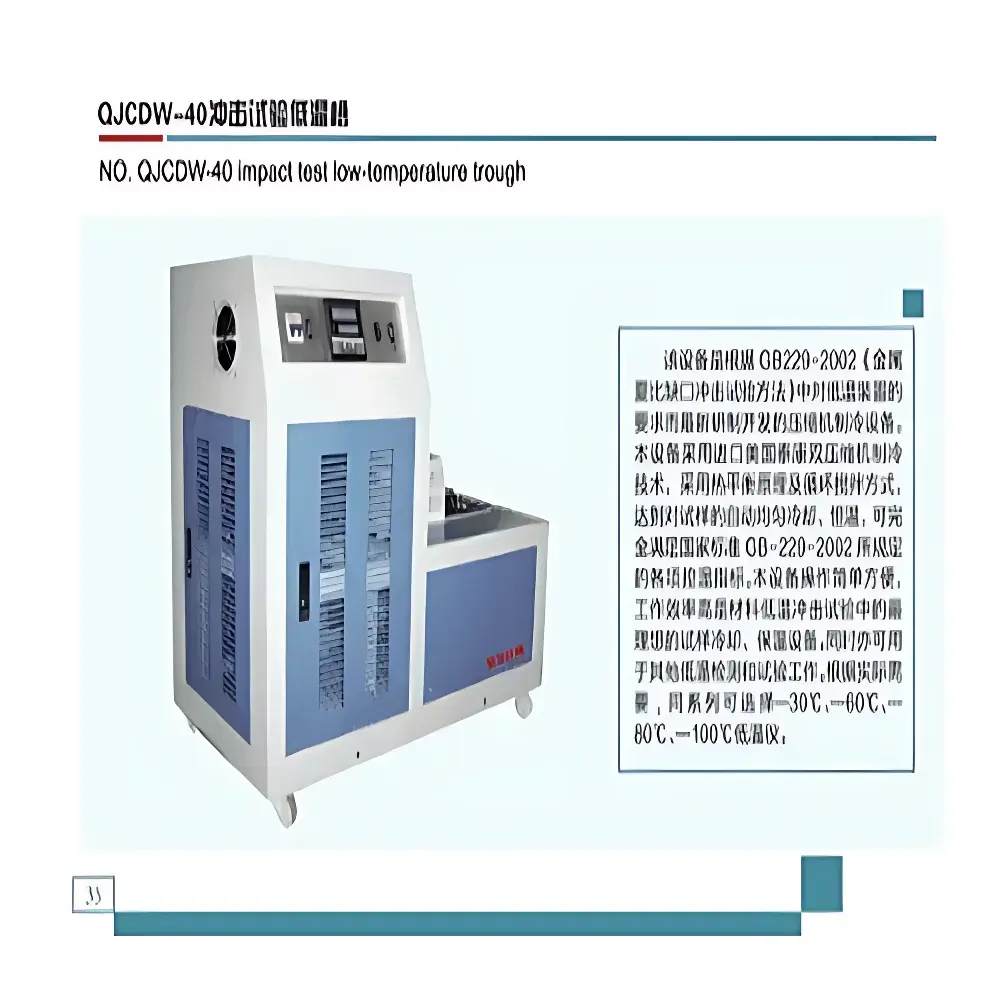
QJCXS-43 Low-Temperature Brittleness Tester for Plastics and Elastomers
| Origin | Shanghai, China |
|---|---|
| Manufacturer Type | Authorized Distributor |
| Origin Category | Domestic (PRC) |
| Model | QJCXS-43 |
| Price | USD 5,900 (FOB Shanghai) |
| Test Temperature Range | −70 °C to 0 °C |
| Impact Velocity | 2.0 m/s ±0.2 m/s |
| Temperature Stability During Test (3 min) | ±0.5 °C |
| Impact Pin to Clamp Lower Edge Distance | 11.0 mm ±0.5 mm |
| Dimensions (W×D×H) | 700 mm × 700 mm × 1300 mm |
| Power Consumption | 1100 W |
Overview
The QJCXS-43 Low-Temperature Brittleness Tester is a precision laboratory instrument engineered to determine the brittle transition temperature of elastomeric and thermoplastic materials under controlled cryogenic conditions. Based on the principle of impact-induced fracture initiation, the device subjects standardized specimens—typically dumbbell- or rectangular-shaped strips—to a calibrated pendulum-driven impact pin at defined sub-zero temperatures. The brittle temperature (Tb) is identified as the lowest temperature at which 50% of tested specimens exhibit visible cracking or complete fracture upon impact, in accordance with standardized pass/fail criteria. This test method provides critical data for evaluating low-temperature service limits, material formulation robustness, and comparative performance of rubber compounds, TPEs, PVC blends, and other flexible polymeric systems. Designed and validated against GB/T 1682–2014 (revised version of GB 1682–1982), the system supports quality assurance workflows aligned with ISO 2285, ASTM D746, and DIN 53505 requirements.
Key Features
- Integrated dual-zone refrigeration system utilizing cascade compressor technology to achieve stable operation down to −70 °C without liquid nitrogen dependency
- High-reproducibility impact mechanism with optical encoder feedback ensuring consistent impact velocity (2.0 m/s ±0.2 m/s) across repeated cycles
- Digital PID-controlled temperature chamber with real-time monitoring and automatic stabilization logic; maintains ±0.5 °C uniformity over 3-minute dwell periods per test sequence
- Adjustable specimen clamp assembly accommodating standard GB/T 1682 specimens (25.4 mm × 6.4 mm × 2.0 mm) and ASTM D746 geometries
- Robust stainless-steel construction with insulated chamber walls and anti-frost ventilation design for long-term reliability in continuous QC environments
- Front-panel LED interface with dedicated function keys for temperature setpoint, dwell time, and impact trigger—no external PC required for basic operation
Sample Compatibility & Compliance
The QJCXS-43 accepts vulcanized rubber sheets, thermoplastic elastomer plaques, and rigid plastic films prepared per GB/T 2941, ISO 179-1, or ASTM D3182. Specimen thickness must be within 1.5–3.0 mm to ensure valid energy transfer during impact. The instrument complies with national and international regulatory frameworks governing polymer characterization: it satisfies metrological traceability requirements for thermal and mechanical parameters under JJF 1001–2011 (General Metrological Terminology), meets essential safety provisions of GB 4793.1–2007 (Electrical Safety for Lab Equipment), and supports audit-ready documentation for GLP-compliant laboratories. Optional calibration certificates (NIST-traceable temperature sensors and velocity verification kits) are available upon request.
Software & Data Management
While the base unit operates autonomously, an optional Windows-based software package (QTest-BT v3.2) enables automated test sequencing, multi-temperature gradient profiling, and statistical analysis of brittle point distributions. The software logs timestamped temperature profiles, impact event timestamps, and pass/fail outcomes with configurable export to CSV or PDF formats. Audit trail functionality records user logins, parameter modifications, and calibration events—supporting compliance with FDA 21 CFR Part 11 when deployed with electronic signature modules and role-based access control. Raw data files retain full metadata including ambient lab conditions, operator ID, and instrument firmware revision.
Applications
- Formulation screening of nitrile rubber (NBR), EPDM, silicone, and fluorocarbon elastomers for automotive sealing applications
- Batch-to-batch consistency verification in tire compound production and conveyor belt manufacturing
- Low-temperature performance benchmarking of medical-grade TPU catheter tubing and IV bag materials
- Regulatory submission support for ISO 10993–5 cytotoxicity assessments requiring cold-flexibility data
- R&D validation of plasticizer migration effects on PVC rigidity at sub-zero storage conditions
- Supplier qualification testing per OEM technical specifications (e.g., Ford WSS-M99P1111-A, GM GMW15635)
FAQ
What standards does the QJCXS-43 comply with?
It is fully compliant with GB/T 1682–2014, and its mechanical and thermal performance aligns with ASTM D746, ISO 2285, and DIN 53505 test protocols.
Is liquid nitrogen required for operation?
No—the system uses a self-contained cascade refrigeration unit capable of reaching −70 °C without external cryogens.
Can the instrument be integrated into a LIMS environment?
Yes, via RS-232 or optional Ethernet interface; QTest-BT software supports HL7 and ASTM E1384 message formatting for LIMS interoperability.
What maintenance intervals are recommended?
Compressor oil and refrigerant levels should be verified annually; impact pin wear inspection is advised every 5,000 cycles or quarterly—whichever occurs first.
Is third-party calibration certification available?
Yes, accredited calibration services (ISO/IEC 17025) are offered with uncertainty budgets reported per parameter, including temperature uniformity mapping and impact velocity verification.



