
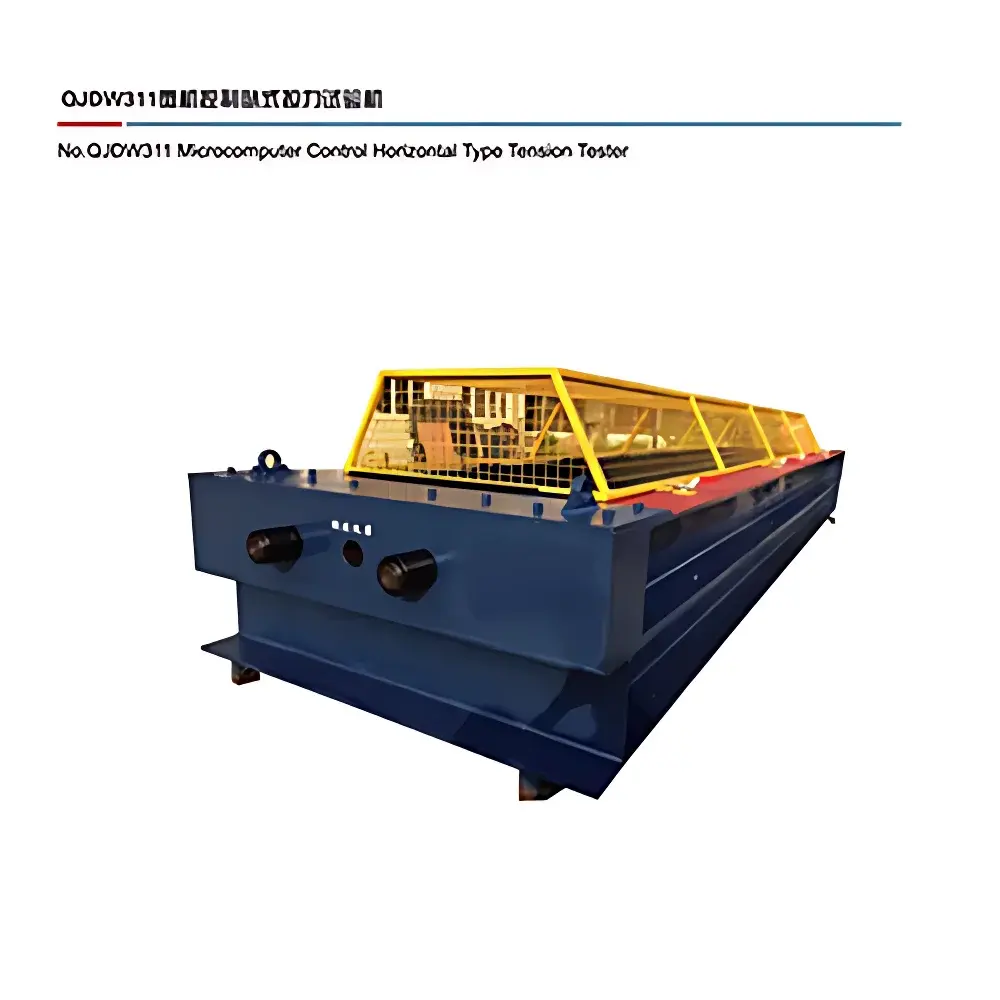
QJDW311-3000KN Hydraulic Horizontal Tensile Testing Machine
| Origin | Shanghai, China |
|---|---|
| Manufacturer Type | Authorized Distributor |
| Origin Category | Domestic (China) |
| Model | QJDW311 |
| Instrument Type | Hydraulic Tensile Testing Machine |
| Maximum Test Load | 3000 kN |
| Load Measurement Range | 4–100% of full scale |
| Load Accuracy Class | Class 1 (per ISO 7500-1 / ASTM E4) |
| Crosshead Speed Range | 0.01–50 mm/min (adjustable), up to 150 mm/min at no load |
| Test Stroke | 1500 mm |
| Displacement Resolution | 0.001 mm |
| Effective Test Length | 10 m |
| Internal Span Width | 800 mm |
| Total Machine Length | 17,000 mm |
| Power Supply | 7.5 kW |
| Machine Weight | ≈30,000 kg |
| Deformation Measurement Accuracy | ±1% of reading |
| Displacement Measurement Accuracy | ±0.5% of reading |
| Strain Rate Control Range | 0.001–0.1 s⁻¹ |
| Stress Rate Control Range | Up to 10 kN/s |
| Hold Stability | ±1% of set value for ≥60 min (force drift ≤4% FS within 30 s) |
Overview
The QJDW311-3000KN Hydraulic Horizontal Tensile Testing Machine is an industrial-grade, microprocessor-controlled static tensile testing system engineered for high-force mechanical characterization of elongated structural components under uniaxial loading. Designed in strict compliance with ISO 7500-1:2018 (metallic materials — calibration of force-proving instruments) and ASTM E4-23 (standard practices for force verification of testing machines), this horizontal configuration eliminates gravitational bending moments inherent in vertical setups—critical for evaluating long, flexible specimens such as wire ropes, anchor chains, fiber-optic cables, safety harnesses, and high-strength synthetic slings. The machine employs a dual-cylinder hydraulic actuation system with closed-loop electro-hydraulic servo control, enabling precise regulation of load, displacement, strain, and stress rates across the full 3000 kN capacity. Its 10-meter effective test length and 1500 mm stroke accommodate pre-tensioning, creep, and long-duration hold tests per ISO 6892-1 Annex D and ASTM A938. Structural rigidity is ensured by a monolithic welded steel frame rated for ≥30,000 kg operational mass, with thermal and vibration isolation features integrated into the foundation mounting design.
Key Features
- Class 1 load accuracy (≤±1% indication error) verified per ISO 7500-1, supported by high-stability hydraulic load cells calibrated traceably to national standards
- Full-scale 3000 kN capacity with 500,000-count internal resolution—no range switching required, maintaining consistent digitization across 4–100% FS
- Programmable multi-phase control modes: constant load, constant displacement rate (0.01–50 mm/min), constant strain rate (0.001–0.1 s⁻¹), and constant stress rate (up to 10 kN/s)
- Real-time digital feedback loop with ≤1% deviation from setpoint during 60+ minute sustained load holds; force drift limited to ≤4% FS over any 30-second interval
- Integrated high-resolution displacement measurement: 0.001 mm resolution, ±0.5% relative error, synchronized with load acquisition at ≥1 kHz sampling rate
- Dual-zone motion control: low-speed precision testing (0.01 mm/min) and rapid positioning (150 mm/min no-load speed) via adaptive pump pressure modulation
- Robust mechanical architecture: 17,000 mm total length, 800 mm internal span width, and 1640 mm × 820 mm base footprint optimized for anchoring on reinforced concrete foundations
Sample Compatibility & Compliance
The QJDW311 accommodates specimens up to 10 meters in active gauge length and ≥500 mm in diameter (with optional custom grips). Standard configurations support ASTM A391 (chain testing), ISO 17076 (rope breaking strength), IEC 61386 (conduit tensile resistance), and MIL-STD-1344 (cable pull-out verification). Grip systems include wedge-action hydraulic clamps (for metallic wires up to φ40 mm), serrated flat-face jaws (for webbing and textile slings), and adjustable U-bolt fixtures (for cable terminations). All mechanical interfaces conform to ISO 26203-2:2022 (tensile testing of high-strength materials) and support GLP-compliant audit trails when paired with validated software. The system meets CE machinery directive 2006/42/EC requirements and includes emergency stop circuits compliant with ISO 13850.
Software & Data Management
Control and analysis are executed via a Windows-based, bilingual (English/Chinese) application certified for 21 CFR Part 11 compliance—including electronic signatures, role-based access control, and immutable audit logs. The software supports automated sequence programming (e.g., preload → ramp → hold → relaxation → unload), real-time curve overlay (load vs. displacement, stress vs. strain), and localized zoom/pan for fracture onset analysis. Raw data export is available in ASCII, CSV, and XML formats compatible with MATLAB, Python (NumPy/Pandas), and LIMS integration. Calibration certificates—including sensor linearity, hysteresis, and repeatability—are stored digitally with time-stamped metadata. Firmware updates preserve backward compatibility with legacy test protocols and maintain ISO/IEC 17025 traceability documentation.
Applications
This system serves quality assurance laboratories, third-party certification bodies (e.g., DNV-GL, LR, BV), and R&D departments validating mechanical integrity across aerospace (fastener retention in composite airframes), marine (anchor chain proof testing per ISO 1704), energy (subsea umbilical cable qualification), and infrastructure (bridge cable anchor verification). It is routinely deployed for fatigue pre-conditioning per ISO 10204, creep rupture evaluation per ASTM E139, and dynamic preload simulation in offshore mooring systems. Its horizontal geometry enables direct coupling with extensometers for true strain measurement and facilitates in-situ environmental chamber integration (optional −40°C to +150°C).
FAQ
What international standards does the QJDW311 comply with for calibration and operation?
It conforms to ISO 7500-1:2018 (force calibration), ISO 5893:2016 (tensile testing machine verification), and ASTM E4-23. Load cell calibration is traceable to NIM (China) or NIST-equivalent national metrology institutes.
Can the system perform creep and stress-relaxation tests?
Yes—via programmable hold phases with continuous force monitoring and automatic compensation for hydraulic leakage, meeting ISO 899-1 requirements for thermoplastic creep testing.
Is remote diagnostics and firmware update supported?
Yes—the embedded controller supports secure TLS-encrypted remote access for troubleshooting and over-the-air firmware updates, subject to customer network policy approval.
What grip options are available for non-metallic specimens like aramid fiber ropes?
Customizable soft-jaw inserts (rubber-coated, polyurethane-lined, or segmented ceramic-faced) are available to prevent specimen slippage and surface damage during high-load testing.
Does the system meet regulatory requirements for pharmaceutical or medical device component validation?
While not GMP-certified out-of-box, the software platform supports 21 CFR Part 11 validation packages, IQ/OQ documentation templates, and audit-ready electronic records—enabling qualification for USP and ISO 13485 environments.



