
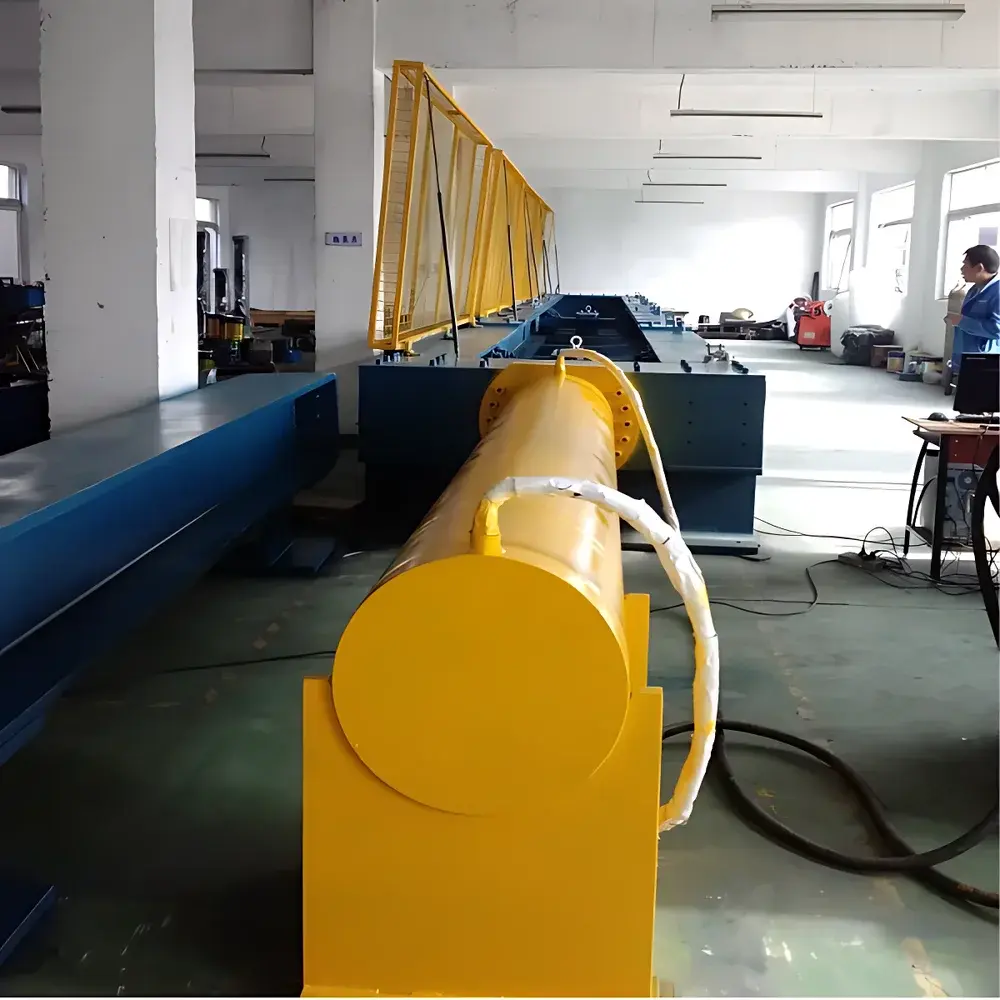
QJDW311 Horizontal Cable Tensile Testing Machine
| Origin | Shanghai, China |
|---|---|
| Manufacturer Type | Authorized Distributor |
| Origin Category | Domestic (PRC) |
| Model | QJDW311 |
| Quotation | USD 42,000 (FOB Shanghai) |
| Instrument Type | Hydraulic Tensile Testing Machine |
| Maximum Test Load | 3000 kN |
| Load Measurement Range | Customizable |
| Load Accuracy | ±0.5% of full scale |
| Stroke | Customizable |
| Displacement Resolution | ≤1% of full stroke |
Overview
The QJDW311 Horizontal Cable Tensile Testing Machine is a heavy-duty, floor-mounted hydraulic testing system engineered for high-capacity static tensile evaluation of elongated, flexible structural components. Unlike vertical tensile frames, its horizontal configuration accommodates specimens up to several meters in length—including marine anchor chains, high-voltage power cables, synthetic fiber ropes, steel wire ropes, and safety harness assemblies—without gravitational sag or alignment-induced bending moments. The machine operates on a closed-loop servo-hydraulic control architecture, delivering stable, programmable load application across the full 3000 kN capacity. It complies with fundamental mechanical testing principles defined in ISO 7500-1 (static calibration of force-proving instruments), ASTM E4 (load verification of testing machines), and ISO 6892-1 (tensile testing of metallic materials), while supporting method adaptation for non-metallic rope standards such as ISO 19693 (fibre ropes) and IEC 61196-1 (coaxial communication cables).
Key Features
- Horizontal loading axis minimizes lateral deflection and ensures axial force transmission for long, low-stiffness specimens.
- Hydraulic actuation system with dual-stage pressure regulation enables smooth, creep-controlled loading from 0.1% to 100% of full scale.
- High-strength welded steel frame with reinforced anchoring base designed for installation on reinforced concrete foundations (minimum 1.2 m depth).
- Load cell with 0.01% linearity and hysteresis, calibrated per ISO 376 Class 0.5 requirements, traceable to NIM (National Institute of Metrology, China).
- Integrated displacement measurement via linear variable differential transformer (LVDT) with resolution ≤1% of full stroke; optional extensometer interface available for strain-controlled tests.
- Full PC-based control and data acquisition system compliant with IEEE 12207 software lifecycle standards; supports user-defined test sequences, ramp-hold cycles, and break-point detection.
Sample Compatibility & Compliance
The QJDW311 is validated for use with specimens exhibiting diameters from 6 mm to 120 mm and lengths exceeding 15 m. Its modular grip system accepts wedge-type, swivel, and clevis configurations to accommodate round, stranded, and flat-profile geometries. Test protocols align with GB/T 228.1–2021 (metallic materials), ISO 12195:2022 (rope breaking strength), JIS Z 2241 (tensile testing methods), and EN 1492-1 (lifting accessories). All calibration records, uncertainty budgets, and verification reports are generated in accordance with ISO/IEC 17025:2017 requirements and support GLP-compliant laboratory audits.
Software & Data Management
The embedded Windows-based control software provides real-time visualization of load–displacement curves, automatic yield point identification (0.2% offset method), and calculation of tensile strength, elongation at break, and modulus of elasticity. Raw data export is supported in CSV, XML, and universal .tdms formats. Audit trail functionality meets FDA 21 CFR Part 11 requirements for electronic records, including operator login authentication, timestamped event logging, and immutable data archiving. Optional integration with LIMS platforms via OPC UA protocol enables automated result transfer to enterprise quality management systems.
Applications
- Verification of ultimate breaking strength and elongation behavior of submarine power cables under simulated seabed tension conditions.
- Qualification testing of offshore mooring chains per API RP 2SK and DNVGL-RP-0021 standards.
- Routine QA/QC for aerospace-grade aramid and UHMWPE safety tether assemblies.
- Research into stress–strain hysteresis and permanent set in hybrid composite cables used in wind turbine yaw systems.
- Third-party certification testing for ISO 9001:2015 and ISO/IEC 17025-accredited laboratories performing cable type approval.
FAQ
What is the standard foundation requirement for installing the QJDW311?
A minimum 1.2-meter-deep reinforced concrete plinth with M30 grade concrete and embedded anchor bolts is required to ensure static stability during peak-load operation.
Can the system be configured for cyclic loading or fatigue testing?
No—the QJDW311 is optimized for quasi-static tensile evaluation only; fatigue applications require dedicated servo-hydraulic fatigue testers with dynamic load reversal capability.
Is third-party calibration certification included with delivery?
Yes—each unit ships with an ISO/IEC 17025-accredited calibration certificate covering load, displacement, and timebase parameters, valid for 12 months from commissioning.
What maintenance intervals are recommended for hydraulic system integrity?
Hydraulic oil analysis and filter replacement every 1,500 operating hours; annual inspection of seal integrity, hose condition, and accumulator pre-charge pressure is advised.
Does the software support multi-language UI and report generation?
Yes—interface languages include English, German, French, Spanish, and simplified Chinese; report templates comply with ISO/IEC 17025 Annex A.2 formatting guidelines.



