
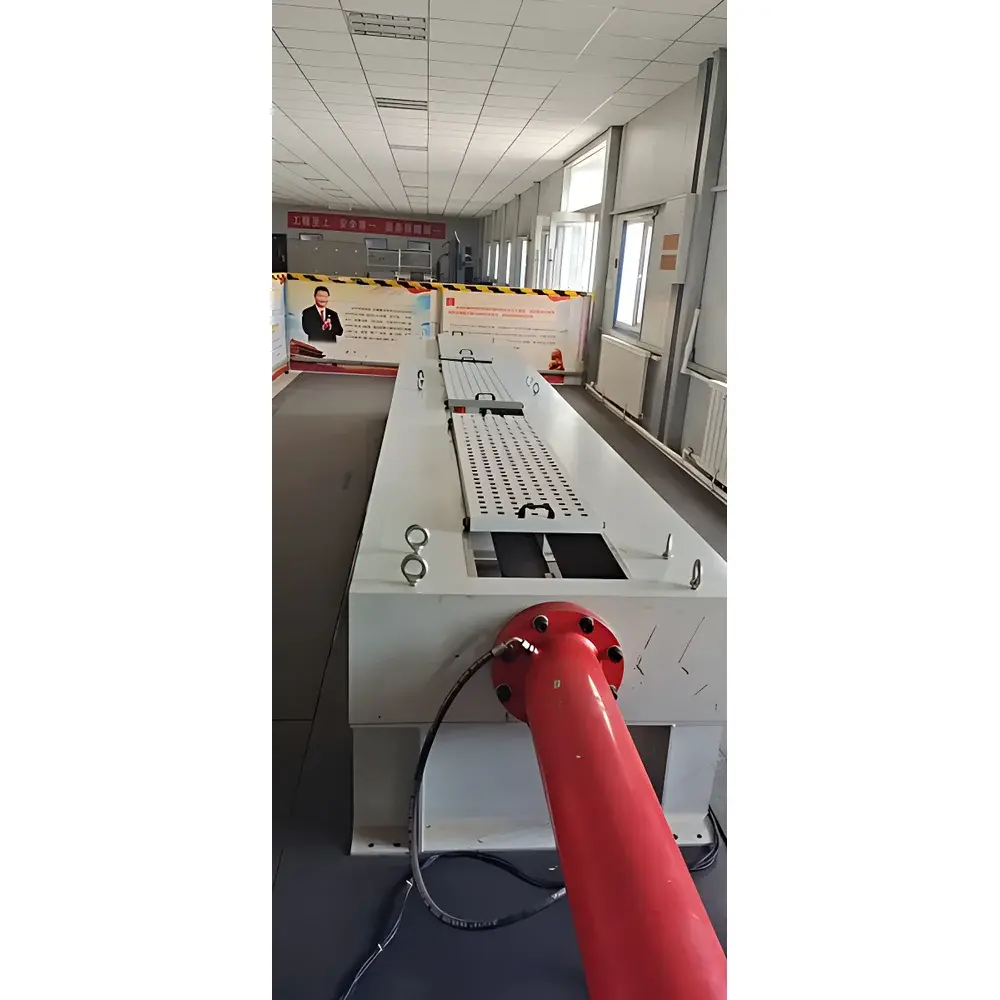
QJDW311 Horizontal Wire Rope Sling Tensile Testing Machine
| Origin | Shanghai, China |
|---|---|
| Manufacturer Type | Authorized Distributor |
| Origin Category | Domestic (China) |
| Model | QJDW311 |
| Quotation | USD 17,000 (FOB Shanghai) |
| Instrument Type | Hydraulic Tensile Testing Machine |
| Maximum Test Load | 2000 kN |
| Test Load Range | 40–2000 kN (full-scale) |
| Load Accuracy | ±0.5% FS |
| Crosshead Speed (Testing) | 0–80 mm/min |
| Crosshead Rapid Approach Speed | ≥200 mm/min |
| Displacement Resolution | 0.01 mm |
| Stroke | Customizable per client specification |
| Compliance | ASTM E4, ISO 7500-1, GB/T 228.1–2021 |
Overview
The QJDW311 Horizontal Wire Rope Sling Tensile Testing Machine is a heavy-duty, servo-controlled hydraulic testing system engineered for static tensile evaluation of high-strength flexible lifting components—including wire rope slings, alloy steel chains, synthetic webbing slings, and forged rigging hardware. Designed in strict accordance with the mechanical loading principles defined in ASTM E4 (Standard Practices for Force Verification of Testing Machines) and ISO 7500-1 (Metallic Materials – Calibration of Force-Testing Machines), this machine delivers traceable, repeatable force application under controlled displacement rates. Its horizontal configuration eliminates gravitational bending moments during axial loading—critical for maintaining pure uniaxial stress states in long, flexible specimens. The integrated oil-hydraulic actuation system ensures high-force stability at low speeds (down to 0.01 mm/min equivalent), while maintaining robust load-holding capability during creep or proof-load holding tests required by EN 1677-1, ASME B30.9, and ISO 4309.
Key Features
- Structural frame fabricated from high-tensile welded steel plates, designed for static rigidity and fatigue resistance under cyclic loads up to 2000 kN.
- Two-point clamping system: front fixed jaw with hydraulic wedge grip and rear manually adjustable jaw for precise specimen alignment and quick setup across variable test lengths.
- Dual-mode hydraulic power unit featuring low-noise gear pumps, temperature-regulated 80-L sealed reservoir, multi-stage filtration (β≥1000 at 3 µm), and real-time monitoring of oil temperature, level, and filter differential pressure.
- Digital dual-channel controller with synchronized analog-to-digital conversion (16-bit resolution), supporting closed-loop control of both load and displacement with independent PID tuning.
- Integrated safety architecture including emergency stop circuitry, mechanical overload limit switches, hydraulic pressure relief valves, and software-based load/position interlocks compliant with ISO 13857.
Sample Compatibility & Compliance
The QJDW311 accommodates specimens up to 12 m in length and 120 mm in nominal diameter, with customizable jaw inserts for round, flat, and eye-type terminations. It supports standardized test protocols for wire rope break testing (ISO 3154), chain tensile verification (ISO 15630-3), and synthetic sling qualification (EN 1492-1). All force measurement subsystems are calibrated per ISO/IEC 17025-accredited procedures, with certificate traceability to NIM (National Institute of Metrology, China) and optional UKAS endorsement. System validation documentation satisfies GLP audit requirements for third-party certification bodies conducting CE marking assessments under Machinery Directive 2006/42/EC.
Software & Data Management
Control and data acquisition are managed via proprietary WinTest Pro v4.2 software, running on an embedded industrial PC with Windows 10 IoT Enterprise OS. The interface provides real-time dual-axis plotting (load vs. displacement, load vs. time), automatic yield point detection per ISO 6892-1 Annex A, and programmable multi-step test sequences (e.g., preload → ramp → hold → unload). Raw data is stored in .tdms format with embedded metadata (operator ID, calibration date, environmental conditions), supporting 21 CFR Part 11-compliant electronic signatures and audit trail generation. Export options include CSV, PDF reports with digital signature fields, and XML for LIMS integration.
Applications
- Proof-load verification of lifting slings prior to field deployment (per OSHA 1926.251 and LOLER Regulation 9).
- Destructive tensile failure analysis of spliced or socketed wire ropes to validate termination integrity.
- Cyclic load testing of chain assemblies under simulated service conditions (e.g., 20,000-cycle endurance per ASTM A977).
- Creep behavior characterization of synthetic fiber slings at elevated temperatures (optional environmental chamber integration).
- Calibration transfer support for in-house metrology labs verifying portable load cells and dynamometers.
FAQ
What standards does the QJDW311 comply with for force calibration?
It conforms to ISO 7500-1 Class 0.5, ASTM E4 Class I, and GB/T 228.1–2021 Annex B for static force verification.
Can the machine perform constant-rate-of-travel (CRT) and constant-rate-of-loading (CRL) tests?
Yes—dual closed-loop control enables seamless switching between displacement-controlled and load-controlled modes without hardware reconfiguration.
Is remote diagnostics and firmware update supported?
Yes, via secure TLS 1.2-enabled Ethernet connection with authenticated VNC access and over-the-air update capability through encrypted firmware packages.
What is the typical lead time for custom stroke or jaw configuration?
Standard delivery is 12 weeks; extended stroke (>3 m) or specialized gripping solutions require additional engineering review and add 4–6 weeks.
Does the system include factory calibration documentation?
Yes—each unit ships with a full ISO/IEC 17025 calibration certificate covering load cell, displacement transducer, and pressure sensor, valid for 12 months from shipment date.



