
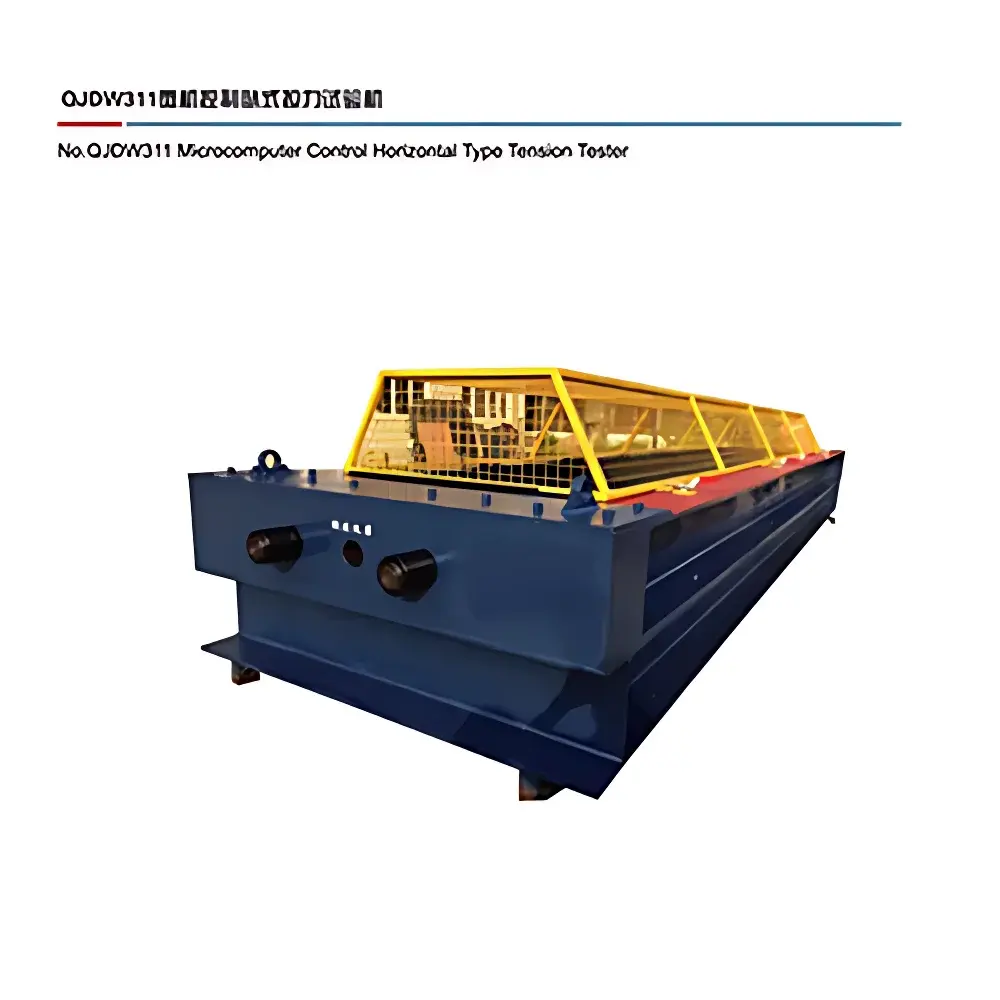
QJDW311 Static Horizontal Tensile Testing Machine
| Origin | Shanghai, China |
|---|---|
| Manufacturer Type | Authorized Distributor |
| Origin Category | Domestic (China) |
| Model | QJDW311 |
| Quotation | USD 17,000 (approx.) |
| Instrument Type | Hydraulic Tensile Testing Machine |
| Max Test Load | 3000 kN |
| Load Measurement Range | 4–100% of full scale |
| Load Accuracy | ≤ ±1% FS |
| Displacement Resolution | 0.001 mm |
| Displacement Accuracy | ±0.5% of reading |
| Crosshead Speed Range | 0.01–50 mm/min (programmable) |
| Maximum Stroke | 1500 mm |
| Effective Test Length | 10 m |
| Internal Span Width | 800 mm |
| Overall Machine Length | 17,000 mm |
| Power Supply | 7.5 kW |
| Machine Weight | ≈ 30,000 kg |
| Compliance | GB/T 228.1–2021, ISO 6892-1:2019, ASTM E8/E8M |
Overview
The QJDW311 Static Horizontal Tensile Testing Machine is a heavy-duty, electro-hydraulic servo-controlled system engineered for high-capacity static tensile evaluation of structural and safety-critical flexible components. Designed in strict accordance with GB/T 228.1–2021 (equivalent to ISO 6892-1:2019 and ASTM E8/E8M), it employs a dual-cylinder hydraulic actuation architecture with closed-loop force and displacement feedback to deliver stable, low-drift load application over extended durations — essential for creep, stress relaxation, and proof-load verification protocols. Its horizontal configuration accommodates specimens up to 10 meters in effective test length and 30,000 kg in total mass, making it suitable for full-scale qualification testing of marine mooring chains, aerospace cable assemblies, power transmission conductors, and civil engineering anchor systems where axial alignment, minimal bending moment, and long-stroke stability are non-negotiable.
Key Features
- High-force electro-hydraulic servo system delivering precise 3000 kN static load with ≤ ±1% full-scale accuracy and 500,000-count internal resolution — no range switching required across the entire capacity.
- Programmable crosshead speed from 0.01 mm/min (for slow-rate creep or yield characterization) to 50 mm/min (for rapid preloading), plus 150 mm/min no-load positioning speed for operational efficiency.
- Dual-mode control architecture supporting simultaneous or independent regulation of force, displacement, strain, and stress rate — each with ≤ ±1% setpoint deviation under sustained conditions.
- Integrated high-precision hydraulic load cell and linear variable differential transformer (LVDT)-based displacement transducer, both traceably calibrated to national metrological standards.
- Robust machine frame constructed from high-strength welded steel with 800 mm internal span width and 17,000 mm total footprint, ensuring torsional rigidity and minimal deflection during multi-ton loading.
- Real-time data acquisition at ≥ 100 Hz sampling rate, enabling accurate capture of transient yielding, necking, and fracture events without aliasing.
Sample Compatibility & Compliance
The QJDW311 accommodates a broad spectrum of high-strength flexible specimens including wire ropes (6×19, 6×37, 8×19 IWRC), synthetic fiber slings (PP, PET, HMPE), aircraft-grade safety webbing, submarine optical-electrical cables, offshore anchor chains (R3/R4 grade), and utility-grade ACSR conductors. Specimen gripping is implemented via hydraulically actuated wedge-type jaw systems with replaceable hardened inserts, configurable for flat, round, or oval cross-sections. All test procedures and reporting align with regulatory frameworks governing structural integrity verification: ISO 17025-accredited calibration paths, FDA-relevant documentation traceability (per 21 CFR Part 11 audit trail requirements for electronic records), and full compliance with GLP/GMP test execution workflows. Test reports include raw time-series data, annotated stress–strain curves, modulus calculation per ISO 527-1, and permanent elongation assessment per ASTM D412.
Software & Data Management
The system operates under a Windows-based, bilingual (English/Chinese) test control and analysis platform compliant with IEC 61508 functional safety principles. Software modules support automated test sequence scripting, real-time PID parameter tuning, multi-channel synchronized acquisition (load, displacement, extensometer if installed), and customizable report generation (PDF/Excel/XML). All data files are stored with embedded metadata: operator ID, calibration certificate IDs, environmental conditions (optional temperature/humidity input), and digital signatures. Audit trails record every user action—including parameter modification, test start/stop, and result export—with timestamped, non-erasable logs meeting ISO/IEC 17025 clause 7.7 and EU Annex 11 requirements for computerized system validation.
Applications
- Proof-load certification of lifting gear per EN 13889 and ASME B30.9.
- Long-term stress relaxation testing of aramid and UHMWPE fibers under constant 50–80% MBL conditions.
- Creep rupture evaluation of galvanized steel strands used in prestressed concrete bridges (AASHTO LRFD specifications).
- Failure mode analysis of hybrid composite cables subjected to combined tension-bending loads.
- Verification of breaking strength and elongation-at-break for Class 80 and Class 100 chain assemblies per ISO 1704.
- Calibration transfer for secondary force standards in national metrology institutes (NMI) and accredited calibration labs.
FAQ
What is the maximum specimen length this machine can accommodate?
The effective test length is 10 meters, with total machine length of 17 meters to allow for anchorage zones, load train integration, and safety clearances.
Does the system support extensometer integration for true strain measurement?
Yes — the control software includes dedicated analog and digital input channels for clip-on or non-contact extensometers (e.g., video-based DIC systems), enabling direct strain acquisition independent of crosshead displacement.
Is the test software compliant with 21 CFR Part 11 for regulated industries?
Yes — the software implements role-based access control, electronic signatures, and immutable audit trails for all critical operations, satisfying FDA requirements for electronic records and signatures.
Can the machine perform hold tests at constant load for durations exceeding 60 minutes?
Yes — the hydraulic pressure maintenance system supports indefinite load holding with drift < 0.2% FS/hour, validated per ISO 7500-1 Class 1 criteria.
What maintenance intervals are recommended for the hydraulic power unit?
Oil analysis and filter replacement are advised every 2,000 operating hours; full system recalibration is recommended annually or after any major component replacement.



