
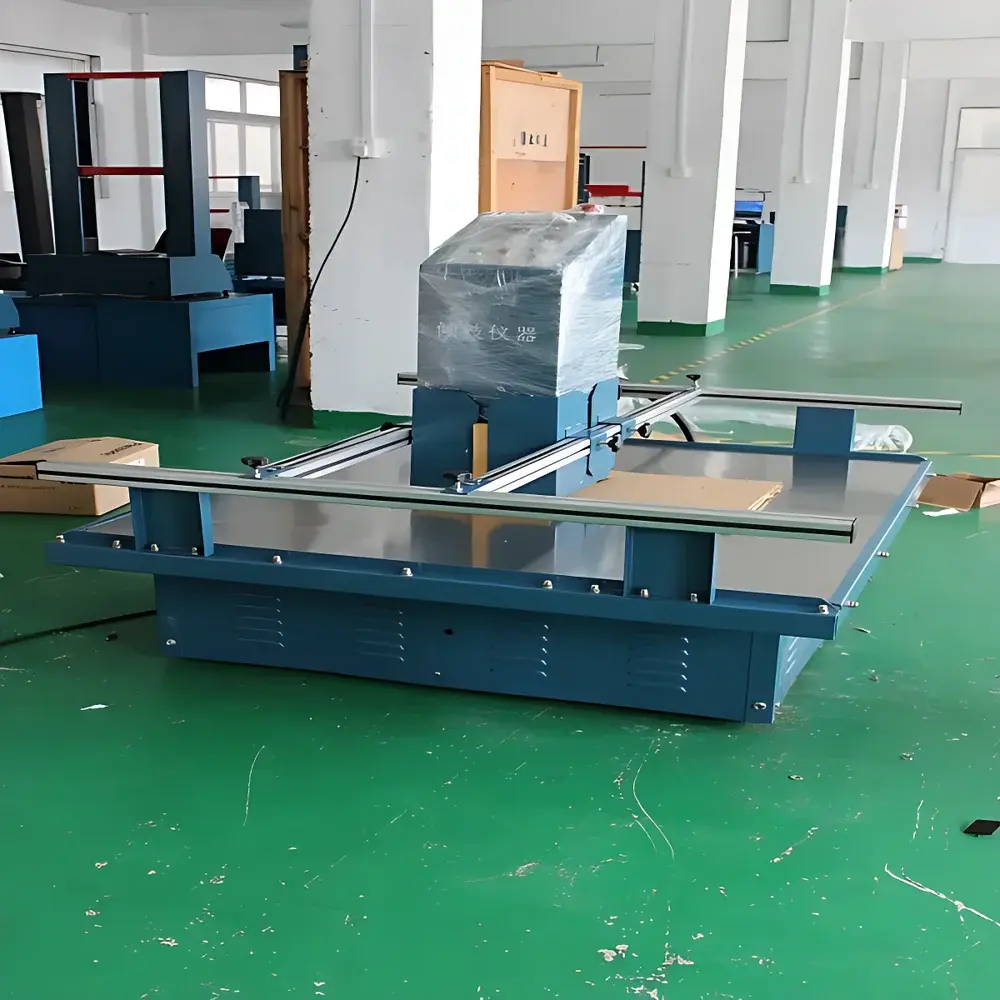
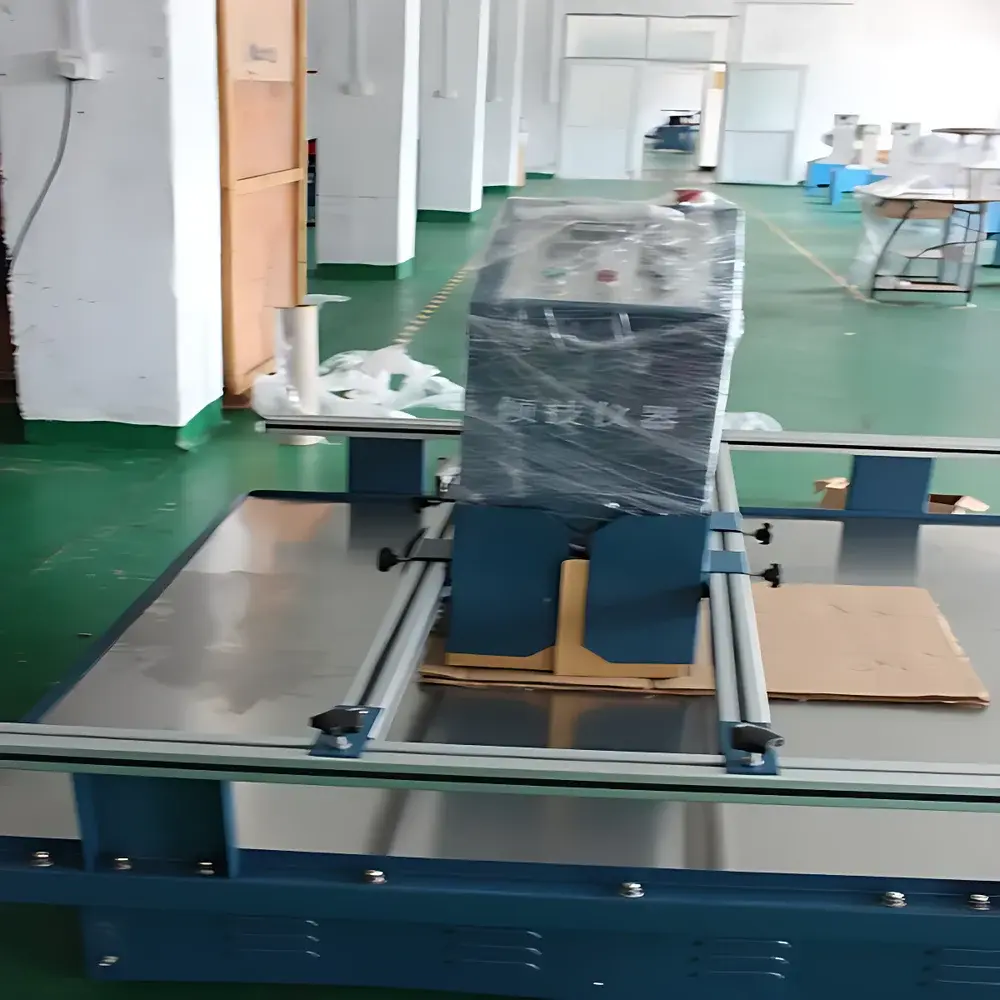
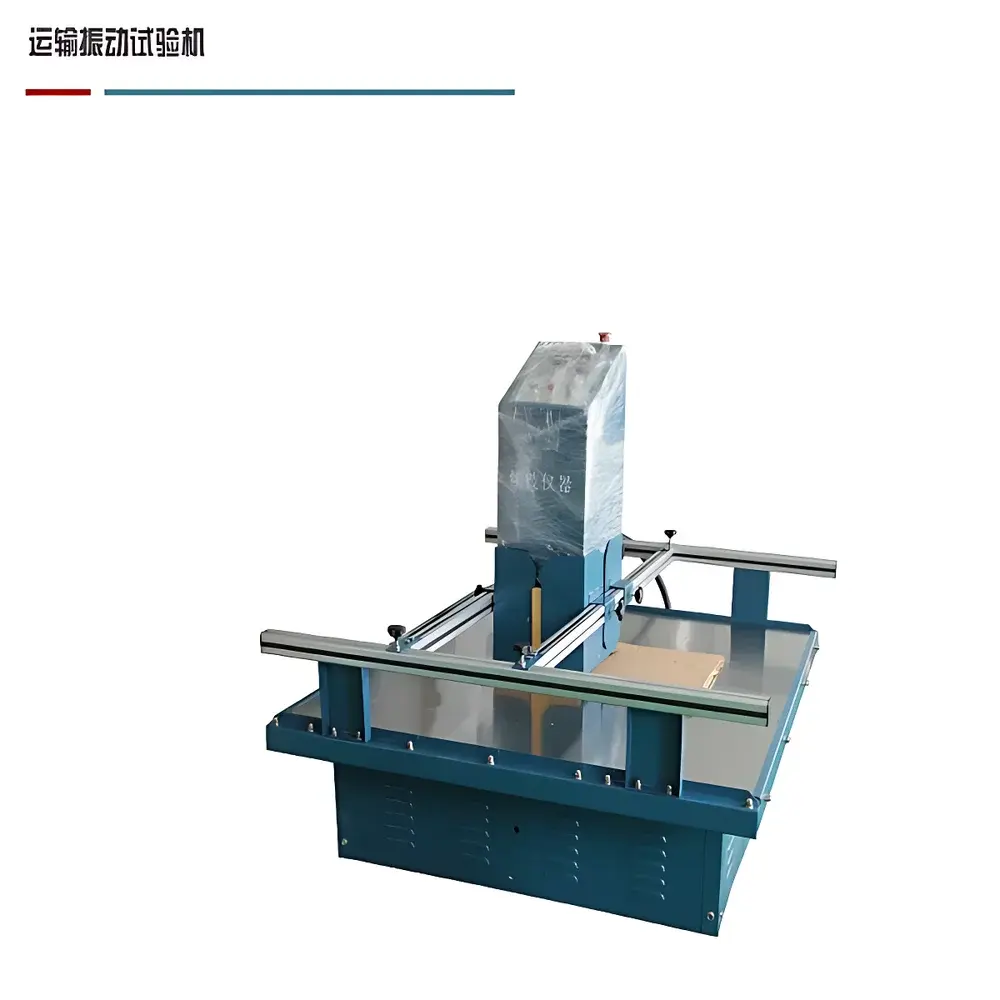
QJDZT-1 Transport Packaging Vibration Tester
| Origin | Shanghai, China |
|---|---|
| Manufacturer Type | Authorized Distributor |
| Origin Category | Domestic (PRC) |
| Model | QJDZT-1 |
| Price | USD 5,000 (approx.) |
| Instrument Type | Automotive Transport Simulation Shaker |
| Rated Frequency Range | 0.5–600 Hz |
| Maximum Test Load | 70 kg |
| Table Surface Dimensions | 500 × 500 mm (standard) |
| Maximum Acceleration | 20 g (peak, sine) |
| Vibration Axis | Vertical (Y-axis, up/down) |
| Control Modes | Standard P/W/T Series Profiles (ASTM D999, ISO 2247, ISTA 3A/3E compliant) |
| Waveform Options | Sine (half-wave or full-wave selectable) |
| Frequency Accuracy | ±0.1% of setpoint |
| Drive System | Electromagnetic shaker with closed-loop acceleration feedback |
Overview
The QJDZT-1 Transport Packaging Vibration Tester is an electromagnetically driven vertical-axis shaker engineered to replicate the dynamic mechanical stresses encountered during road, rail, and intermodal freight transport. It operates on the principle of controlled sinusoidal excitation—applying calibrated acceleration profiles across a defined frequency spectrum (0.5–600 Hz) to packaged goods mounted on its rigid 500 × 500 mm aluminum table. Unlike broadband random shakers, the QJDZT-1 specializes in deterministic sine sweep, dwell, and resonance search protocols mandated by international packaging validation standards including ASTM D999 (vibration testing of shipping containers), ISO 2247 (sinusoidal vibration of packaged products), and ISTA Procedure 3A (simulated truck transport). Its core function is not merely to induce motion, but to quantify package system integrity under repeatable, traceable boundary conditions—enabling early detection of structural fatigue, component loosening, cushioning degradation, or seal failure prior to field deployment.
Key Features
- Electromagnetic shaker architecture with integrated accelerometer feedback loop for real-time amplitude and frequency fidelity (±0.1% setpoint accuracy)
- Dual-channel independent control capability: supports simultaneous or sequential Y-axis excitation across two discrete load zones—ideal for comparative testing of multiple SKUs or layered pallet configurations
- Standardized profile library compliant with P-series (progressive sweep), W-series (resonance dwell), and T-series (transient shock simulation) per ASTM D999 Annex A
- Rigid, low-resonance table structure optimized for uniform transmissibility across 0.5–600 Hz; modal analysis confirms first bending mode >1,200 Hz
- Thermal management system ensures continuous operation at maximum rated acceleration (20 g peak sine) without derating
- Front-panel interface with tactile keypad and high-contrast LCD; optional RS-232/USB connectivity for remote parameter upload and test log export
Sample Compatibility & Compliance
The QJDZT-1 accommodates packaged units up to 70 kg mass and dimensions within 600 × 600 × 600 mm (L×W×H), with center-of-gravity height ≤300 mm above table surface. Fixturing uses standardized M6 threaded inserts (16 positions, 100-mm grid) compatible with industry-standard clamping brackets and load-spreading plates. All test protocols align with regulatory expectations for pre-shipment qualification: data records include timestamped frequency sweeps, dwell durations, acceleration spectra, and pass/fail annotations per ISO/IEC 17025 documentation requirements. The system supports audit-ready reporting for GLP-compliant environments and satisfies clause 5.2 of FDA Guidance for Industry: Container Closure Integrity Testing in Sterile Product Manufacturing.
Software & Data Management
While the base unit operates via embedded firmware, optional PC-based control software (QJ-VibControl v2.1) enables advanced test sequencing, waveform synthesis, and automated compliance reporting. Software features include: configurable sweep rates (oct/min), dwell hold logic with amplitude ramping, real-time FFT spectral monitoring, and CSV/Excel export of raw acceleration vs. time traces. All user actions—including parameter changes, start/stop commands, and calibration events—are logged with operator ID and timestamp, fulfilling 21 CFR Part 11 electronic record requirements when deployed with Windows domain authentication. Calibration certificates (traceable to NIM, China) are stored digitally alongside test archives.
Applications
- Validation of corrugated box compression strength and edge crush resistance under simulated trailer vibration
- Assessment of electronics enclosure fastener retention after extended 10–55 Hz resonance dwell cycles
- Verification of pharmaceutical secondary packaging integrity (cartons, shrink-wraps) per ISTA 3E for parcel delivery networks
- Structural fatigue screening of automotive instrument clusters subjected to 20–200 Hz road-induced harmonics
- Qualification of military-grade ruggedized enclosures against MIL-STD-810H Method 514.7, Tailored Vibration Profile (Transport Category)
- Root-cause analysis of adhesive bond failures in multi-material assemblies using resonant frequency shift tracking
FAQ
What standards does the QJDZT-1 directly support?
ASTM D999, ISO 2247, ISTA 3A, ISTA 3E, and MIL-STD-810H Method 514.7 (Transport Category). Custom profiles can be loaded via USB.
Is third-party calibration included with purchase?
Yes—a factory calibration certificate (NIM-traceable) is provided with initial delivery. Annual recalibration services are available through authorized service centers in APAC and EMEA.
Can the system perform resonance search and dwell tests?
Yes. The W-series control mode executes automatic resonance detection followed by programmable dwell duration at identified natural frequencies.
What is the maximum allowable center-of-gravity height for stable operation?
300 mm above the table surface for loads up to 70 kg. Higher CoG requires optional counterbalance fixtures.
Does the shaker meet electromagnetic compatibility (EMC) requirements for laboratory use?
Complies with IEC 61326-1:2013 Class B emissions and immunity specifications for industrial laboratories.
Related Products



