
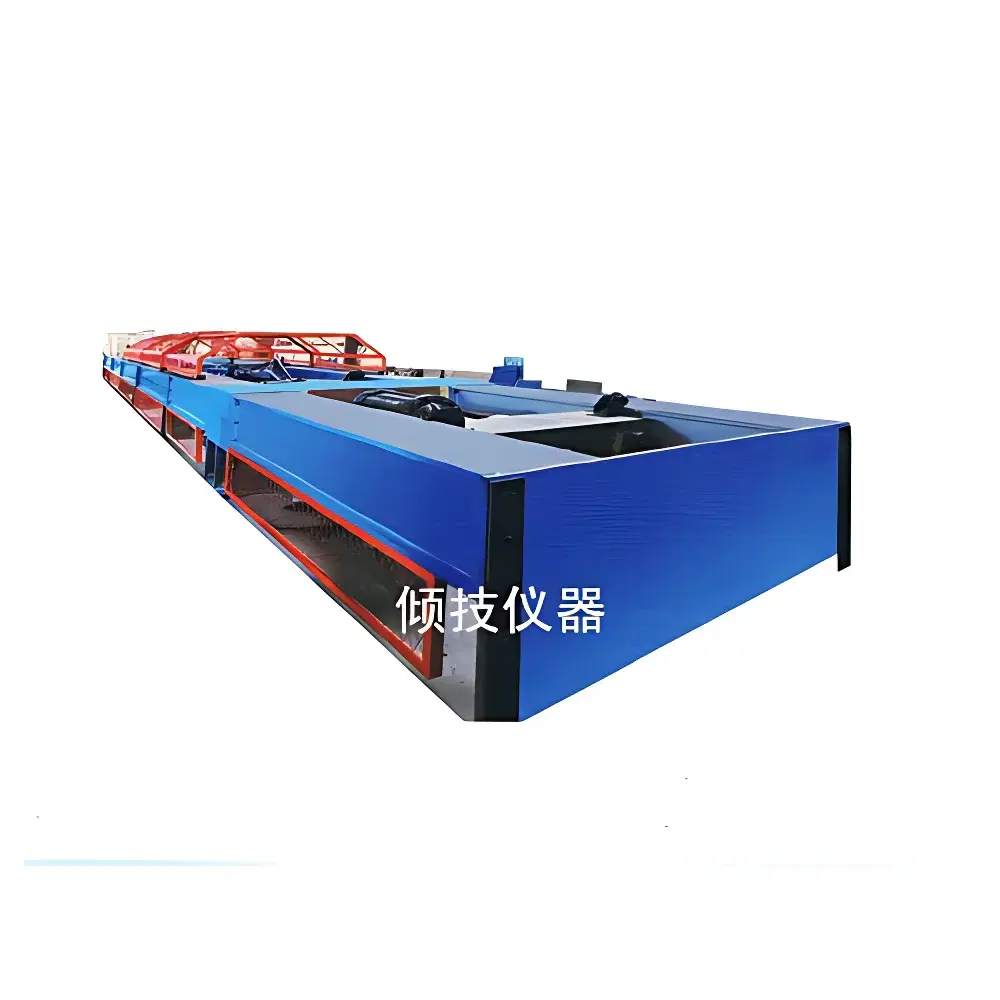
QJIT QJDW-311 Electro-Hydraulic Servo Horizontal Tensile Testing Machine
| Brand | QJIT |
|---|---|
| Model | QJDW-311 |
| Max Test Force | 5000 kN |
| Force Accuracy | ±0.5% of full scale |
| Stroke | 20,000 mm |
| Displacement Resolution | 0.1 mm |
| Compliance | ASTM E4, ISO 7500-1, GB/T 228.1, JIS Z 2241, DIN 50105 |
| Control System | Full PC-based electro-hydraulic servo control |
| Test Class | Class 1 (ISO 7500-1) |
| Repeatability | ≤1% |
| Displacement Accuracy | ≤1% |
| Strain Measurement Capability | Optional extensometer interface |
Overview
The QJIT QJDW-311 Electro-Hydraulic Servo Horizontal Tensile Testing Machine is an industrial-grade static mechanical testing system engineered for high-force, long-stroke tensile evaluation of elongated, flexible, and low-stiffness specimens. Unlike vertical frame configurations, its horizontal architecture eliminates gravitational sag effects and enables stable, unobstructed loading of specimens exceeding several meters in length—critical for optical fiber cables, submarine communication cables, geotextile membranes, high-strength synthetic ropes, and aerospace tether systems. The machine operates on a closed-loop electro-hydraulic servo principle: a high-bandwidth servo valve modulates hydraulic flow to a precision actuator, while real-time feedback from load cells, linear variable differential transformers (LVDTs), and optional clip-on or video extensometers ensures dynamic force and displacement regulation per ISO 7500-1 Class 1 requirements. Designed for integration into quality control laboratories and R&D facilities, the QJDW-311 delivers traceable, repeatable, and auditable test data under ambient environmental conditions.
Key Features
- Robust horizontal frame with reinforced steel base bed and guided crosshead assembly, rated for continuous operation at 5000 kN nominal capacity
- High-resolution hydraulic power unit featuring pressure-compensated servo valves, temperature-stabilized oil reservoir, and filtration compliant with ISO 4406:2017 (18/16/13)
- Dual-channel digital controller supporting simultaneous force, displacement, and strain (with extensometer) control modes—including ramp, hold, cyclic, and creep protocols
- Modular load cell system with factory-calibrated transducers offering ±0.5% full-scale accuracy and thermal drift compensation across 10–40 °C operating range
- 20,000 mm effective stroke accommodates specimen lengths up to 18 m, with programmable crosshead speed ranging from 0.001 to 200 mm/min (adjustable via software)
- Displacement measurement via high-linearity LVDT with 0.1 mm resolution and ≤1% linearity error over full stroke
- Compliance with mechanical safety standards: ISO 12100, EN 692, and CE Machinery Directive 2006/42/EC
Sample Compatibility & Compliance
The QJDW-311 is optimized for specimens requiring minimal bending moment during axial loading—particularly low-modulus, high-elongation materials such as optical fibers (ITU-T G.652/G.655), armored fiber optic cables, polymer-coated steel wire ropes, aramid yarns, and elastomeric mooring lines. Its horizontal orientation prevents buckling and ensures pure uniaxial stress state development. The system supports standardized gripping solutions including wedge-action pneumatic grips, hydraulic self-tightening jaws, and custom-designed fixtures for fragile or irregular cross-sections. All test procedures and reporting are fully aligned with international mechanical testing standards: ASTM E4 (force verification), ASTM E8/E21 (tensile properties of metallic materials), ISO 7500-1 (static calibration), ISO 527-1 (plastics), GB/T 228.1 (Chinese metallic materials standard), JIS Z 2241, and DIN 50105. Calibration certificates are NIST-traceable and include uncertainty budgets per ISO/IEC 17025.
Software & Data Management
The embedded Windows-based testing software provides ISO 17025-compliant data acquisition, real-time curve visualization (stress–strain, load–displacement, creep/time), and automated report generation in PDF and Excel formats. It supports multi-user role-based access control (administrator, operator, reviewer), electronic signatures, and full audit trail logging—including parameter changes, calibration events, and test interruptions—as required by FDA 21 CFR Part 11 and GLP/GMP environments. Raw data files are stored in open ASCII format with timestamped metadata (test ID, operator, environmental conditions, calibration status). Optional modules include fatigue analysis (S–N curve derivation), statistical process control (SPC) charting, and API integration for LIMS synchronization.
Applications
- Qualification testing of submarine fiber-optic cable assemblies per ITU-T L.92 and IEC 60794-4
- Tensile strength and elongation-at-break assessment of high-modulus polyethylene (HMPE) and ultra-high-molecular-weight polyethylene (UHMWPE) ropes used in marine and defense applications
- Proof loading and failure mode analysis of pre-stressed concrete tendons and FRP reinforcement bars
- Creep and stress-relaxation characterization of viscoelastic polymers under sustained load conditions (up to 1000 hours)
- Validation of splicing integrity and connector pull-out resistance in telecom infrastructure deployments
- R&D-level investigation of interfacial adhesion strength in composite cable structures (e.g., fiber–matrix debonding onset)
FAQ
What is the maximum certified test force for the QJDW-311, and can it be extended beyond 5000 kN?
The QJDW-311 is type-approved for 5000 kN static tensile loading per ISO 7500-1 Class 1. Custom configurations with higher-capacity actuators and reinforced frames are available upon engineering review—but require revalidation and recalibration.
Does the system support automatic calibration verification per ASTM E4?
Yes—the software includes guided calibration verification routines using certified reference load cells. Results are automatically logged with uncertainty values and compliance status against ASTM E4 Annex A1.
Can third-party extensometers be integrated for strain measurement?
The system provides analog and digital interfaces (LVDT, RS-422, and encoder inputs) compatible with major OEM extensometers, including MTS, ZwickRoell, and Instron models.
Is remote diagnostics and software update capability included?
Standard Ethernet connectivity enables secure remote access via TLS-encrypted VNC session for technical support, firmware updates, and configuration backup—subject to customer network policy approval.
What documentation is provided for regulatory audits?
Delivery includes full IQ/OQ documentation package, traceable calibration certificates, risk assessment (FMEA), and a 21 CFR Part 11 compliance statement with electronic signature validation protocol.



