
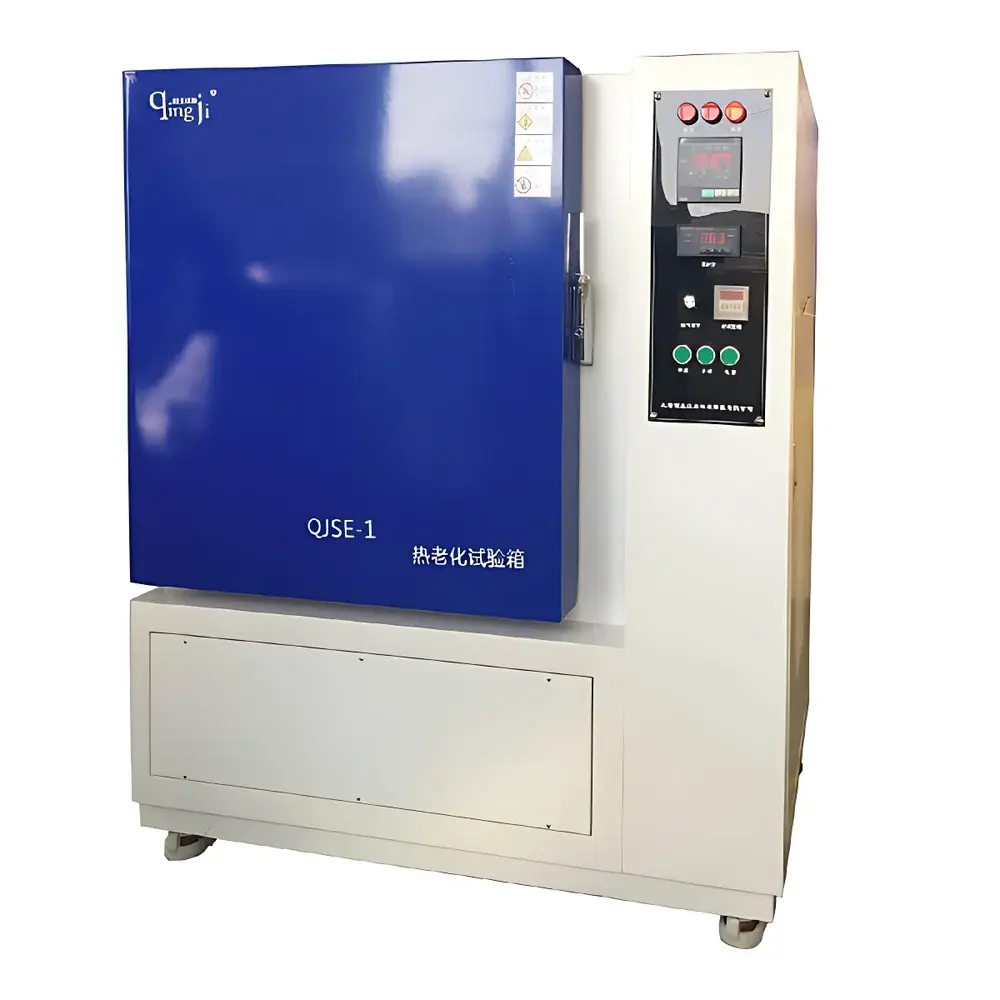
QJSE-1 Air-Circulating Thermal Aging Test Chamber
| Origin | Shanghai, China |
|---|---|
| Manufacturer Type | Authorized Distributor |
| Origin Category | Domestic (PRC) |
| Model | QJSE-1 |
| Price | USD 6,300 (FOB Shanghai) |
| Max Operating Temperature | 200 °C |
| Temperature Range | Ambient +20 °C to 300 °C |
| Temperature Uniformity | ±1.5 °C (at 200 °C, steady state) |
| Temperature Fluctuation | ≤±0.5 °C |
| Temperature Deviation | ≤±2 °C |
| Heating Rate | Ambient +20 °C to 200 °C in ≤60 min |
| Air Exchange Rate | 50 cycles/hour (adjustable via calibrated damper system) |
| Internal Chamber Dimensions (W×H×D) | Customizable per user specification |
| Total Power Consumption | 6.7 kW (Heating: 6 kW |
| Fan & Control | 0.7 kW) |
| Sound Pressure Level | ≤65 dB(A) at 1 m |
Overview
The QJSE-1 Air-Circulating Thermal Aging Test Chamber is an engineered environmental test system designed for accelerated thermal aging evaluation of polymeric materials, elastomers, thermoplastics, electrical insulation compounds, and cable sheathing systems. It operates on the principle of forced convection with precisely regulated air exchange—distinct from static oven-based aging—to replicate real-world oxidative degradation mechanisms under controlled, reproducible thermal stress. Unlike sealed chambers, the QJSE-1 maintains a continuous, metered inflow and exhaust of ambient air, enabling consistent oxygen replenishment critical for simulating long-term service life in atmospheric conditions. Its temperature control architecture integrates dual independent air circulation ducts, ensuring uniform thermal distribution across the entire working volume while minimizing stratification. The chamber complies with core international standards governing polymer aging performance, including IEC 60811-401 (formerly IEC 540) for electric cables and ISO 188:2017 for rubber—accelerated aging in air at elevated temperatures.
Key Features
- Forced-air dual-channel circulation system with independently adjustable inlet/outlet dampers to maintain precise air exchange rates (standard setting: 50 cycles/hour, range: 5–100 cycles/hour)
- Digital PID temperature controller with imported high-stability sensor (Pt100 Class A) and real-time deviation compensation algorithm
- Robust stainless-steel interior chamber (SUS304) with reinforced insulation (120 mm thick mineral fiber), minimizing thermal loss and improving energy efficiency
- Integrated over-temperature protection circuitry: independent mechanical thermostat + electronic cut-off + visual/audible alarm (red LED + buzzer)
- Front-access observation window with double-layer tempered glass and anti-fog heating film for uninterrupted sample monitoring
- Modular power distribution board supporting optional auxiliary loads (e.g., data loggers, humidity sensors, or external load banks)
Sample Compatibility & Compliance
The QJSE-1 accommodates standard test specimens defined in IEC 60811-401, ASTM D573, and ISO 188—including dumbbell-shaped tensile strips (Type 1 or 2), compression set specimens, and insulated wire segments mounted on ceramic or quartz mandrels. Its customizable internal dimensions support multi-tier sample racks and fixture integration for parallel testing of heterogeneous material batches. All operational parameters—including temperature setpoint accuracy, uniformity, and air exchange rate—are validated per ISO/IEC 17025-accredited procedures. The system meets essential requirements for GLP-compliant laboratories conducting aging studies referenced in UL 1581, CSA C22.2 No. 0.3, and EN 50363-1. Traceable calibration certificates (NIST-traceable Pt100 probes and airflow anemometers) are supplied with each unit.
Software & Data Management
While the base configuration features a standalone digital controller with local data logging (up to 10,000 timestamped records), optional RS485/Modbus RTU interface enables seamless integration into centralized laboratory information management systems (LIMS) or SCADA platforms. Third-party software packages (e.g., LabVIEW, MATLAB, or custom Python-based DAQ tools) can acquire real-time temperature profiles, cycle counts, and alarm events. Audit trail functionality—including operator ID tagging, parameter change logs, and firmware version tracking—is available when paired with compliant PC-based supervision software meeting FDA 21 CFR Part 11 requirements (electronic signatures, secure user roles, and immutable record retention).
Applications
- Accelerated aging of cross-linked polyethylene (XLPE), ethylene propylene rubber (EPR), and silicone insulation used in medium-voltage power cables
- Evaluation of thermal oxidative stability in automotive under-hood plastics (PP, PA66-GF, PBT) per SAE J2236 and ISO 20019
- Pre-qualification screening of flame-retardant additives in PVC formulations under DIN 53483-1
- Service life prediction modeling for photovoltaic encapsulants (EVA, POE) using Arrhenius extrapolation from 85 °C, 100 °C, and 120 °C aging datasets
- Quality assurance testing of medical-grade silicone tubing per ISO 10993-12 protocols for extractables and leachables assessment
FAQ
What standards does the QJSE-1 explicitly support for cable insulation testing?
IEC 60811-401 (electrical properties after aging), ISO 188:2017 (rubber aging), and ASTM D573 (rubber degradation in hot air).
Can the air exchange rate be calibrated and verified?
Yes—each unit includes a factory-calibrated hot-wire anemometer port and documented airflow verification procedure per ISO 12100 Annex E.
Is remote monitoring supported out-of-the-box?
Standard configuration supports local display and data logging only; Ethernet or Wi-Fi connectivity requires optional communication module (QJSE-1-ETH).
What maintenance intervals are recommended for sustained accuracy?
Biannual verification of temperature uniformity and air exchange rate is advised; annual recalibration of Pt100 sensors and airflow transducers is recommended per ISO/IEC 17025 guidelines.
Does the chamber meet CE or UKCA marking requirements?
Yes—the QJSE-1 conforms to EU Machinery Directive 2006/42/EC and Electromagnetic Compatibility Directive 2014/30/EU, with full technical documentation available upon request.



