
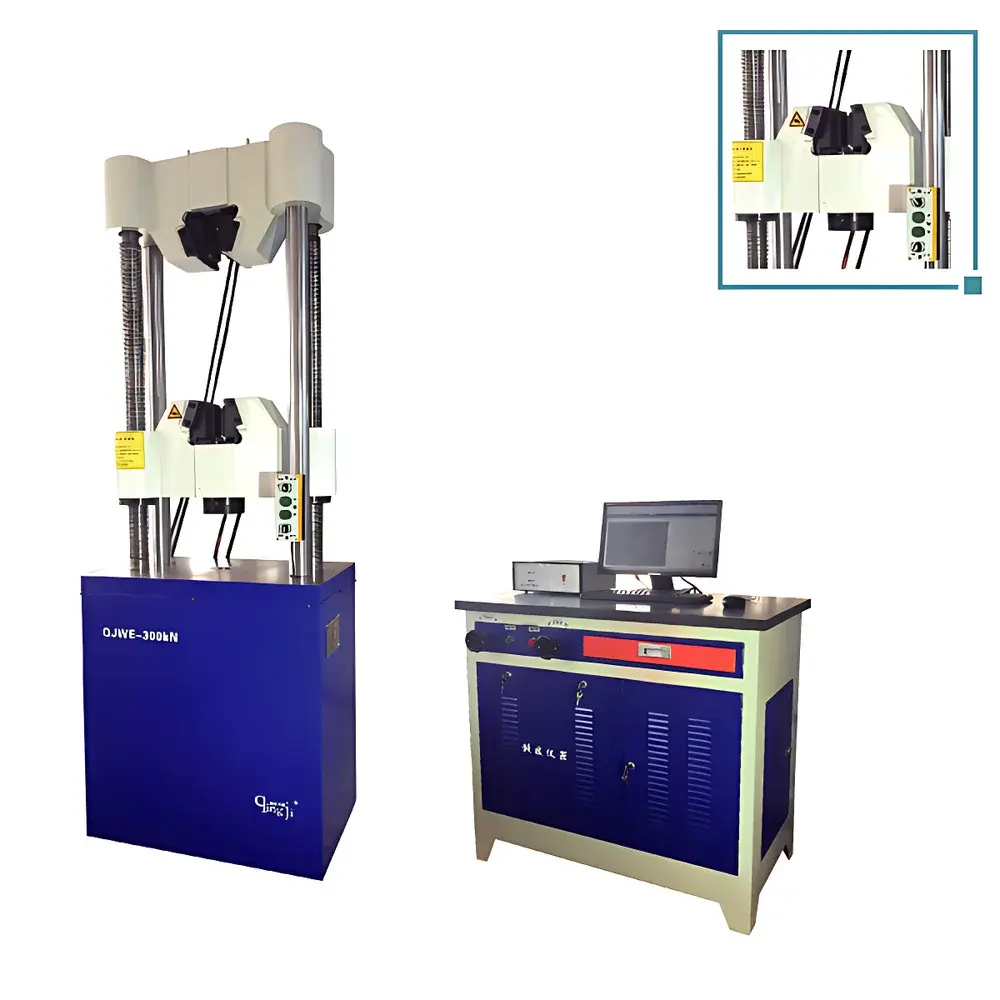
QJWE Series Electro-Hydraulic Servo Universal Testing Machine
| Origin | Shanghai, China |
|---|---|
| Manufacturer Type | Authorized Distributor |
| Origin Category | Domestic (China) |
| Model | QJWE Series |
| Price | USD 7,800 (approx.) |
| Instrument Type | Electro-Hydraulic Servo Testing Machine |
| Test Capacity Options | 50 kN, 100 kN, 300 kN, 600 kN, 1000 kN, 2000 kN |
| Accuracy | ±1% of full scale |
| Resolution | ≤0.5% of full scale |
| Compression Space | 550–700 mm |
| Tensile Space | 550–700 mm |
| Round Specimen Grip Range | φ6–12 mm to φ20–70 mm |
| Flat Specimen Grip Thickness | 0–15 mm to 0–40 mm |
| Piston Stroke | 200–250 mm |
| Bend Support Span | 400–1000 mm |
| Shear Specimen Diameter | φ10–φ30 mm |
| Dimensions (W×D×H) | 640×550×1800 mm to 1255×866×4700 mm |
| Motor Power | 1.5 kW or 3.25 kW, 3-phase |
| Machine Weight | 1200 kg to 6600 kg |
Overview
The QJWE Series Electro-Hydraulic Servo Universal Testing Machine is an industrial-grade static mechanical testing system engineered for high-precision tensile, compressive, flexural, and shear characterization of structural materials. Based on the principles of hydraulic force generation and closed-loop electro-hydraulic servo control, it delivers stable load application with programmable loading rates—from quasi-static to low-speed ramp profiles—enabling compliance with standardized mechanical test protocols including ASTM E4, ASTM E8/E8M, ISO 6892-1, ISO 7500-1, GB/T 228.1, and EN 10002-1. Designed specifically for reinforcing steel (deformed bar), the system integrates a lower-cylinder configuration with adjustable test zones, facilitating efficient specimen handling and alignment for both round and flat cross-sections commonly used in civil engineering and metallurgical quality assurance.
Key Features
- Electro-hydraulic servo architecture with proportional valve control, ensuring smooth, noise-reduced actuation and high reproducibility across repeated load cycles
- Imported high-accuracy load cells (±1% FS accuracy) and displacement transducers calibrated traceably to national metrology standards
- Digitally configurable test profiles—including constant rate of extension (CRE), constant rate of loading (CRL), and stress/strain-controlled ramps—via embedded real-time controller
- Adjustable test space: tensile and compression zones independently configurable from 550 mm to 700 mm, accommodating standard and extended-length specimens per ASTM A615/A615M and ISO 15630-1
- Dual-mode gripping system: interchangeable wedge-type clamps for round specimens (φ6–70 mm) and flat specimens (up to 40 mm thickness), each optimized for uniform stress distribution and minimal slippage
- Integrated bending fixture with variable support span (400–1000 mm) and standardized shear die sets (φ10–φ30 mm) compliant with ASTM A370 Annex A4 and ISO 8496
- Rugged cast-iron frame with reinforced base plate and precision-machined guide columns, minimizing parasitic deflection during high-capacity tests (up to 2000 kN)
Sample Compatibility & Compliance
The QJWE platform accommodates a broad spectrum of metallic and non-metallic specimens relevant to construction materials testing. Primary applications include hot-rolled deformed steel bars (HRB335, HRB400, HRB500 per GB/T 1499.2), welded wire mesh, prestressed strands, structural aluminum alloys, and cementitious composites such as concrete cylinders and mortar prisms. All configurations meet mechanical verification requirements defined in ISO 7500-1 Class 1 and ASTM E4 calibration standards. The machine’s structural design conforms to CE machinery directive 2006/42/EC safety principles, while data acquisition architecture supports audit-ready documentation aligned with GLP and ISO/IEC 17025 laboratory accreditation frameworks.
Software & Data Management
Control and analysis are executed via a Windows-based software suite featuring dual-mode operation: standalone local control or networked multi-station supervision. Real-time data acquisition captures load, displacement, and strain (when extensometer-equipped) at ≥100 Hz sampling rate. Dynamic curve plotting enables live monitoring of stress–strain, load–displacement, and time-history responses. Post-test functionality includes automated yield point detection (0.2% offset method), ultimate tensile strength (UTS), elongation at break, modulus calculation, and fracture energy integration. Export options support CSV, XML, and PDF report generation with customizable templates—fully compatible with LIMS integration and compliant with FDA 21 CFR Part 11 when configured with electronic signature and audit trail modules.
Applications
- Tensile testing of reinforcing steel bars per GB/T 228.1, ASTM A615, and ISO 6892-1 to determine yield strength, tensile strength, and total elongation
- Compression testing of concrete cubes and cylinders (150 × 150 × 150 mm or 150 mm diameter × 300 mm height) per GB/T 50081 and ASTM C39
- Three-point bending of reinforced concrete beams and steel plates per ASTM C78 and ISO 10543
- Shear testing of bolted connections and shear keys using standardized punch-and-die fixtures
- Quality conformance verification in precast plant laboratories, third-party inspection agencies, and national construction material testing centers
- Research-grade mechanical property mapping for new alloy development and composite reinforcement evaluation
FAQ
What standards does the QJWE Series comply with for reinforcing steel testing?
The system meets core mechanical testing standards including GB/T 228.1–2021, ASTM A615/A615M–22, ISO 6892–1:2019, and EN 10080 for reinforcing steels, with hardware and software validated per ISO 7500–1:2018 Class 1 accuracy requirements.
Can the machine be integrated into an existing laboratory information management system (LIMS)?
Yes—data export supports CSV, XML, and ODBC-compliant database interfaces; optional API modules enable bidirectional communication with major LIMS platforms under ISO/IEC 17025-aligned workflows.
Is extensometer support available for strain measurement?
Standard configurations accept clip-on or video-based extensometers (e.g., 25 mm or 50 mm gauge length); compatibility is verified per ISO 9513:2012 for Class 1 strain measurement accuracy.
What maintenance intervals are recommended for hydraulic components?
Hydraulic oil replacement is advised every 2,000 operating hours or biannually; filter elements require inspection quarterly; annual calibration of load cell and displacement sensor is recommended for accredited use.
Does the system support remote diagnostics and firmware updates?
Remote access is enabled via secure VPN connection; firmware upgrades and controller parameter backups are performed through authenticated client software with version-controlled change logs.



