
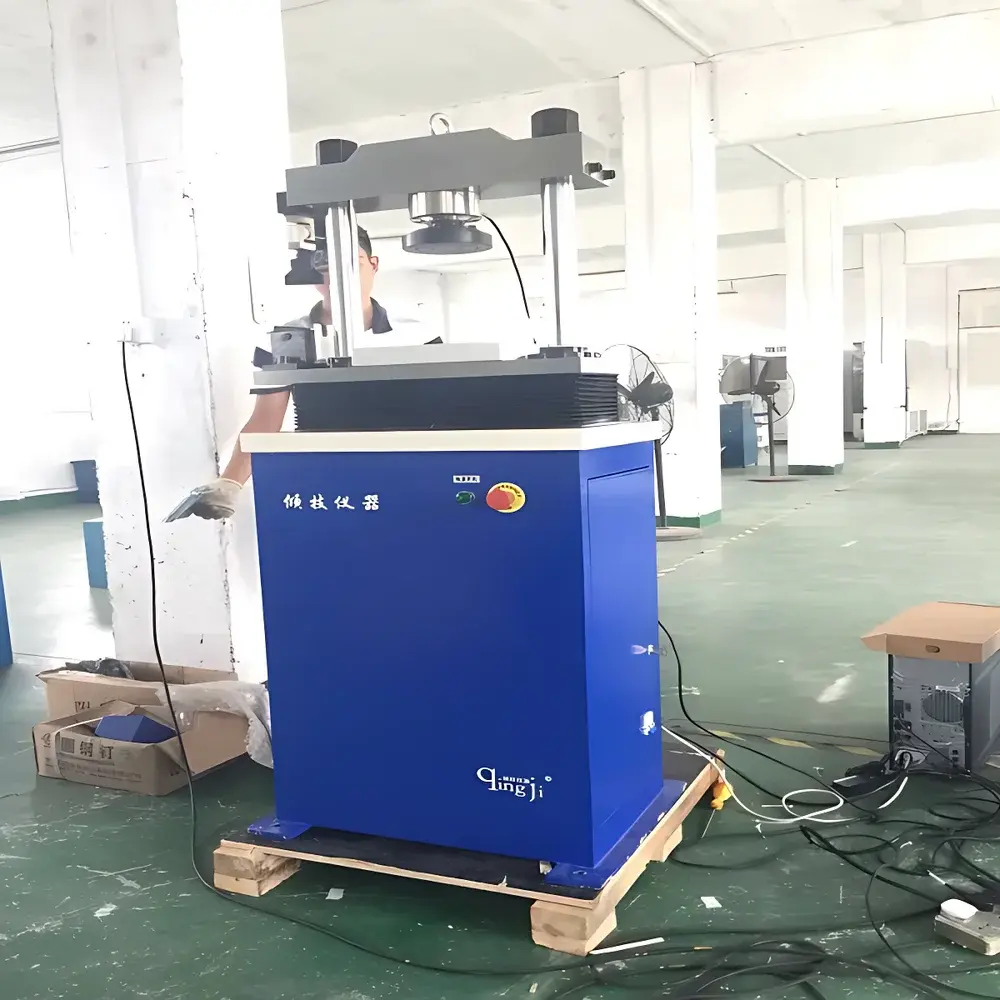
QJYL872 Microcomputer-Controlled Electronic Compression Testing Machine
| Origin | Shanghai, China |
|---|---|
| Manufacturer Type | Authorized Distributor |
| Origin Category | Domestic (PRC) |
| Model | QJYL872 |
| Price | USD 4,200 (FOB Shanghai) |
| Maximum Test Force | 300 kN |
| Force Loading Rate | 0–10 kN/s |
| Platen Spacing | Customizable |
| Platen Dimensions | Customizable |
| Flexural Test Capacity | 10 kN |
| Flexural Loading Rate | 0–0.075 kN/s |
| Relative Indication Error | ±1.0% |
| Compliance Standards | GB/T 17671–1999, GB 13544–2000, GB/T 50081–2002 |
Overview
The QJYL872 Microcomputer-Controlled Electronic Compression Testing Machine is a high-precision, servo-controlled electromechanical system engineered for standardized uniaxial compression and three-point flexural testing of construction materials. It operates on closed-loop force feedback control, utilizing a precision load cell and high-resolution displacement transducer to deliver repeatable, traceable mechanical property data in accordance with international and national material testing protocols. Designed specifically for quality assurance laboratories in cement manufacturing, civil engineering inspection agencies, building materials R&D centers, and academic institutions, the QJYL872 meets the fundamental mechanical testing requirements defined by ISO 679 (cement strength), ISO 7030 (brick compressive strength), and ASTM C109/C348 where applicable via method adaptation. Its modular architecture supports both compression and flexure modes without mechanical reconfiguration—enabling rapid transition between cement mortar cube testing (per GB/T 17671–1999), concrete cylinder evaluation (per GB/T 50081–2002), and clay brick validation (per GB 13544–2000).
Key Features
- Servo-motor-driven loading system with real-time force-rate control (0–10 kN/s for compression; 0–0.075 kN/s for flexure), ensuring compliance with dynamic rate specifications in multiple standards.
- Dual-range load measurement: full-scale 300 kN for compression, 10 kN for flexural testing—both calibrated to Class 1 accuracy per ISO 7500-1.
- Microcomputer-based control unit with embedded Windows CE OS, supporting programmable test sequences, automatic peak detection, and digital load–displacement curve acquisition at ≥100 Hz sampling rate.
- Modular platen interface accommodating custom platen dimensions and spacing—optimized for standard 40×40×160 mm cement prisms, 150×150×150 mm concrete cubes, or non-standard structural specimens.
- Integrated safety interlocks including overload cutoff, emergency stop circuit, and mechanical limit switches compliant with IEC 60204-1.
- Force indication error ≤ ±1.0% of full scale across the entire operating range, verified per GB/T 2611–2007 and traceable to NIM (National Institute of Metrology, China) certified reference standards.
Sample Compatibility & Compliance
The QJYL872 accommodates rigid, quasi-brittle, and ductile specimens up to 300 kN ultimate load capacity—including Portland cement mortars, fired clay bricks, autoclaved aerated concrete (AAC), precast concrete elements, metallic compression coupons, and polymer-modified tile adhesives. All test routines adhere strictly to the procedural constraints of GB/T 17671–1999 (cement strength), GB 13544–2000 (burnt clay bricks), and GB/T 50081–2002 (concrete mechanical properties). Optional accessories extend functionality to splitting tensile tests (ASTM C496), modulus of elasticity determination (GB/T 50081–2002 Annex B), and post-peak softening characterization. The system is fully compatible with GLP-compliant documentation workflows when paired with validated software modules.
Software & Data Management
The embedded control software provides ISO/IEC 17025-aligned test execution, including user-defined test templates, electronic signature support, audit trail logging (with timestamped operator ID and parameter changes), and export of raw data in CSV and XML formats. Data files include force–displacement curves, peak load values, modulus calculations, and pass/fail status against preset acceptance criteria. Software validation documentation—including IQ/OQ protocols and 21 CFR Part 11 readiness assessment—is available upon request for regulated environments. All firmware updates are delivered via secure USB interface with version-controlled release notes.
Applications
- Cementitious materials: compressive strength of OPC, slag-blended, and pozzolanic mortars per GB/T 17671–1999.
- Masonry units: compressive performance verification of solid/hollow bricks, concrete blocks, and pavers per GB 13544–2000 and GB/T 21144–2007.
- Structural concretes: cube/cylinder strength grading, early-age strength monitoring, and mix-design validation per GB/T 50081–2002.
- Quality control in precast plants: routine compression checks on beams, columns, and cladding panels.
- Academic research: stress–strain behavior analysis, fracture energy quantification, and creep-compression coupling studies under controlled loading rates.
FAQ
Does the QJYL872 comply with ISO 7500-1 calibration requirements?
Yes—the load cell and signal conditioning chain are factory-calibrated to Class 1 accuracy per ISO 7500-1, with certificate of calibration included.
Can the system be integrated into a LIMS environment?
Yes—CSV and XML data exports support direct ingestion into most laboratory information management systems; API integration is available via optional middleware module.
Is third-party certification (e.g., CNAS) supported for metrological validation?
Yes—full technical documentation, uncertainty budgets, and traceability statements are provided to facilitate CNAS or equivalent accreditation audits.
What maintenance intervals are recommended for long-term accuracy retention?
Annual recalibration of the load cell and displacement sensor is recommended; preventive maintenance (lubrication, alignment check, electrical continuity test) every 6 months ensures optimal repeatability.
Are test reports generated in bilingual (Chinese/English) format?
Yes—the software supports dual-language report templates, with configurable headers, footers, and compliance statement fields per regional regulatory needs.



