
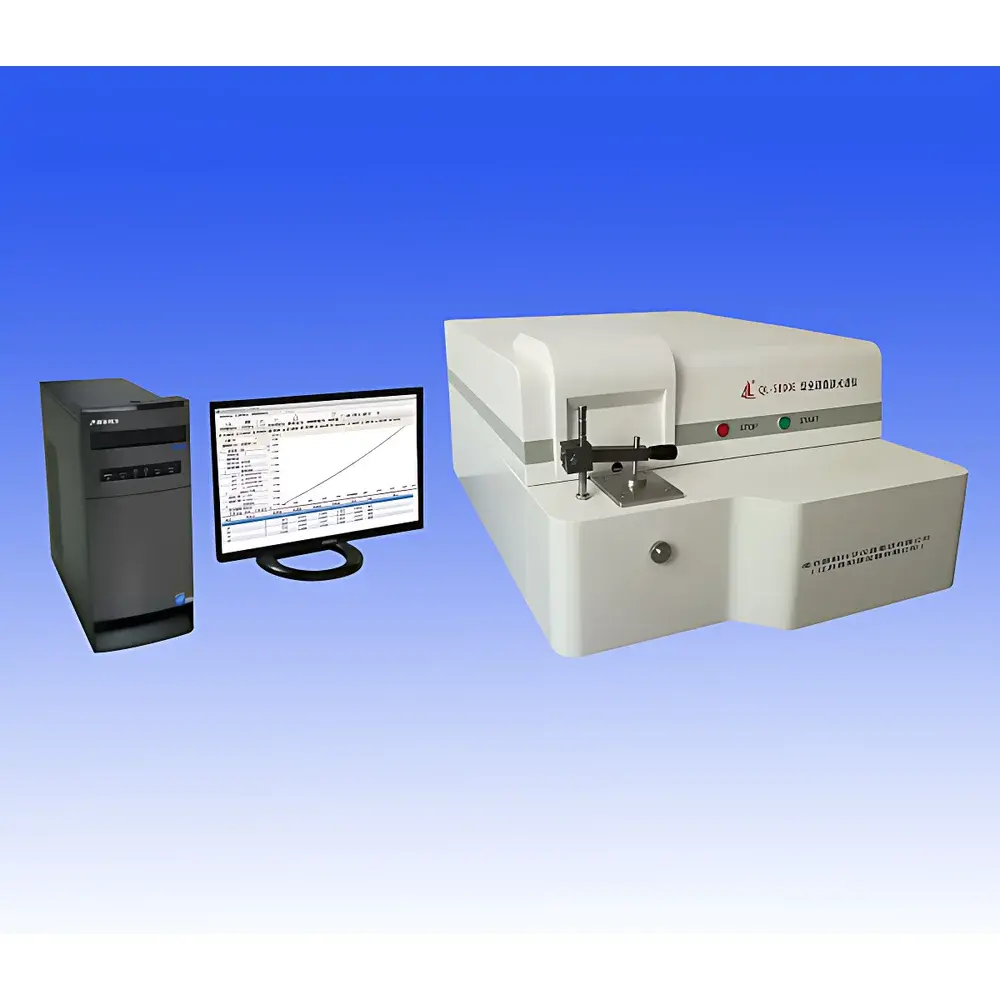
QL-5800E Benchtop Full-Spectrum Direct-Reading Optical Emission Spectrometer (OES)
| Brand | Qilin (QL) |
|---|---|
| Model | QL-5800E |
| Instrument Type | Benchtop OES |
| Excitation Source | Spark Discharge |
| Detector | CCD Array |
| Focal Length | 401 mm |
| Grating Groove Density | 2400 lines/mm |
| Wavelength Range | 140–680 nm |
| Number of Detection Channels | 60 |
| Optical System | Paschen–Runge Mount with Vacuum-Enclosed Roland Circle |
| Base Materials Supported | Fe, Cu, Al, Ni, Co, Mg, Ti, Zn, Pb, Sn, Ag |
| Analysis Time | ~20 s per sample |
| Dimensions | 780 × 565 × 360 mm |
| Weight | 78 kg |
| Power Supply | AC 220 V, 50/60 Hz, 1000 W |
Overview
The QL-5800E Benchtop Full-Spectrum Direct-Reading Optical Emission Spectrometer is a high-performance spark-source optical emission spectrometer engineered for precise, rapid elemental analysis of metallic alloys in laboratory and production environments. Based on the Paschen–Runge optical configuration with a vacuum-sealed Roland circle design, it delivers high spectral resolution and photometric stability across its full wavelength range of 140–680 nm. The instrument utilizes spark discharge excitation in an argon-purged environment to generate atomic and ionic emission lines from solid metal samples. Emitted light is dispersed by a 2400 lines/mm holographic grating (focal length: 401 mm) and simultaneously captured by a high-sensitivity CCD array detector—enabling true full-spectrum acquisition without mechanical scanning. This architecture supports quantitative determination of major, minor, and trace elements—including critical non-metals such as C, P, S, N, B, and As—in ferrous and non-ferrous matrices. Designed for long-term operational stability, the system integrates real-time environmental monitoring (vacuum level, optical chamber temperature, argon pressure) and automatic optical alignment routines to maintain calibration integrity over extended service intervals.
Key Features
- Full-spectrum CCD detection with pixel-level data acquisition enables simultaneous multi-element analysis without sequential channel switching or hardware reconfiguration.
- Digital high-energy pre-spark (HEPS) source provides stable, reproducible plasma excitation; discharge frequency adjustable from 100–1000 Hz to optimize signal-to-noise for diverse alloy types.
- Vacuum optical chamber with multi-stage oil-backstream prevention: integrated vacuum differential valve and inline oil trap ensure CMOS/CCD detector longevity and spectral fidelity.
- Modular argon gas management system replaces traditional solenoid valves and rotameters; includes electrode self-purge function and optimized laminar flow design to reduce argon consumption by up to 40% versus conventional systems.
- Open-style spark stand with adjustable sample clamping mechanism accommodates irregular geometries, rods ≥3 mm diameter, and flat specimens up to 40 mm thickness; tungsten jet-stream electrode maintains localized inert atmosphere during ablation.
- Plug-in lens assembly allows rapid optical window cleaning without breaking vacuum—minimizing downtime and eliminating risk of misalignment during maintenance.
- Ethernet-based TCP/IP communication ensures electromagnetic immunity and future-proof connectivity; supports remote diagnostics, firmware updates, and centralized fleet monitoring via standard industrial networks.
Sample Compatibility & Compliance
The QL-5800E is validated for direct solid-sample analysis across 11 primary base materials: iron, copper, aluminum, nickel, cobalt, magnesium, titanium, zinc, lead, tin, and silver. It complies with core analytical standards including ASTM E415 (steel), ASTM E1086 (stainless steel), ASTM E1991 (aluminum), ISO 11573 (copper alloys), and GB/T 4336 (Chinese national standard for carbon steel). Its vacuum optical path meets ISO 8596 requirements for stray-light suppression (<0.001% at 200 nm), while software audit trails, user access control, and electronic signature support align with FDA 21 CFR Part 11 and GLP/GMP documentation frameworks. All factory-preloaded calibration curves are traceable to NIST SRM reference materials and certified by third-party metrology labs.
Software & Data Management
The QL-5800E operates under Qilin’s proprietary OES-Studio v4.x platform, a dual-language (English/Chinese), Windows 10–compatible application built on a modular architecture. It features automated spectral line identification, dynamic background correction, matrix-matched interference correction algorithms, and multivariate regression quantification models. Data handling conforms to ASTM E1382 guidelines for analytical result reporting: all measurements include uncertainty estimates, detection limits (3σ), and repeatability statistics (RSD ≤1.2% for major elements). Raw spectral data is stored in HDF5 format with embedded metadata (instrument ID, operator, timestamp, environmental logs); export options include CSV, XML, PDF reports, and LIMS-compatible ASTM E1382-compliant ASCII files. Software supports role-based permissions, change history logging, and optional 21 CFR Part 11 compliance modules with electronic signatures and audit trail review.
Applications
The QL-5800E serves quality control laboratories in foundries, metallurgical R&D centers, aerospace component manufacturers, power generation equipment suppliers, and scrap metal recyclers. Typical use cases include incoming raw material verification (e.g., verifying grade compliance of stainless steel billets per UNS S30400), melt process control (real-time monitoring of Mn, Cr, Ni in continuous casting), failure analysis (detection of interstitial contaminants like oxygen or hydrogen-induced embrittlement markers), and regulatory conformance testing (RoHS-compliant Pb/Cd/Hg screening in brass fittings). Its ability to quantify low-Z elements in aluminum die-castings (e.g., 0.002 wt% Ca in A380) and nitrogen in superalloys (e.g., Inconel 718) makes it suitable for advanced materials development where compositional tolerances fall below ±0.01%.
FAQ
What base materials does the QL-5800E support out-of-the-box?
The instrument ships with pre-calibrated analytical programs for Fe, Al, Cu, Ni, Co, Mg, Ti, Zn, Pb, Sn, and Ag matrices. Additional base materials can be added via optional calibration kits without hardware modification.
Is vacuum pump maintenance required regularly?
Yes—oil-based rotary vane pumps require oil changes every 500 operating hours; however, the integrated oil trap extends service intervals and prevents contamination of the optical chamber.
Can the system analyze coated or plated samples?
Surface coatings must be removed prior to analysis; the spark erosion depth is ~50–100 µm per measurement, and heterogeneous layers will compromise accuracy unless homogenized by grinding or milling.
How is spectral drift compensated during extended operation?
The system performs automatic pixel mapping calibration every 4 hours or after thermal equilibrium is reached; reference lines (e.g., Fe II 238.204 nm) are used to compute real-time pixel offset corrections.
Does the software support custom method development?
Yes—users may define new calibration curves using certified reference materials, configure custom interference corrections, and assign unique report templates per customer requirement.





