
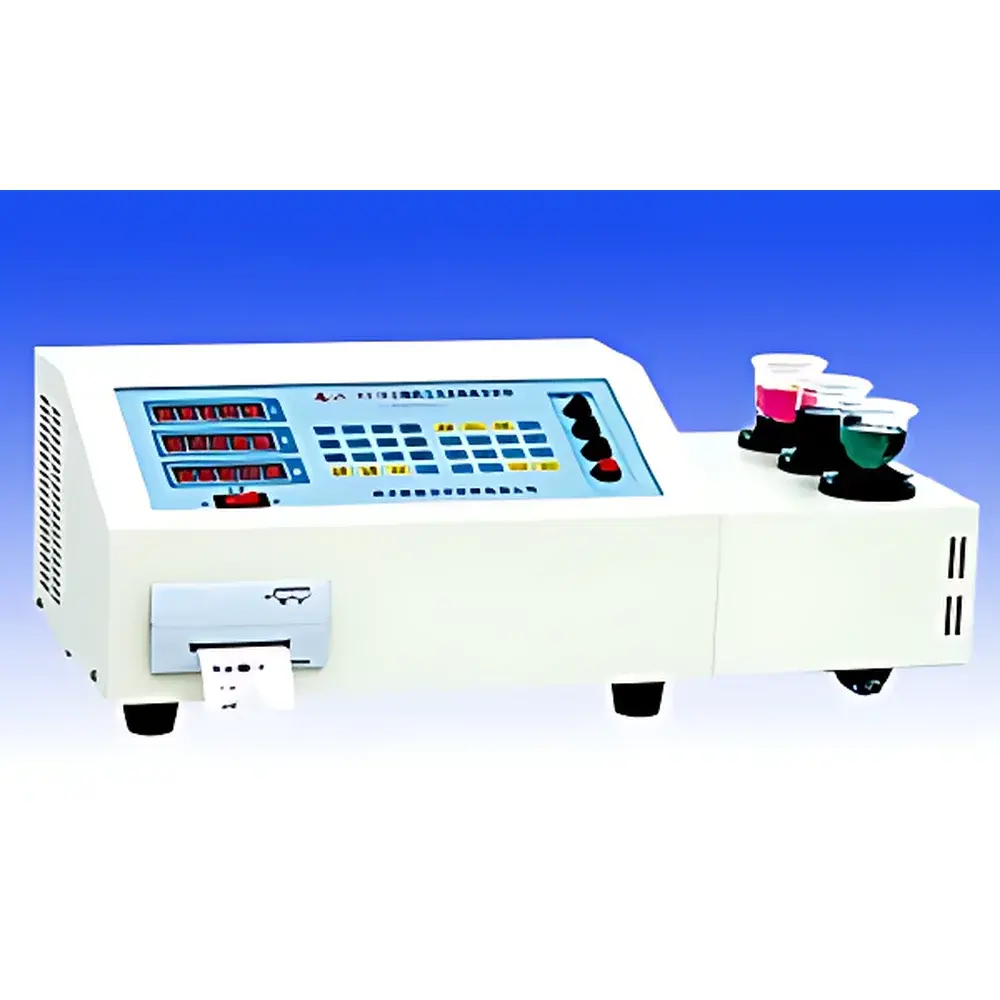
QL BS3B Metal Elemental Analyzer
| Brand | QL |
|---|---|
| Model | BS3B |
| Origin | Jiangsu, China |
| Type | Cold-light Source Spectrophotometric Multi-Element Analyzer for Metals |
| Measurement Principle | Dual-beam Photometric Absorption (Cold Light Source) with Silicon Photodiode Detection |
| Element Range | Mn 0.10–15.00%, Si 0.10–5.00%, P 0.005–0.80%, Cr 0.010–25.0%, Mo 0.010–6.00%, Mg 0.010–0.99% |
| Calibration Curves | Up to 15 user-storable calibration curves |
| Optical System | Fixed-wavelength cold light source modules with automatic zero/full-scale self-calibration |
| Sample Form | Solid metal samples (pre-dissolved or fused into solution) |
| Interface | Touch-sensitive keypad with audible key feedback |
| External Melting Design | Yes |
| Power Supply | AC 220 V ±10%, 50 Hz |
| Dimensions | 620 × 420 × 220 mm |
| Weight | 28 kg |
Overview
The QL BS3B Metal Elemental Analyzer is a benchtop photometric absorption analyzer engineered for rapid, reliable quantitative determination of major and minor metallic elements in ferrous and non-ferrous alloys. It operates on the principle of dual-beam cold-light source spectrophotometry—utilizing stable, low-heat LED-based optical sources paired with high-linearity silicon photodiodes to measure absorbance at fixed analytical wavelengths. Unlike traditional flame or arc emission systems, this instrument eliminates thermal drift and lamp aging concerns by employing solid-state cold light sources, enabling consistent baseline stability and improved inter-day reproducibility. Designed for routine metallurgical QC environments—including foundry floor, heat-treatment labs, and incoming material inspection—the BS3B delivers trace-to-major element quantification without requiring argon purge, high-voltage excitation, or vacuum optics. Its architecture supports standardized wet chemical sample preparation (acid digestion or flux fusion), aligning with ASTM E307, ISO 4941, and GB/T 223 series methods for metal analysis.
Key Features
- Cold-light source optical system with automatic zero and full-scale self-calibration—minimizes photometric drift and eliminates manual dark-current adjustment.
- Microcontroller-based operation with embedded firmware supporting up to 15 independent calibration curves, each configurable for specific alloy families (e.g., carbon steels, stainless grades, aluminum alloys).
- Touch-sensitive membrane keypad with audible key confirmation and context-aware shortcut functions—reduces operator training time and minimizes input errors.
- External sample melting station design—decouples high-temperature fusion from optical electronics, preventing thermal cross-contamination and extending service intervals.
- Modular cold-light source slots—allow field-swappable wavelength-specific emitters (e.g., 525 nm for Mn, 620 nm for Cr, 410 nm for P), enabling method expansion without hardware replacement.
- No valves, no fluidic tubing, no consumable lamps—reducing scheduled maintenance and eliminating failure modes common in flow-injection or flame-AAS systems.
Sample Compatibility & Compliance
The BS3B accepts aqueous solutions prepared from standardized dissolution protocols: HCl/HNO3 digestion for low-alloy steels; LiBO2/Li2B4O7 fusion for refractory alloys containing Ti, W, or V; and HF-assisted digestion where silicates are present. It is compatible with ASTM E1019 (determination of C, S, N, O in metals), ISO 6429 (photometric determination of phosphorus in steel), and GB/T 223.3–2008 (silicon in ferroalloys). While not a regulated GMP instrument per se, its calibration traceability, curve storage audit trail, and fixed-wavelength architecture support GLP-compliant documentation when integrated with laboratory notebooks or LIMS. The absence of radioactive sources or high-pressure gases ensures compliance with OSHA 1910.1200 and EU Directive 2014/34/EU for non-hazardous lab equipment.
Software & Data Management
The BS3B operates via embedded firmware—no external PC required for basic operation. All calibration data, sample IDs, and measurement timestamps are stored internally in non-volatile memory with battery-backed retention (>10 years). Optional RS-232 or USB-to-serial interface enables connection to Windows-based data logging software (supplied separately), which exports ASCII-formatted reports compliant with ASTM E1447 for elemental analysis records. Software features include automatic outlier detection (Grubbs’ test), QC chart generation (X-bar/R), and export to CSV for integration with enterprise LIMS platforms. Audit trails record all curve modifications, zero/full-scale recalibrations, and user logins—supporting FDA 21 CFR Part 11 readiness when deployed with appropriate access controls and electronic signature validation.
Applications
- Routine furnace-side analysis of molten iron and steel—monitoring Mn, Si, and P for ladle-to-tap control.
- Finished product verification in forging, casting, and rolling mills—ensuring conformance to AISI, ASTM A276, or EN 10088 specifications.
- Supplier material qualification—verifying Cr/Ni ratios in stainless feedstock or Cu/Mg content in aluminum extrusion billets.
- Research and development of new alloy compositions—rapid screening of dopant elements (e.g., rare earth additions in Mg alloys) during prototyping.
- Educational metallurgy labs—teaching fundamental principles of Beer-Lambert law application, calibration linearity, and matrix interference correction.
FAQ
What sample preparation methods are recommended for the BS3B?
Standard acid digestion (HCl/HNO3 mixtures) is suitable for most carbon and low-alloy steels. For high-Cr/Ni stainless or Ni-base superalloys, alkaline fusion with lithium metaborate is required prior to acid dissolution.
Can the BS3B analyze nitrogen or oxygen?
No—this instrument is optimized for photometric determination of elements forming stable colored complexes (e.g., Mn, Cr, P, Si). Nitrogen and oxygen require inert gas fusion infrared detection (e.g., LECO analyzers) and are outside its operational scope.
Is calibration traceable to NIST standards?
Calibration solutions must be prepared from NIST-traceable stock standards (e.g., NIST SRM 3126a for Fe-Mn). The instrument itself does not hold NIST certification but supports traceable workflows when used with certified reference materials and documented SOPs.
How often does the cold light source require replacement?
LED-based cold light sources typically exceed 50,000 hours of operational life under normal use—equivalent to >10 years at 12 h/day. No scheduled replacement is specified; output stability is monitored automatically during self-calibration cycles.
Does the BS3B comply with ISO/IEC 17025 requirements?
It supports essential technical requirements (stability, repeatability, calibration verification) but requires laboratory-developed uncertainty budgets, proficiency testing participation, and documented method validation to achieve full ISO/IEC 17025 accreditation.
Related Products






