
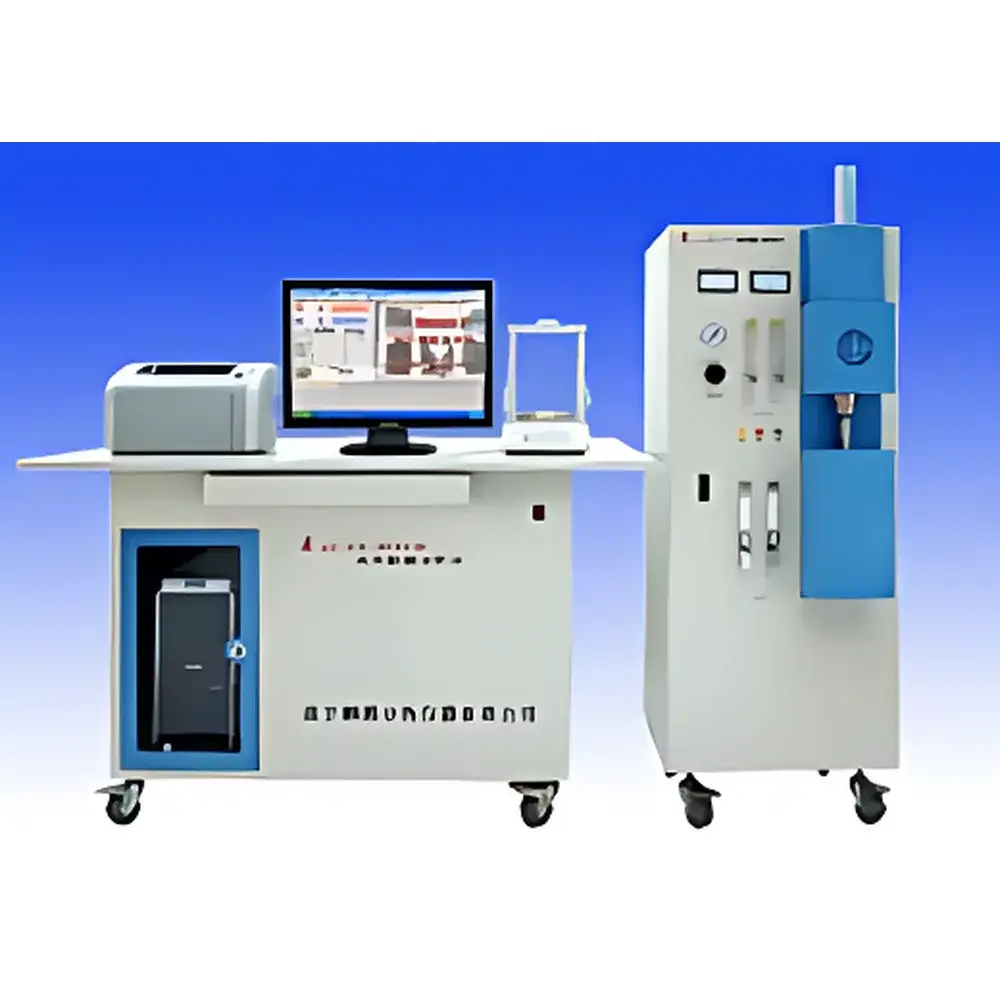
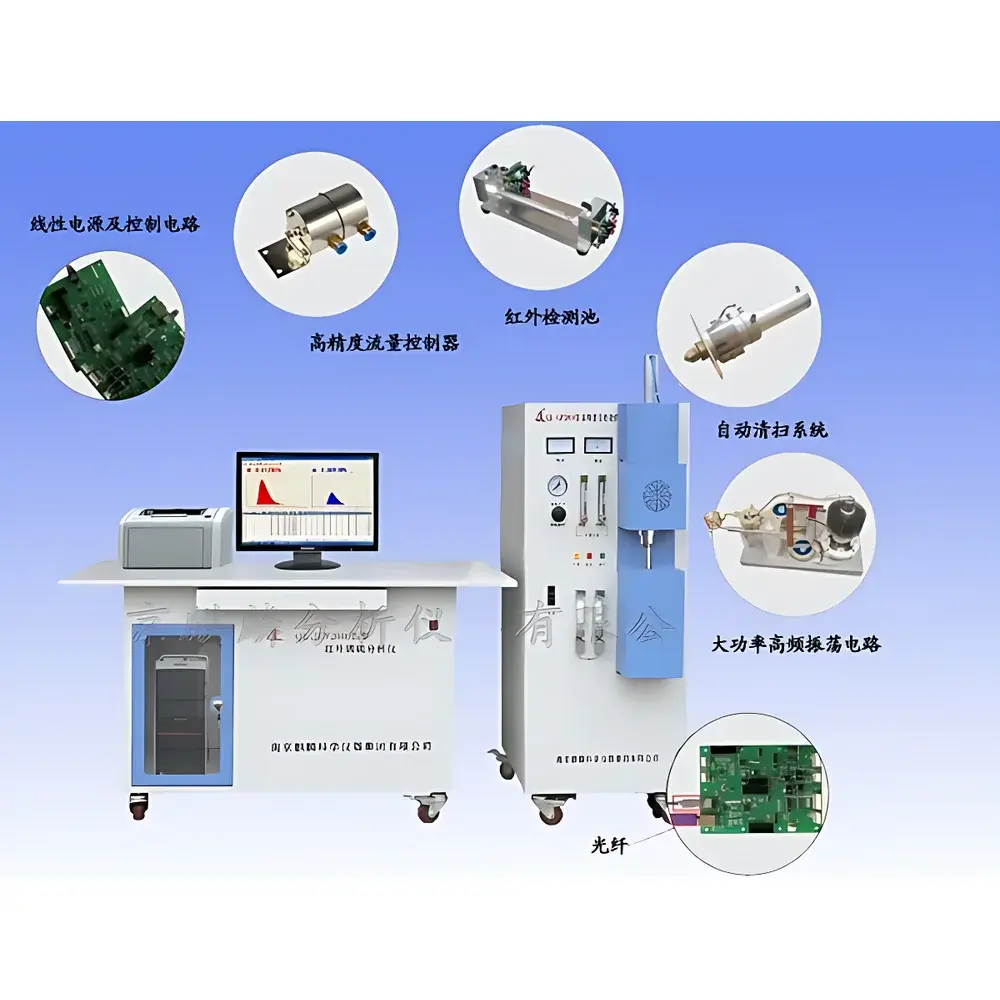
QL HW2000B High-Frequency Infrared Carbon-Sulfur Analyzer
| Brand | QL |
|---|---|
| Model | HW2000B |
| Origin | Jiangsu, China |
| Measurement Principle | Non-Dispersive Infrared (NDIR) Absorption |
| Heating System | 2.5 kVA High-Frequency Induction Furnace (18 MHz) |
| Carbon Range | 0.00001–99.999% (w/w) |
| Sulfur Range | 0.00001–99.999% (w/w) |
| Sensitivity | 0.1 ppm |
| Accuracy | Compliant with ISO 9556:1989 (C) and ISO 4935:1989 (S) |
| Analysis Time | Adjustable 25–60 s (typical 35 s) |
| Sample Weighing | Integrated 0–120 g analytical balance with 0.1 mg readability |
| Compliance | GB/T 20123–2006, ISO 15350:2000 |
| Dust Mitigation | Automated furnace head cleaning system |
| Sulfur Recovery Enhancement | Integrated furnace head heating module |
| Software Interface | Windows-based GUI with real-time gas release curve visualization, audit trail, calibration management, and statistical reporting |
Overview
The QL HW2000B High-Frequency Infrared Carbon-Sulfur Analyzer is a fully integrated elemental combustion analyzer engineered for precise, routine quantification of total carbon (C) and total sulfur (S) in solid metallic and non-metallic materials. It operates on the principle of high-frequency induction combustion followed by non-dispersive infrared (NDIR) spectroscopic detection. In this method, a weighed sample is combusted in a pure oxygen atmosphere within a 2.5 kVA, 18 MHz high-frequency induction furnace—generating CO2 and SO2 gases quantitatively proportional to the C and S content. These combustion gases are swept through optimized optical cells where dual-channel NDIR detectors measure absorbance at characteristic wavelengths (4.26 µm for CO2, 7.35 µm for SO2). The instrument’s optical path design minimizes cross-talk and baseline drift, ensuring high specificity and long-term signal stability. Unlike thermal conductivity or electrochemical methods, NDIR provides inherent selectivity, linearity over six orders of magnitude, and immunity to carrier gas composition fluctuations—critical for heterogeneous industrial samples.
Key Features
- High-stability, low-noise pyroelectric NDIR detectors with temperature-compensated reference channels for sub-ppm sensitivity (0.1 ppm detection limit) and reproducible baseline recovery.
- Modular hardware architecture with isolated power supplies, shielded optical compartments, and EMI-hardened high-frequency circuitry—designed to maintain performance in electrically noisy foundry or QC laboratory environments.
- Automated furnace head cleaning mechanism reduces ash accumulation and prevents memory effects between analyses; combined with programmable pre-burn cycles, it ensures consistent combustion efficiency across diverse matrices (e.g., high-carbon steels vs. low-sulfur ceramics).
- Furnace head heating module maintains optimal catalytic surface temperature (≥850 °C), promoting quantitative oxidation of refractory sulfur species (e.g., sulfides, sulfates) and minimizing SO2 adsorption losses—directly improving sulfur recovery accuracy and inter-laboratory reproducibility.
- Seamless integration with a 0.1 mg readability analytical balance enables unrestricted sample mass entry (0.1–1.0 g typical); software auto-imports weight data, eliminating manual transcription errors and supporting GLP-compliant documentation.
- Real-time dynamic visualization of CO2 and SO2 release profiles during combustion—allowing immediate identification of incomplete combustion, volatile interferences, or abnormal kinetic behavior for root-cause troubleshooting.
Sample Compatibility & Compliance
The HW2000B is validated for analysis of ferrous and non-ferrous alloys—including carbon steels, stainless steels, cast irons, superalloys, aluminum and copper-based metals—as well as inorganic matrices such as cement, limestone, coal, coke, ores, slags, catalysts, and ceramic powders. Its wide dynamic range (0.00001–99.999% w/w for both C and S) accommodates trace-level impurity monitoring in high-purity metals and bulk quantification in carburized components. Method validation meets ISO 9556:1989 (carbon) and ISO 4935:1989 (sulfur), with full alignment to GB/T 20123–2006 and ISO 15350:2000 for combustion conditions, calibration protocols, and uncertainty estimation. Instrument qualification includes factory-installed CRM-based calibration curves traceable to NIST SRMs, with user-accessible recalibration workflows compliant with ISO/IEC 17025 internal quality control requirements.
Software & Data Management
The embedded Windows-based application provides a secure, auditable environment for method development, data acquisition, and regulatory reporting. Core functionalities include multi-point calibration with polynomial fitting, channel-specific gain adjustment, automatic blank subtraction, and real-time interference correction (e.g., H2O vapor compensation). All analytical events—including balance readings, furnace parameters, gas flow rates, detector voltages, and final results—are timestamped and stored with full metadata. The system supports 21 CFR Part 11-compliant user authentication, electronic signatures, and immutable audit trails. Export formats include CSV, XML, and PDF reports with customizable templates aligned to LIMS integration standards (ASTM E1482, ASTM E1578). Statistical tools enable X-bar/R charting, Gage R&R analysis, and trend monitoring per ISO 5725 guidelines.
Applications
- Quality control of incoming raw materials (scrap metal, ferroalloys, fluxes) in steelmaking and foundry operations.
- Final product certification for ASTM A743/A744 (cast stainless), ASTM A276 (stainless bar), and ISO 6892-1 (tensile testing material verification).
- Process optimization in heat treatment and carburizing lines via rapid C-profile verification.
- Environmental compliance testing of coal and coke for sulfur content per EPA Method 7090 and ISO 334.
- Research applications in metallurgy, geochemistry, and catalysis requiring high-precision stoichiometric determination.
- Failure analysis laboratories performing root-cause investigation of embrittlement, hot cracking, or corrosion-related defects linked to C/S segregation.
FAQ
What combustion gases are measured, and how is spectral interference avoided?
CO2 and SO2 are measured independently using narrow-band optical filters centered at 4.26 µm and 7.35 µm, respectively. Optical path isolation and reference-channel normalization suppress overlapping absorbance from H2O, NOx, and CO.
Is the instrument suitable for analyzing sulfur in coal with high ash content?
Yes—the automated furnace head cleaning system and programmable post-combustion flush cycles mitigate ash deposition, while the furnace head heater ensures complete sulfur liberation from silicate-bound species.
Can calibration curves be extended beyond the default range?
Yes—user-defined multi-range calibration sets support extended quantification up to 99.999%, with independent linearity verification per ISO 80000-1.
Does the software support remote diagnostics and firmware updates?
Yes—secure HTTPS-based remote access enables manufacturer-assisted troubleshooting and version-controlled firmware deployment without local IT intervention.
How is measurement uncertainty estimated for routine use?
The software calculates expanded uncertainty (k=2) per GUM (JCGM 100:2008) using CRM-certified calibration standards, repeatability studies, balance uncertainty, and detector noise metrics—all documented in the exported report.





