
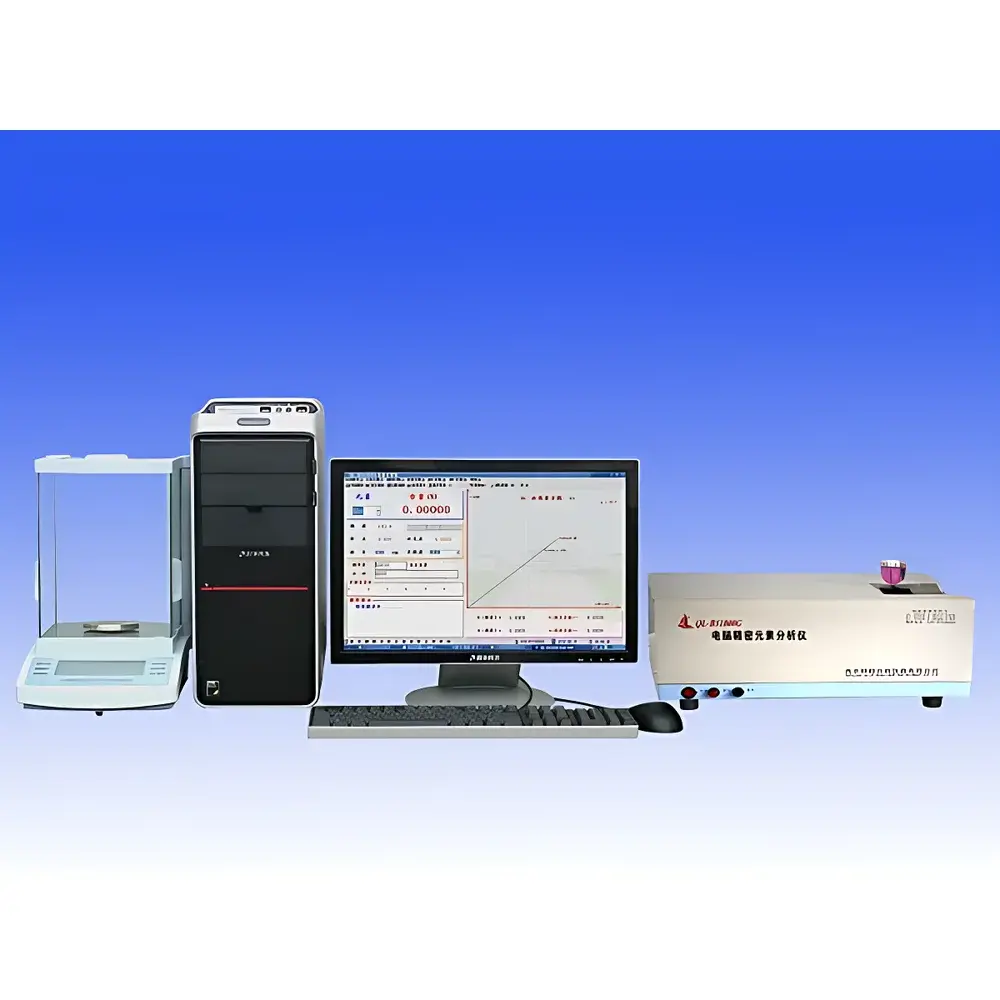
QL Instrument QL-BS1000G Alloy Elemental Analyzer
| Brand | QL Instrument |
|---|---|
| Origin | Jiangsu, China |
| Model | QL-BS1000G |
| Detection Principle | Photometric Colorimetry with Self-Aligning Exit-Slit Diffraction Grating Optical System |
| Wavelength Selection | Computer-Automated |
| Measurement Time per Element | ≤5 s |
| Weighing Device | Analytical Balance (0.0001 g resolution) |
| Sample Type | Solid metallic alloys (as dissolved acid digests) |
| Temperature Range | 10–30 °C |
| Relative Humidity | <75% RH |
| Compliance | GB/T 223 series (e.g., GB/T 223.3–2008, GB/T 223.5–2008, GB/T 223.11–2008) |
| Software Interface | Native Chinese GUI with integrated printer driver (RS-232/USB) |
| Optical Architecture | Custom-designed exit-slit grating monochromator with fixed slit width and adjustable wavelength positioning |
Overview
The QL Instrument QL-BS1000G Alloy Elemental Analyzer is a benchtop photometric elemental analyzer engineered for quantitative determination of major and trace metallic elements in ferrous and non-ferrous alloy matrices. It operates on the principle of visible/near-UV photometric colorimetry: analyte-specific chromogenic reagents react with acid-digested sample solutions to form stable colored complexes; absorbance is measured at precisely selected wavelengths using a computer-controlled self-aligning exit-slit diffraction grating optical system. This architecture eliminates manual wavelength calibration drift and ensures long-term spectral stability—critical for multi-element sequential analysis in metallurgical QC labs. Unlike atomic absorption or ICP-based systems, the QL-BS1000G delivers rapid, cost-effective quantification of Mn, Si, P, Cr, Ni, Mo, Cu, Mg, and rare earth elements (REEs) in steel, cast iron, stainless alloys, and aluminum-based composites—without requiring argon plasma, high-voltage lamps, or vacuum optics.
Key Features
- Computer-automated wavelength selection across 320–850 nm range via precision stepper-motor-driven diffraction grating
- Self-aligning exit-slit optical path design minimizes alignment sensitivity and maintains spectral resolution over extended operation
- Integrated 0.1 mg analytical balance (0.0001 g readability) with tare function and RS-232 interface for direct mass input into calibration curves
- Fixed-pathlength cuvette holder (10 mm quartz cells) with temperature-stabilized LED light source and silicon photodiode detector
- Pre-programmed calibration algorithms for 12+ elements—including Mn (0.10–65.00 wt%), Si (0.10–75.00 wt%), P (0.005–1.00 wt%), Cr (0.01–45.00 wt%), Ni (0.01–50.00 wt%), Mo (0.101–6.00 wt%), Mg (0.010–0.100 wt%), and REEs (0.01–0.100 wt%)—all traceable to national standard reference materials
- Single-button assay initiation with full sequence execution: reagent addition timing, color development delay, absorbance measurement, and concentration calculation
Sample Compatibility & Compliance
The QL-BS1000G is validated for use with acid-digested solid metal samples prepared per ISO 11885:2007 (water quality — determination of elements by ICP-MS) digestion protocols adapted for alloys—typically HCl/HNO₃/HF mixtures followed by dilution to known volume. It complies with the methodology requirements of GB/T 223 series standards (e.g., GB/T 223.3 for phosphorus, GB/T 223.5 for manganese, GB/T 223.11 for chromium), which are harmonized with ASTM E30 and ISO 4935 for spectrochemical analysis of steels. While not designed for regulatory submission under FDA 21 CFR Part 11, its audit-ready data logs (timestamped absorbance values, balance readings, operator ID, and calibration history) support GLP-aligned internal QA/QC workflows. All reported results include uncertainty estimates derived from replicate measurements and certified reference material (CRM) validation per ISO/IEC 17025 guidelines.
Software & Data Management
The embedded Windows-compatible software provides a fully localized Chinese graphical user interface with context-sensitive help, real-time spectral preview, and dynamic calibration curve fitting (linear, quadratic, or cubic regression). Each analysis session auto-generates a structured ASCII log file containing sample ID, element(s) measured, raw absorbance, calculated concentration, CRM recovery %, and instrument status flags. Data export supports CSV, Excel (.xlsx), and PDF report formats—with optional watermarking for controlled document distribution. Printer output includes full metadata: date/time, analyst name, instrument serial number, calibration verification timestamp, and pass/fail indicators against predefined tolerance bands. No cloud connectivity or remote access capabilities are implemented—ensuring full data sovereignty within on-premise lab networks.
Applications
- Routine QC testing of incoming raw materials (scrap steel, nickel pellets, copper anodes) in foundry and forging facilities
- In-process verification of heat treatment batch composition in stainless steel production lines
- Failure analysis laboratories assessing segregation or contamination in turbine blades or aerospace fasteners
- Third-party certification labs performing contract testing per customer-specification limits (e.g., ASTM A276 for stainless bars)
- Educational institutions teaching classical wet-chemical spectrophotometric methods alongside modern instrumental techniques
FAQ
What sample preparation method is required prior to analysis?
Solid metal samples must be dissolved using standardized acid digestion (e.g., HCl/HNO₃ for low-alloy steels; HF-containing mixtures for high-Si or refractory alloys), followed by volumetric dilution and filtration to remove particulates.
Does the system support simultaneous multi-element analysis?
No—it performs sequential single-element measurements. Each element requires its own optimized chromogenic reaction, reagent addition step, and wavelength setting.
Is external calibration verification mandatory before each batch?
Yes. At minimum, one certified reference material (CRM) matching the matrix and concentration range must be analyzed per 10 samples to confirm accuracy and detect drift.
Can the instrument quantify nitrogen or oxygen?
No. The QL-BS1000G is limited to elements amenable to solution-phase colorimetric chemistry—primarily transition metals and metalloids. Interstitial elements (N, O, C, S) require combustion infrared or carrier gas hot extraction methods.
What maintenance intervals are recommended?
Daily: cleaning of cuvette holder and optical window; weekly: verification of balance linearity and lamp intensity; annually: grating alignment check and photodiode responsivity calibration using NIST-traceable filters.





