
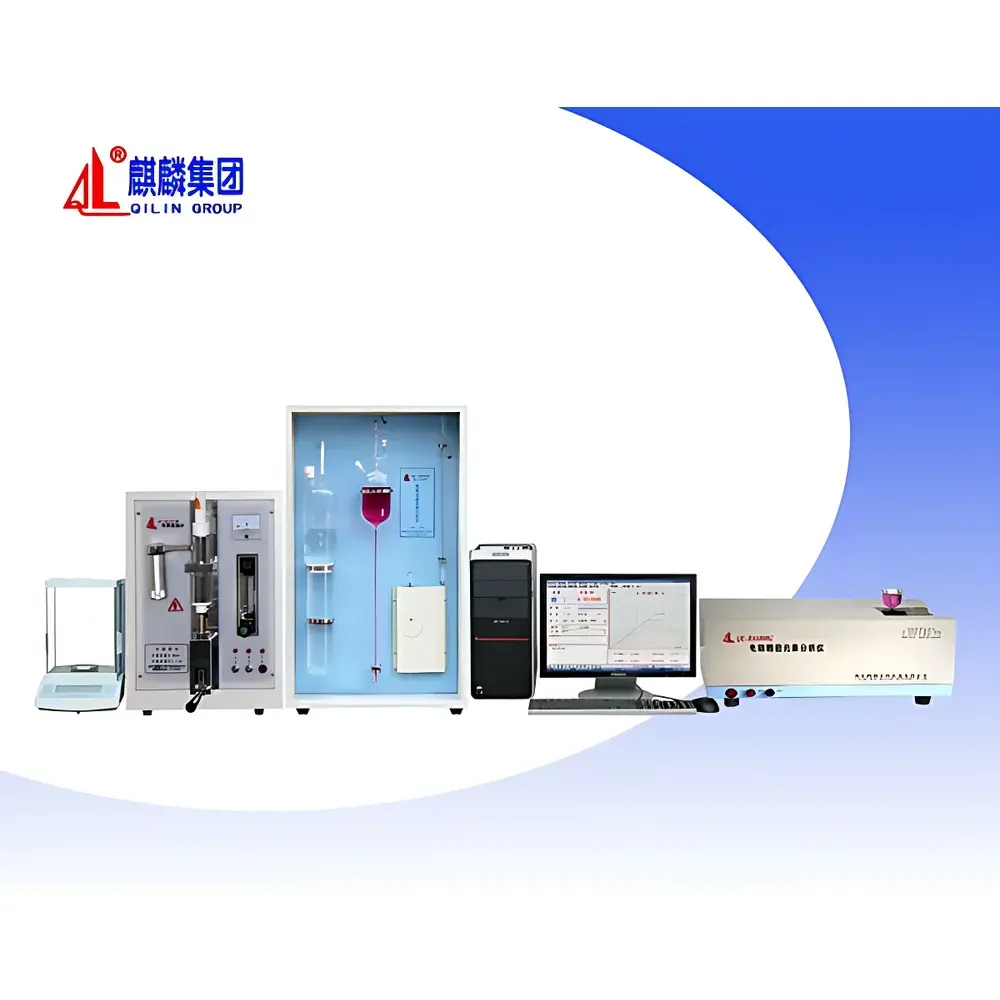
QL-S3000C Metal Elemental Analyzer by Qilin
| Brand | Qilin (QL) |
|---|---|
| Origin | Jiangsu, China |
| Model | QL-S3000C |
| Measurement Principle | Infrared Absorption (C/S) + Photometric Colorimetry (Multi-element) |
| Elemental Range | C (0.001–10.00%), S (0.0005–0.5000%), Mn (0.10–15.00%), Si (0.10–5.00%), P (0.005–0.80%), Cr (0.01–25.0%), Mo (0.101–6.00%), Ni (0.010–30.0%), Mg (0.010–0.100%), Rare Earths (0.01–0.100%), Cu, Al, V, W, Ti, Fe, etc. |
| Analysis Time | ~5 min (combined IR + photometric mode) |
| Wavelength Adjustment | Motor-driven holographic grating, digitally controlled, 400–800 nm, step resolution <1 nm |
| Calibration Curves | Up to 99 user-storable regression curves |
| Compliance | GB/T 223.3–5:1988, GB/T 223.68–69:1997 |
| Sample Handling | Off-line dissolution, variable-mass weighing via optional electronic balance interface |
| Data Output | ASCII/CSV export, direct thermal or dot-matrix printing |
| Software Control | Windows-based GUI with real-time data acquisition, audit trail logging, and GLP-compliant result archiving |
Overview
The QL-S3000C Metal Elemental Analyzer is a dual-mode laboratory instrument engineered for quantitative determination of major, minor, and trace elements in ferrous and non-ferrous alloys. It integrates infrared absorption spectroscopy for carbon and sulfur quantification with high-stability photometric colorimetry for simultaneous multi-element analysis—including Mn, Si, P, Cr, Ni, Mo, Mg, Cu, Al, V, W, Ti, and rare earth elements. The system operates on the principle of Beer-Lambert law-based absorbance measurement in solution-phase samples, coupled with precise IR detection of CO2 and SO2 gases evolved during high-frequency combustion. Designed for metallurgical QC/QA laboratories, foundries, and third-party testing facilities, the QL-S3000C delivers reproducible results under routine industrial conditions while maintaining full traceability per ISO/IEC 17025 requirements.
Key Features
- Dual-detection architecture: Dedicated infrared cells for C/S analysis (detection limits: 0.0005% S, 0.001% C) and a motorized holographic grating monochromator for photometric analysis across 400–800 nm.
- Digitally tunable optical system: Stepper-motor-driven grating enables sub-nanometer wavelength positioning accuracy (<1 nm step resolution), eliminating manual calibration drift and enabling rapid method switching between elements.
- Off-line sample dissolution workflow: Eliminates internal fluidic valves and tubing, reducing maintenance frequency and extending operational lifetime—particularly critical in high-throughput metallographic labs handling aggressive acid digests.
- Variable-mass sample introduction: Supports both fixed- and variable-weight protocols; compatible with RS232/USB-connected analytical balances for automated mass import into calculation routines.
- Robust photometric subsystem: Features cold-light LED sources, imported photodiodes with auto-zero/full-scale compensation, and temperature-stabilized optical path to ensure long-term signal stability.
- Software-controlled reagent delivery: Electrode-free titration module with patented anti-clogging valve design minimizes downtime associated with sulfide precipitate buildup in S-channel systems.
- Comprehensive calibration management: Stores up to 99 element-specific calibration curves using polynomial or linear regression models; supports user-defined curve validation and outlier rejection protocols.
Sample Compatibility & Compliance
The QL-S3000C is validated for solid metallic samples—including carbon steels, stainless steels, cast irons, aluminum alloys, copper-base alloys, and nickel superalloys—following standardized dissolution procedures (e.g., ASTM E350, ISO 6429). Sample preparation requires external digestion (HCl/HNO3/HF mixtures as appropriate), after which clear filtrates are introduced manually into the photometric flow cell or combustion crucible. All reported measurement uncertainties comply with national standards GB/T 223.3–5:1988 (for Mn, Si, P) and GB/T 223.68–69:1997 (for C/S), with documented repeatability ≤0.5% RSD for mid-range concentrations. The system supports GLP-aligned operation through time-stamped audit trails, user-access controls, and electronic signature-capable reporting modules compliant with FDA 21 CFR Part 11 when deployed with validated software configuration.
Software & Data Management
Built on a Windows-native platform, the QL-S3000C control software provides full instrument orchestration—from wavelength selection and reagent timing to spectral acquisition and stoichiometric conversion. Raw absorbance and IR voltage signals are logged at 10 Hz with embedded metadata (operator ID, sample ID, timestamp, method version). Data export supports CSV, TXT, and XML formats compatible with LIMS integration. Reports include calibrated concentration values, confidence intervals derived from curve-fit residuals, and pass/fail flags against user-defined specification limits. Historical datasets are indexed by batch, material grade, and analyst, enabling longitudinal quality trend analysis and root-cause investigations per IATF 16949 Clause 8.5.1.2.
Applications
- Raw material verification in steelmaking and alloy production
- In-process composition monitoring during heat treatment and casting
- Supplier qualification and incoming inspection of purchased billets, ingots, and powders
- Failure analysis laboratories requiring rapid elemental profiling of fracture surfaces or corrosion products
- R&D environments evaluating novel alloy formulations where multi-element interdependence must be quantified
- Third-party certification labs performing accredited testing per CNAS-CL01 (equivalent to ISO/IEC 17025)
FAQ
What sample forms are compatible with the QL-S3000C?
Solid metal chips, turnings, or drilled cores—typically 0.2–0.5 g—are required. Powders and pre-dissolved solutions may be used only after method validation for matrix interference.
Does the system support automatic digestion?
No. Sample dissolution is performed externally using standard hotplate or microwave-assisted digestion systems; the QL-S3000C accepts only clarified aqueous solutions or solid combustibles.
Can calibration curves be transferred between instruments?
Yes—curve parameters (coefficients, wavelength, reagent volumes) are stored in portable .CUR files and can be imported across identical QL-S3000C units after verification against certified reference materials.
Is regulatory compliance documentation available?
Factory-issued IQ/OQ protocols, GB-standard verification reports, and software validation summaries are supplied with each unit; GMP-relevant documentation packages are available upon request.
What maintenance intervals are recommended?
IR detector purge gas filters: every 6 months; photometric cuvette cleaning: after each batch; grating alignment verification: annually or after mechanical shock.






