
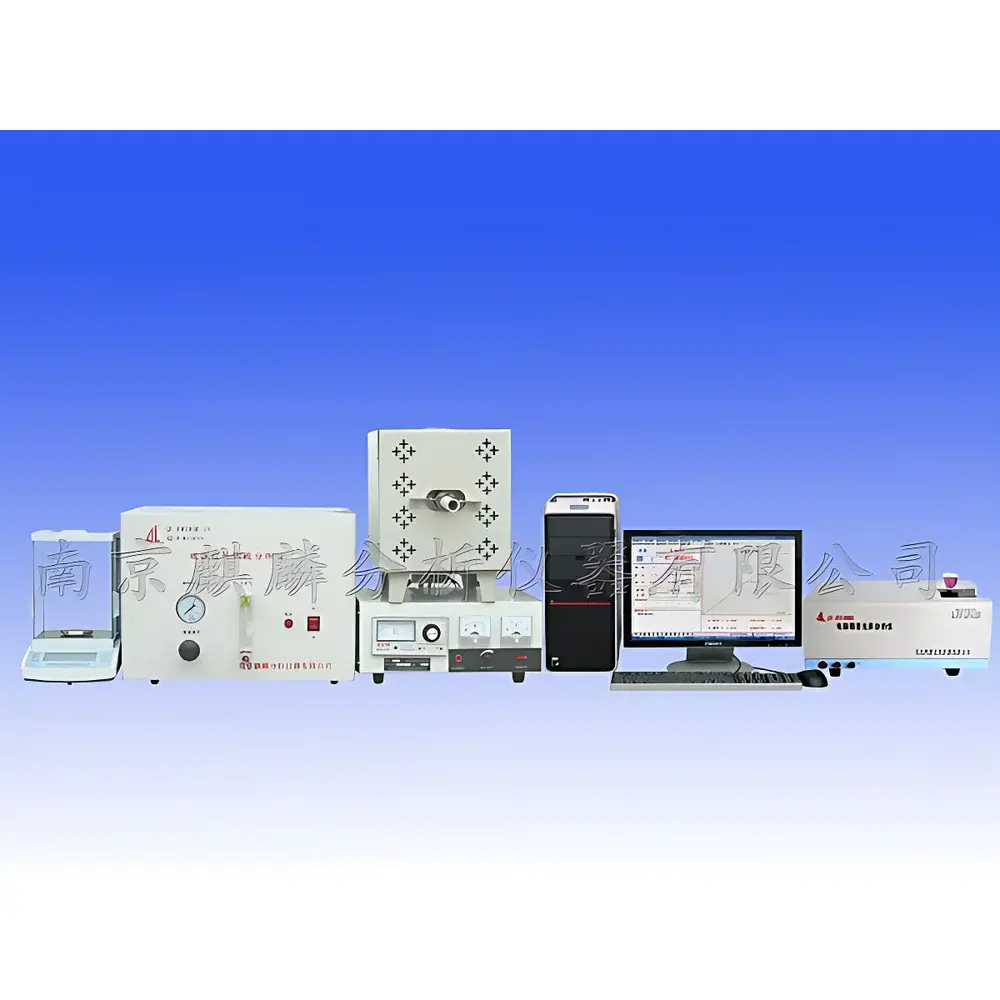
QL-S3000D Multi-Element Analyzer with Integrated Infrared Carbon/Sulfur Module
| Origin | Jiangsu, China |
|---|---|
| Manufacturer Type | Authorized Distributor |
| Origin Category | Domestic (PRC) |
| Model | S3000D |
| Price | USD 9,600 (FOB Jiangsu) |
| Measurement Principle | IR Absorption (C/S), Photometric Colorimetry (Multi-element) |
| Analysis Time | ~120 s per sample |
| Compliance | GB/T 223.3–5:1988, GB/T 223.68–69:1997 |
| Wavelength Range | 400–800 nm (motorized grating, step resolution <1 nm) |
| Curve Storage | 99+ user-expandable calibration curves |
| Sample Form | Solid metal alloys (ferrous & non-ferrous), pre-digested solutions |
| Data Output | ASCII, CSV, Excel-compatible export |
| Interface | Windows-based PC control, RS-232/USB, thermal line printer support |
Overview
The QL-S3000D Multi-Element Analyzer with Integrated Infrared Carbon/Sulfur Module is a dual-technology benchtop analytical system engineered for quantitative elemental composition analysis of metallic materials in metallurgical, foundry, and quality assurance laboratories. It combines two validated analytical methodologies within a single platform: infrared absorption spectroscopy for carbon and sulfur determination, and computer-controlled photometric colorimetry for simultaneous quantification of up to 18 additional elements—including Si, Mn, P, Cr, Ni, Mo, Cu, Ti, V, W, Al, Mg, Re, and Fe—in solid ferrous and non-ferrous alloys. The instrument operates on the principle of Beer-Lambert law-based absorbance measurement in the visible spectrum (400–800 nm), coupled with high-stability IR detection at characteristic absorption bands for CO₂ and SO₂ gases generated during high-temperature combustion. Designed for routine use in furnace-side, incoming inspection, and finished-product verification workflows, the QL-S3000D delivers reproducible results without requiring vacuum optics or inert gas purging—reducing operational overhead while maintaining compliance with Chinese national standards GB/T 223.3–5:1988 and GB/T 223.68–69:1997.
Key Features
- Integrated dual-module architecture: HW2000E(D)-type tubular furnace IR C/S analyzer + BS1000A-derived multi-element photometer
- Motorized holographic diffraction grating optical system with digital wavelength positioning (step resolution <1 nm); eliminates manual slit adjustment and mechanical drift
- Computer-guided automatic wavelength selection: operator selects target element → system auto-calibrates optical path to optimal λ
- Non-contact cold-light source with imported photodetectors; zero/full-scale auto-calibration reduces baseline drift
- External digestion workflow: eliminates internal valves, tubing, and pump wear—extending mean time between maintenance (MTBM) >18 months
- Unlimited sample mass input: electronic balance integration enables不定量称样 (variable-mass sample introduction) with real-time weight acquisition via RS-232 or USB
- 99+ expandable calibration curves stored in non-volatile memory; linear and polynomial regression models supported
- Dual-mode reagent delivery: precision syringe pump for colorimetric reagents; electrode-free titration control for sulfur endpoint detection
- Thermal line printer interface and configurable data export (CSV, TXT, Excel-ready formats)
Sample Compatibility & Compliance
The QL-S3000D is validated for solid metallic specimens requiring acid dissolution prior to analysis—including carbon steels, low- and high-alloy steels, cast irons (gray, ductile, alloyed), stainless steels, and copper- and aluminum-based alloys. Sample preparation follows standardized wet-chemical digestion protocols (e.g., HCl/HNO₃ mixtures for steel, HF-containing media for siliceous matrices). While not certified to ISO/IEC 17025 under third-party accreditation, the system’s performance parameters align with the repeatability and accuracy requirements of GB/T 223 series methods. Optional software add-ons support basic GLP documentation—user log-in tracking, method versioning, and timestamped result archiving—but do not fulfill full FDA 21 CFR Part 11 electronic signature requirements without external validation.
Software & Data Management
Control and data acquisition are managed through a Windows 10/11-compatible application written in C++ with Qt framework, installed on supplied OEM desktop PC. The GUI features fully localized Chinese menus (with optional English language pack), context-sensitive help, and wizard-driven method setup. All analytical sessions generate structured metadata: date/time stamp, operator ID, sample ID, curve ID, wavelength used, raw absorbance/IR voltage, calculated mass fraction (%), and confidence flag based on signal-to-noise ratio. Raw data files are saved in binary .QDA format; export functions support comma-separated values (.CSV), tab-delimited text, and Microsoft Excel (.XLSX) with customizable column headers. Audit trail functionality records parameter changes, curve modifications, and calibration events—though full electronic record integrity requires supplementary IT infrastructure (e.g., networked file server with write-once storage).
Applications
- Furnace-side rapid composition check for melt adjustment in steelmaking and foundry operations
- Incoming raw material verification against supplier certificates of analysis (CoA)
- Finished product release testing per ASTM A751 or GB/T 222
- Scrap sorting and recycling grade identification (e.g., distinguishing 304 vs. 316 stainless scrap)
- R&D alloy development where iterative compositional tuning is required
- Failure analysis labs performing comparative elemental profiling across fracture surfaces and bulk matrix
- Third-party inspection agencies conducting contract testing under CNAS-accredited procedures (when paired with validated SOPs)
FAQ
What sample preparation is required prior to analysis?
Solid metal samples must be drilled, milled, or filed to produce homogeneous chips or powder; then dissolved using appropriate acid mixtures (e.g., aqua regia for Ni-base alloys, HCl/HF for high-Si cast iron). Filtration and dilution to working range are performed off-instrument.
Can the QL-S3000D analyze non-metallic materials such as ceramics or polymers?
No—it is specifically designed for metallic matrices digestible by standard mineral acids. Non-conductive or refractory samples (e.g., Al₂O₃, SiC) require alternate techniques like XRF or ICP-OES.
Is hardware-level compliance with ISO 17025 or FDA 21 CFR Part 11 available?
The base configuration does not include cryptographic signing, biometric authentication, or immutable audit logs required for regulatory submissions; these capabilities demand external validation and supplemental software/hardware layers.
How many elements can be measured simultaneously in one run?
Carbon and sulfur are measured concurrently during combustion; up to six additional elements may be quantified per digested solution batch via sequential wavelength scanning—total analysis time remains ≤120 seconds.
What maintenance intervals are recommended for long-term stability?
Optical alignment verification every 6 months; IR detector desiccant replacement annually; combustion tube cleaning after every 500 analyses; full system performance verification using CRMs every quarter.




