
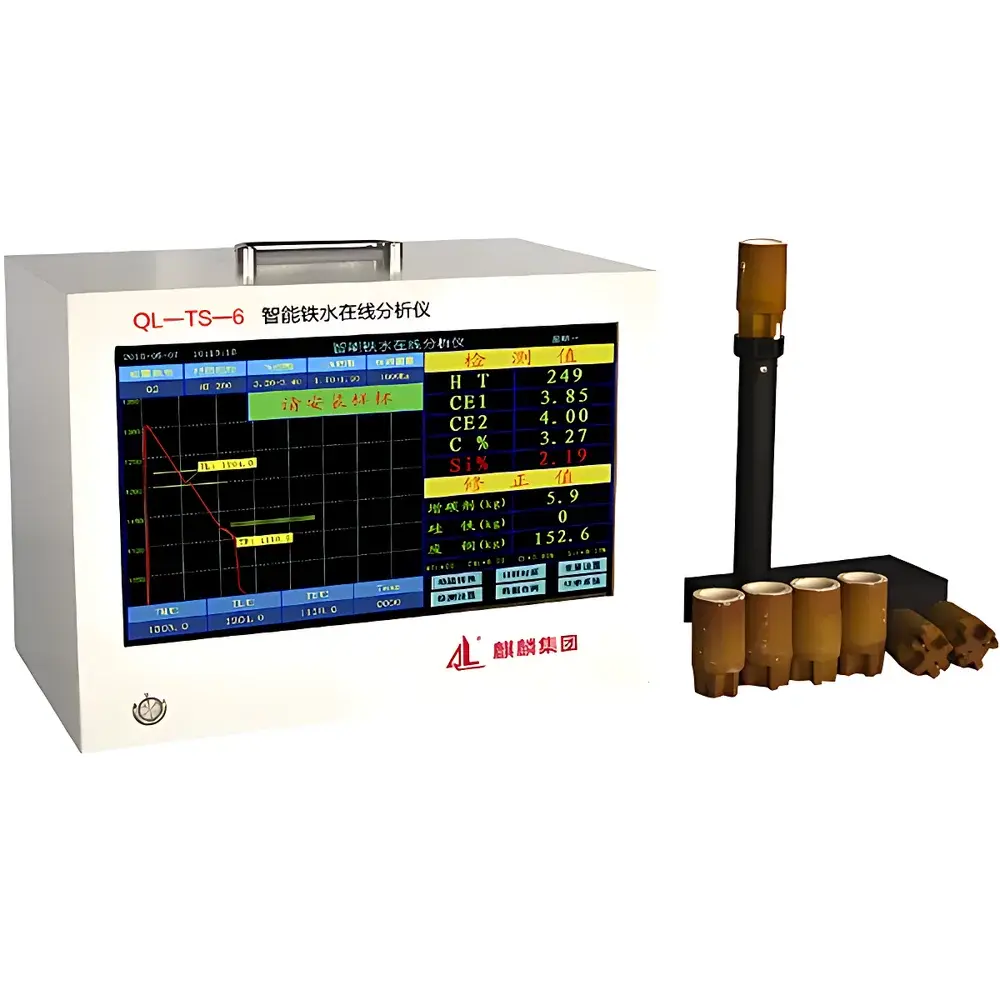
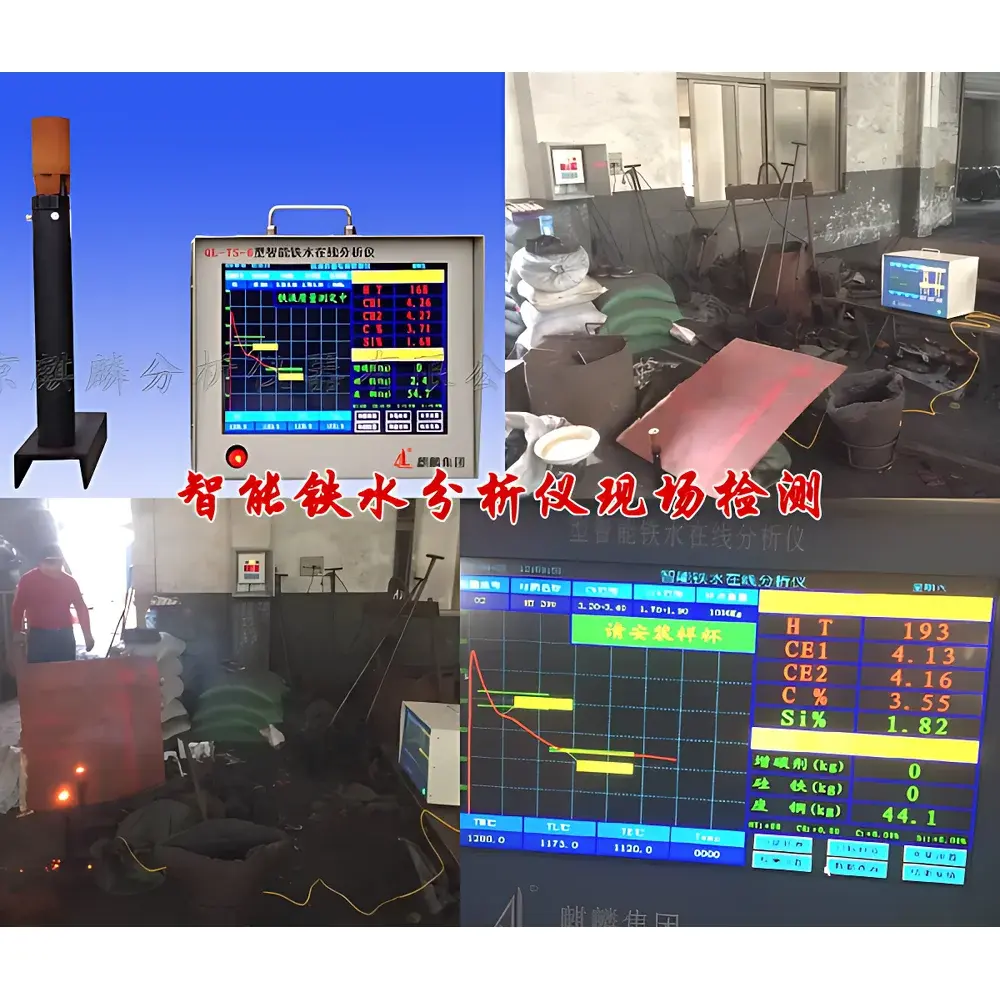
QL-TS-6 Foundry Molten Iron Analyzer by Qilin
| Brand | Qilin (QL) |
|---|---|
| Origin | Jiangsu, China |
| Model | TS-6 |
| CE Range | 3.2–4.8 wt%, ±0.08 wt% |
| C Range | 2.8–4.2 wt%, ±0.04 wt% |
| Si Range | 0.9–3.0 wt%, ±0.04 wt% |
| Analysis Time | ≤60 s |
| Data Storage | 3000 measurements with time stamp |
Overview
The QL-TS-6 Foundry Molten Iron Analyzer is an industrial-grade thermal analysis instrument engineered for real-time elemental assessment of molten cast iron in foundry cupola and induction furnace environments. It operates on the principle of solidification thermal analysis (STA), utilizing high-precision thermocouples to capture the cooling curve of a small, representative iron sample as it transitions from liquid to solid phase. From characteristic inflection points—such as the liquidus temperature (TL), eutectic temperature (TE), recalescence peak (TR), and solidus temperature—the system calculates carbon equivalent (CE), total carbon (C%), silicon (Si%), undercooling (ΔT), maximum undercooling (ΔTM), and nodularity index (RM) using empirically validated calibration models. Designed specifically for continuous operation in high-temperature, electrically noisy foundry floors, the TS-6 delivers repeatable, traceable results without requiring wet chemical analysis or laboratory turnaround.
Key Features
- Industrial-grade embedded platform: Fanless motherboard, ruggedized 17-inch resistive touchscreen display, and solid-state storage ensure operational reliability in ambient temperatures up to 55 °C and vibration-prone environments.
- Multi-parameter thermal analysis output: Simultaneous real-time display of cooling curve, first derivative (dT/dt), CE, C%, Si%, TL, TE, ΔT, ΔTM, and RM—enabling immediate process interpretation.
- Configurable calibration architecture: Supports up to eight user-defined calibration curves (calibration lines), each linked to specific base materials (e.g., gray iron, ductile iron, compacted graphite iron) and target composition sets.
- Automated alloy correction module: Calculates precise addition quantities (e.g., ferrosilicon, scrap return, inoculant) based on measured composition, batch weight, and material-specific recovery rates.
- Electromagnetic interference (EMI) mitigation: Features shielded thermocouple wiring with imported temperature-compensated extension cables, grounded anti-noise mounting base, and opto-isolated signal acquisition circuitry.
- Post-analysis data integrity: All measurements are timestamped and stored locally with full audit trail; optional USB export enables offline QA review and integration into MES or ERP systems.
Sample Compatibility & Compliance
The QL-TS-6 is validated for use with molten gray iron (ASTM A48), ductile iron (ASTM A536), and malleable iron (ASTM A47) within typical foundry pouring temperature ranges (1,200–1,500 °C). Sample cups conform to ISO 9954:2017 for thermal analysis specimen geometry and thermal mass consistency. While not certified to IEC 61000-6-2/6-4 for EMC or ISO/IEC 17025 for accredited testing, the instrument supports GLP-compliant operation through its built-in data logging, user access control (via password-protected configuration menus), and immutable measurement records—facilitating internal quality audits and alignment with ISO 9001:2015 clause 8.5.2 (Identification and traceability).
Software & Data Management
The proprietary Qilin Thermal Analysis Software (v4.2+) provides a Windows-based interface optimized for glove-compatible operation. It includes trend charting of CE, C%, and Si% over consecutive heats; overlay comparison of multiple cooling curves; automatic detection of abnormal solidification patterns (e.g., chill formation, graphite flotation); and configurable alarm thresholds for out-of-spec parameters. All raw thermal data (time vs. temperature at 100 ms intervals) and derived values are saved in CSV and binary formats. The system supports remote browser-based monitoring via HTTP/HTTPS, enabling supervisors to view live analysis status and historical logs from office PCs or mobile devices—without requiring proprietary client software. Audit trails include operator ID, measurement timestamp, calibration line used, and manual override flags, satisfying basic requirements for FDA 21 CFR Part 11–aligned documentation practices.
Applications
- Real-time charge optimization in cupola and medium-frequency induction furnaces
- Verification of melt chemistry prior to ladle transfer or inoculation
- Monitoring of graphite morphology evolution during spheroidization treatment
- Statistical process control (SPC) of CE drift across casting shifts
- Troubleshooting shrinkage porosity, carbide formation, or poor machinability via undercooling analysis
- Supporting PPAP documentation for automotive castings per AIAG standards
FAQ
What sample volume is required for a valid analysis?
A minimum of 80–120 g of molten iron is drawn into a standardized refractory cup; sample mass is manually entered to enable accurate yield-based correction calculations.
Can the TS-6 be integrated with existing foundry automation systems?
Yes—via Modbus TCP/IP or ASCII serial protocol (RS-232/485), the analyzer can transmit CE, C%, Si%, and pass/fail status to PLCs or SCADA platforms for closed-loop charge control.
How often does the system require recalibration?
Calibration verification is recommended before each shift using reference samples with certified C/Si content; full multi-point calibration is typically performed weekly or after hardware maintenance.
Is the cooling curve data exportable for third-party statistical analysis?
Yes—raw .CSV files contain full time-temperature series and derived parameters, compatible with JMP, Minitab, Python (pandas), and MATLAB for advanced SPC modeling.
Does the instrument support ASTM E1251-21 methodology?
While not formally certified to ASTM E1251-21, the TS-6 implements its core procedural requirements—including controlled cooling rate, defined cup geometry, and inflection point detection algorithms—making it suitable for internal compliance with that standard.



