
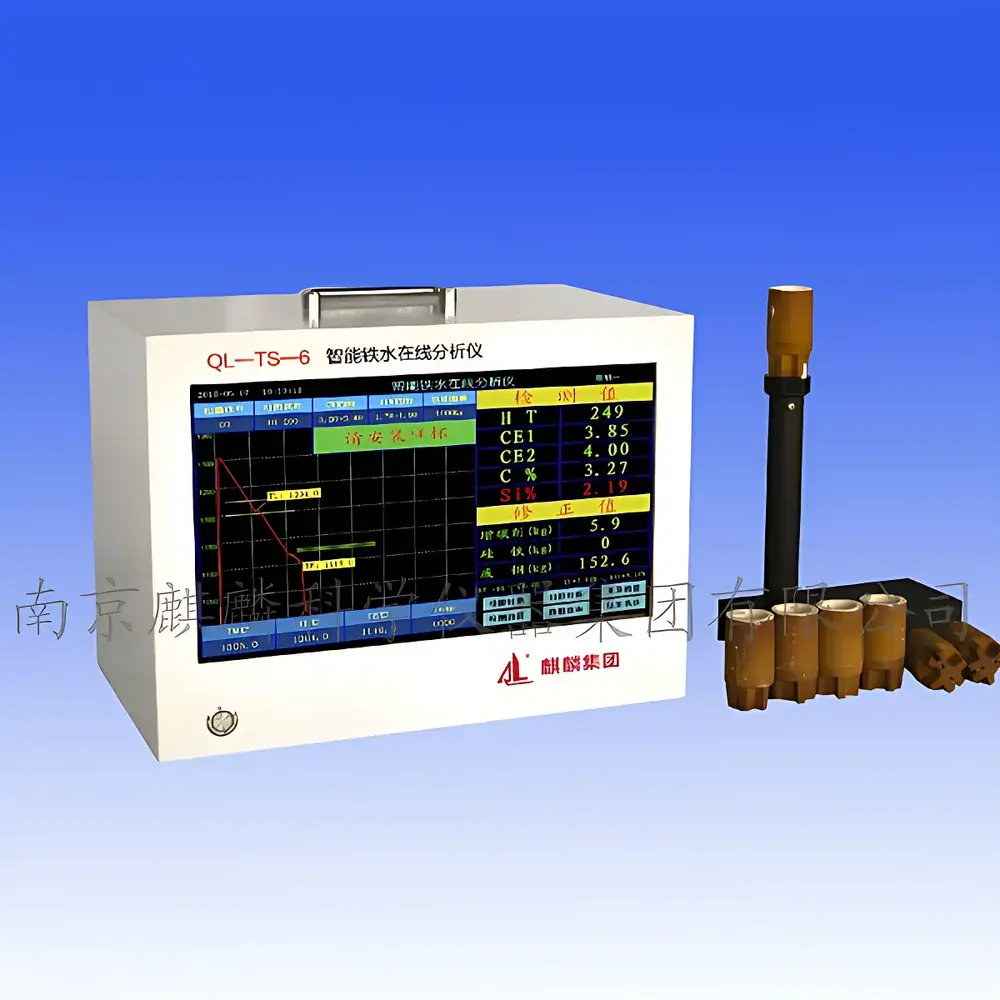
QL-TS-6 Intelligent On-Line Molten Iron Analyzer by Qilin
| Brand | Qilin (QL) |
|---|---|
| Origin | Jiangsu, China |
| Model | QL-TS-6 |
| CE Measurement Range | 3.2–4.8 wt%, ±0.08 |
| C Measurement Range | 2.8–4.2 wt%, ±0.04 |
| Si Measurement Range | 0.9–3.0 wt%, ±0.04 |
| Analysis Time | 90 s |
| Data Storage Capacity | 3,000 measurements |
| Calibration Lines | 8 user-definable |
| Target Compositions | 8 programmable |
| Output | USB flash drive export supported |
| Industrial Display | 17″ ruggedized LCD |
| Thermal Compensation | Imported compensated thermocouple wiring |
| EMC Design | EMI-shielded enclosure with anti-interference mounting base |
| Software | Proprietary molten iron analysis platform with cooling curve visualization, differential solidification analysis, and automated charge calculation |
Overview
The QL-TS-6 Intelligent On-Line Molten Iron Analyzer is a dedicated thermal analysis instrument engineered for real-time elemental assessment of molten cast iron in foundry environments. It operates on the principle of solidification thermal analysis (STA), wherein controlled cooling of a representative iron sample generates a characteristic cooling curve. From this curve—specifically the inflection points corresponding to liquidus (TL), eutectic (TE), and solidus temperatures—the system calculates key metallurgical parameters including carbon equivalent (CE), total carbon (C%), silicon (Si%), undercooling (SC), and nodularity-related indices such as spheroidization rate (SR). Unlike traditional wet chemical or spark-OES methods requiring sample quenching, lab transport, and multi-minute turnaround, the QL-TS-6 delivers quantitative results within 90 seconds directly at the furnace tap-out point—enabling immediate process feedback for charge correction and quality gatekeeping before casting.
Key Features
- Real-time thermal analysis with dual thermocouple input for high-fidelity cooling curve acquisition and differential curve generation (dT/dt)
- Integrated industrial computing platform featuring fanless embedded motherboard, solid-state storage, and 17-inch ruggedized LCD display rated for ambient temperatures up to 55°C and vibration exposure typical of foundry floors
- Eight-user-configurable calibration curves linked to eight distinct target compositions, supporting seamless material grade switching across gray iron, ductile iron, and compacted graphite iron production lines
- Automated charge calculation engine that computes required additions of ferrosilicon, ferromanganese, and scrap based on measured composition, target specification, and batch weight
- Comprehensive data traceability: timestamped storage of 3,000 measurement records with full cooling curve archives, enabling retrospective process audits and statistical process control (SPC) charting
- Electromagnetic compatibility (EMC)-optimized architecture—including shielded signal paths, temperature-compensated Type K thermocouple wiring, and mechanically isolated mounting—to maintain measurement integrity in high-noise electrical environments
- Post-measurement compensation functionality: users may apply offset corrections to C% and Si% values using reference data from certified laboratory assays (e.g., ASTM E1019 or ISO 11582)
Sample Compatibility & Compliance
The QL-TS-6 is validated for use with ladle-sampled molten iron from cupola, induction, and electric arc furnaces operating between 1,350°C and 1,500°C. It supports both white-iron and gray-iron solidification patterns and provides quantitative outputs aligned with foundry-specific specifications such as ASTM A48 (gray iron), ASTM A536 (ductile iron), and ISO 1083. While not an ISO/IEC 17025-accredited instrument per se, its measurement repeatability (±0.04 wt% for C and Si) meets internal quality control requirements for in-process verification under ISO 9001 and IATF 16949 frameworks. The device complies with CE marking directives for electromagnetic compatibility (2014/30/EU) and low voltage safety (2014/35/EU).
Software & Data Management
The proprietary Qilin STA software runs on Windows Embedded Standard OS and features a task-oriented GUI designed for glove-compatible operation. Core modules include: (1) Real-time curve overlay mode showing TL, TE, and solidus points alongside CE/C/Si numeric readouts; (2) Differential curve view highlighting nucleation onset and eutectic recalescence peaks; (3) Trend analysis dashboard plotting CE, C%, and Si% against time or heat number; (4) Charge calculator with editable alloy density and recovery rate tables; (5) USB export function generating CSV files compatible with Excel, Minitab, and MES systems. Audit trail functionality logs all parameter changes, calibration events, and user logins—supporting GLP-aligned documentation practices where required.
Applications
- Front-line composition verification prior to mold pouring to prevent off-spec castings and reduce scrap rates
- Dynamic adjustment of inoculant and spheroidizing agent dosages based on real-time Si and CE feedback
- Monitoring furnace lining wear effects via progressive drift in TL and undercooling values
- Correlation studies between thermal analysis parameters and mechanical properties (e.g., tensile strength, hardness) for predictive modeling
- Training and standardization of pour-room technicians through visual curve interpretation and decision-support prompts
- Integration into Industry 4.0 foundry networks via optional RS-485 or Ethernet Modbus TCP interface (hardware add-on)
FAQ
What sample volume is required for a valid measurement?
A minimum of 150–200 g of molten iron is recommended, poured into a standardized copper or graphite cup with integrated thermocouple sheath.
Can the QL-TS-6 distinguish between ferritic and pearlitic matrix structures?
No—it does not perform microstructural phase quantification. However, it detects solidification path deviations correlated with matrix composition, which experienced users interpret alongside hardness or tensile test data.
Is third-party calibration certification available?
Qilin provides factory calibration reports traceable to NIM (China National Institute of Metrology); ISO/IEC 17025-certified recalibration services are offered through authorized regional partners.
How frequently should the thermocouple be replaced?
Under normal foundry conditions, Type K thermocouples with ceramic protection tubes exhibit service life of 150–250 heats; performance degradation is flagged automatically via signal noise monitoring in firmware v2.3+.
Does the system support multi-language UI?
English and Simplified Chinese interfaces are built-in; additional languages (German, Spanish, Turkish) can be enabled via firmware update upon request.





