
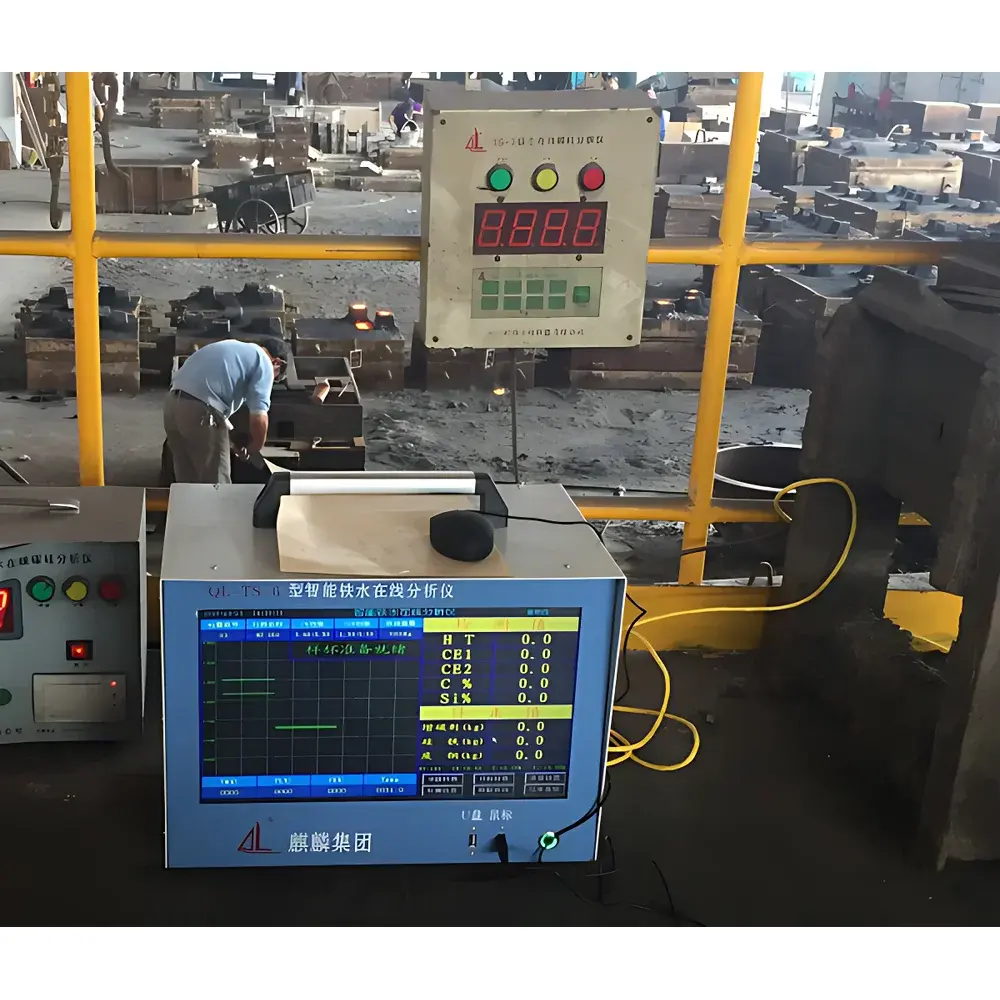
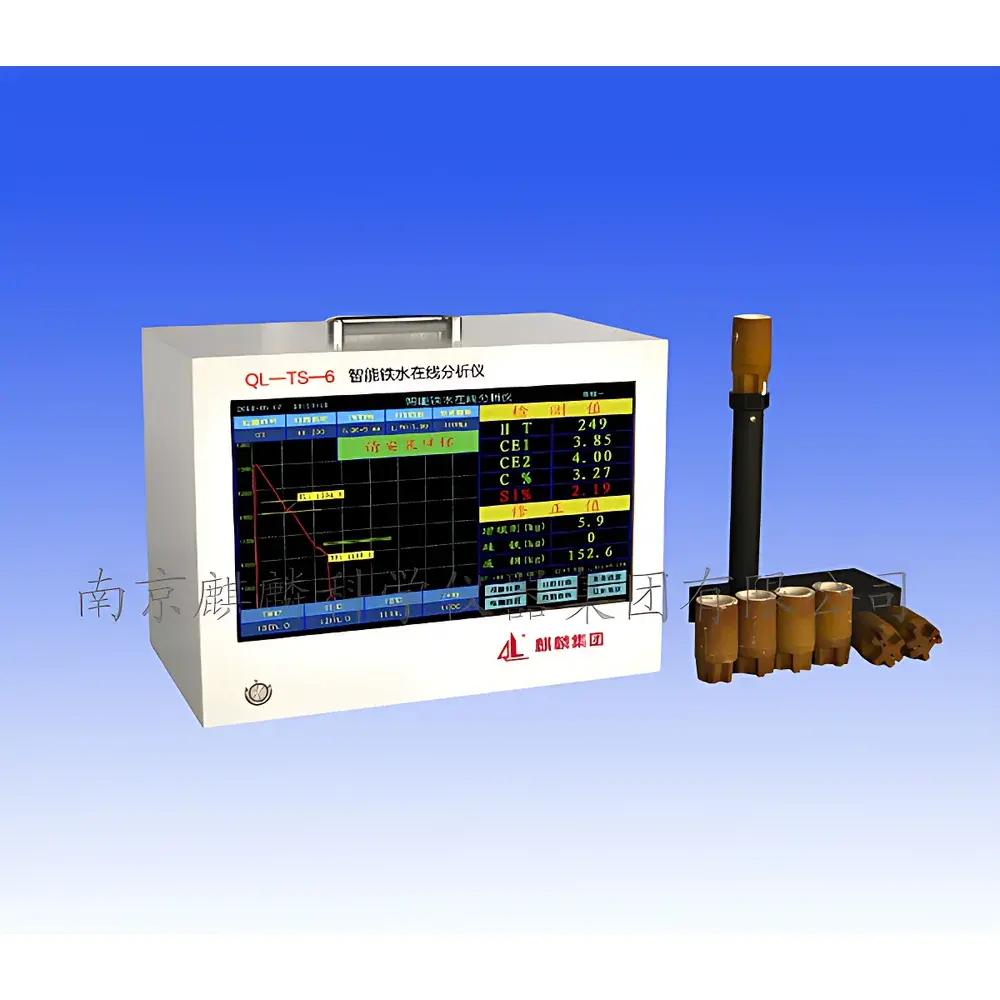
QL-TS-6 Qilin On-Line Iron Melt Carbon-Silicon Analyzer
| Brand | Qilin (QL) |
|---|---|
| Origin | Jiangsu, China |
| Model | TS-6 |
| Measurement Principle | Thermal Analysis (Solidification Curve-Based Inverse Calculation) |
| CE Range | 3.2–4.8 wt%, ±0.08 |
| C Range | 2.8–4.2 wt%, ±0.04 |
| Si Range | 0.9–3.0 wt%, ±0.04 |
| Analysis Time | ≤90 s |
| Data Storage | 3000 measurements with timestamped sequence |
| Calibration Lines | 8 user-definable |
| Target Compositions | 8 pre-set |
| Output | USB export supported |
| Display | 17″ industrial-grade LCD (fanless embedded PC platform) |
| Environmental Rating | Designed for foundry floor operation (EMI-hardened, temperature-compensated thermocouple interface) |
Overview
The QL-TS-6 Qilin On-Line Iron Melt Carbon-Silicon Analyzer is a dedicated thermal analysis instrument engineered for real-time compositional assessment of molten cast iron directly at the furnace tap. It operates on the principle of solidification thermal analysis—capturing the characteristic cooling curve of a small iron melt sample during controlled solidification and applying inverse modeling algorithms to determine carbon equivalent (CE), total carbon (C%), silicon (Si%), undercooling (ΔT), eutectic temperature (TE), liquidus temperature (TL), and derived parameters such as nodularity index (SC), tensile strength (RM), and graphitization behavior. Unlike wet chemical or spectrometric methods requiring sample transfer and preparation, the TS-6 delivers actionable compositional data within 90 seconds of sampling—enabling immediate process decisions in gray iron, ductile iron, and malleable iron production environments. Its architecture integrates an industrial fanless motherboard, ruggedized 17-inch display, and EMI-resistant signal conditioning circuitry to maintain measurement stability amid high-temperature, high-noise foundry conditions.
Key Features
- Real-time thermal analysis based on high-fidelity cooling curve acquisition using calibrated Type K thermocouples with imported temperature-compensated extension wiring
- Simultaneous calculation and display of CE, C%, Si%, ΔT, TE, TL, SC, RM, and solidification microstructure indicators
- Eight programmable calibration curves linked to eight target alloy compositions—supporting rapid grade switching across multiple iron specifications
- Automated charge calculation module: computes required additions of ferrosilicon, scrap, or inoculants based on measured composition, target specification, and batch mass
- Embedded data logging system stores up to 3000 sequential analyses with full time stamps, enabling traceability and statistical process control (SPC) review
- Graphical trend visualization: overlay plots of CE/C/Si over time; first-derivative (dT/dt) curves for precise phase transition identification
- USB-based data export functionality for integration with enterprise quality management systems (QMS) or local LIMS
- No moving parts or internal cooling fans—designed for continuous operation in ambient temperatures up to 55°C and vibration-prone casting floors
Sample Compatibility & Compliance
The TS-6 analyzer is validated for use with standard cup-type samples (typically 100–150 g) taken from cupola, induction, or electric arc furnace melts. It supports both white-iron and gray-iron solidification modes, with algorithmic differentiation between flake graphite (gray) and spheroidal graphite (ductile) solidification signatures. While not certified to ISO/IEC 17025 as a standalone testing laboratory, the instrument conforms to foundational metrological practices outlined in ASTM E1157 (Standard Specification for Sampling and Analysis of Molten Iron) and supports GLP-aligned documentation workflows—including audit-ready measurement logs, calibration history tracking, and user-access-controlled parameter settings. Its electrical design complies with IEC 61000-6-2 (immunity to industrial electromagnetic interference) and IEC 61000-6-4 (emission limits for industrial environments).
Software & Data Management
The proprietary Qilin Iron Analysis Software (v4.x) runs on a Windows Embedded Standard OS platform and features a task-oriented GUI optimized for gloved operation. Core software functions include one-click analysis initiation, automatic curve baseline correction, multi-point thermal drift compensation, and post-measurement manual adjustment of C/Si values using reference wet-chemical results—a critical capability for long-term calibration maintenance. All measurement events are stored in a structured SQLite database with immutable timestamps and operator ID fields (where configured). Export formats include CSV and XML, compatible with common SPC tools (e.g., Minitab, JMP) and ERP-integrated dashboards. The system supports 21 CFR Part 11–compliant optional modules for electronic signatures and audit trail generation upon customer request.
Applications
- On-tap quality verification of ductile iron melts prior to ladle treatment or pouring—ensuring minimum nodularity and matrix consistency
- Rapid feedback loop for charge optimization in cupola operations, reducing scrap rates associated with off-spec carbon/silicon ratios
- Monitoring inoculation effectiveness via undercooling depth and recalescence magnitude in gray iron production
- Supporting APQP and PPAP documentation by providing traceable, time-stamped compositional records per heat
- Process capability studies (Cp/Cpk) for CE control bands in automotive or heavy machinery casting lines
- Training and troubleshooting aid—cooling curve overlays help metallurgists diagnose melting inconsistencies, contamination, or refractory wear effects
FAQ
What sample size and type are required for accurate analysis?
A 100–150 g sample collected in a standard ceramic or graphite cup is sufficient. Sample must be representative, free of slag, and poured without agitation to preserve natural solidification behavior.
Can the TS-6 distinguish between gray and ductile iron grades automatically?
Yes—the software identifies solidification pattern morphology (e.g., presence/absence of recalescence peak, eutectic arrest shape) and classifies accordingly, provided the correct base alloy type is selected prior to analysis.
How often does the system require recalibration?
Initial calibration is performed using reference heats verified by spark-OES or wet chemistry. Subsequent verification is recommended every 8–12 hours of continuous operation or after any major thermocouple replacement.
Is remote monitoring or network integration supported?
Standard configuration includes USB and RS-232 interfaces. Optional Ethernet module enables Modbus TCP communication for PLC integration and centralized dashboard viewing via factory network infrastructure.
Does the analyzer meet international regulatory requirements for quality-critical foundry applications?
While not a certified metrology device, its measurement repeatability (±0.04 wt% for C and Si), documented uncertainty budget, and data integrity controls align with ISO 9001:2015 and IATF 16949 process validation expectations for in-process control equipment.




