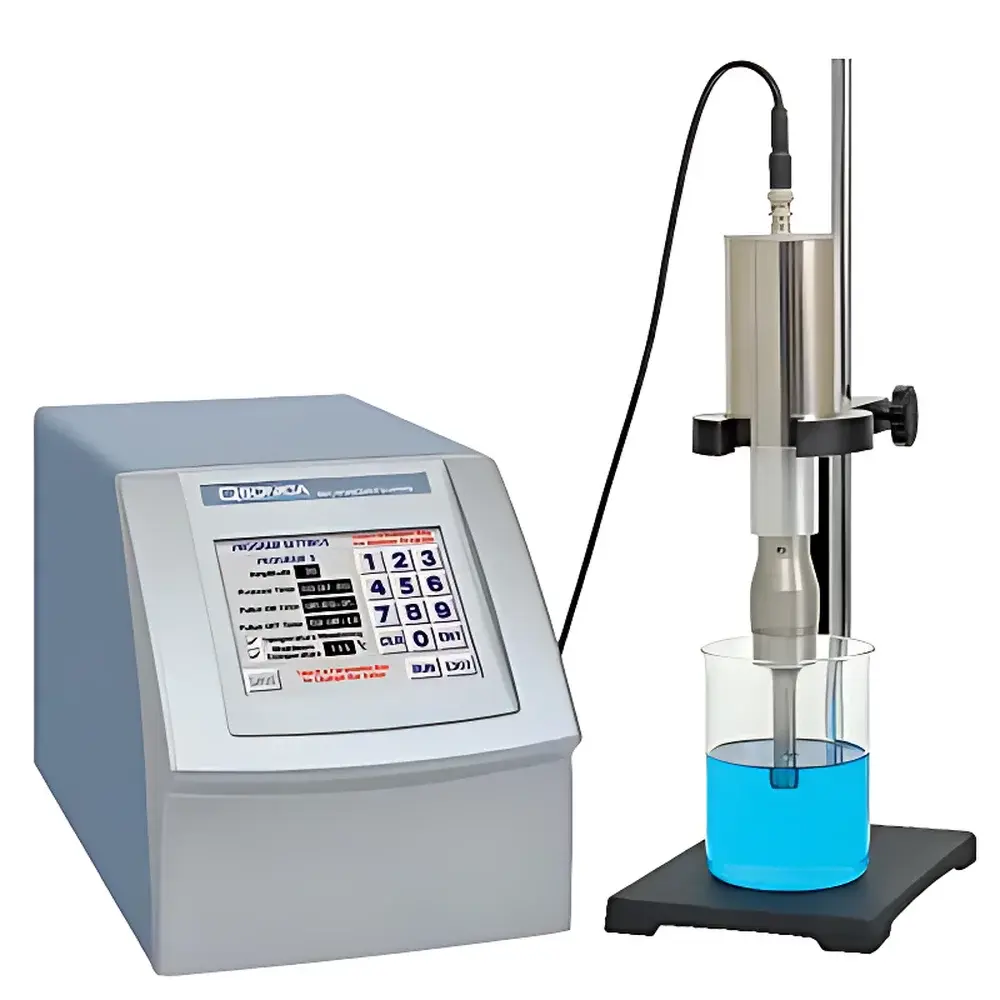
Qsonica Q700 Digital High-Intensity Ultrasonic Sonicator
| Brand | Qsonica LLC |
|---|---|
| Country of Origin | USA |
| Model | Q700 |
| Instrument Type | Ultrasonic Cell Disruptor |
| Ultrasonic Power Output | 700 W |
| Operating Frequency | 20 kHz |
| Temperature Range | 1–121 °C |
| Sample Volume Capacity | 5 µL – 1000 L (via flow cell or microtip) |
| Throughput | 1–384 samples per run |
| Compliance | UL, CE, CSA, RoHS |
Overview
The Qsonica Q700 is a digitally controlled, high-intensity ultrasonic sonicator engineered for precision cell disruption, nucleic acid shearing, protein extraction, and nano-emulsification in research and industrial life science laboratories. It operates on the principle of piezoelectric transduction: electrical energy is converted into mechanical oscillation at 20 kHz, generating intense cavitation in liquid media via titanium alloy probes (horns) directly immersed in the sample. This cavitation—characterized by rapid formation and collapse of microscopic vapor bubbles—produces localized shear forces, shockwaves, and microstreaming sufficient to lyse cells, fragment chromatin, disperse nanoparticles, and homogenize viscous suspensions. Unlike analog systems, the Q700 employs a fully digital signal processor (DSP) core to govern amplitude modulation, frequency tracking, and real-time thermal feedback—enabling reproducible energy delivery across diverse sample matrices, from low-volume microcentrifuge tubes to continuous-flow bioreactor streams up to 20 L/min.
Key Features
- Fully digital 7-inch capacitive touchscreen interface with intuitive icon-driven navigation and multilingual UI support
- Adjustable amplitude control from 0% to 100% in 0.1% increments, enabling precise energy dosing for sensitive biomolecules
- Real-time monitoring of probe temperature, instantaneous power output, cumulative energy (J), pulse duty cycle, and program progress
- Automatic frequency tuning (auto-tuning) that dynamically compensates for load changes, probe wear, and temperature drift to maintain resonant efficiency
- Programmable multi-step protocols (up to 99 steps) with independent control over amplitude, duration, pulse-on/pulse-off timing (1 s–24 h), and temperature thresholds
- Integrated safety architecture including over-temperature cutoff (probe and electronics), current overload protection, and hardware interlocks for external accessories
- Energy-efficient design reduces internal thermal load, extending transducer lifespan and minimizing ambient heat dissipation in enclosed lab environments
- Self-diagnostic system with contextual on-screen guidance, error logging, and firmware-upgradable architecture
Sample Compatibility & Compliance
The Q700 accommodates a broad spectrum of sample formats—from 5 µL in microtiter plates to 1000 L batch volumes using optional flow-through cells. Probe configurations include microtips (1/16″ to 1″ diameter), replaceable-tip horns, solid-body horns, high-amplitude boosters (2× amplification), and non-contact cup horns for high-throughput or biohazardous applications. All titanium probes are certified for autoclaving and compatible with organic solvents, aqueous buffers, and corrosive reagents. The instrument meets UL 61010-1, IEC 61000-6-3 (EMC), EN 61000-6-2, CSA C22.2 No. 61010-1, and RoHS 3 directives. While not inherently GLP/GMP-certified, its audit-ready data logging (via optional USB export or Ethernet integration), programmable SOP enforcement, and full traceability of amplitude, time, temperature, and energy make it suitable for regulated workflows aligned with FDA 21 CFR Part 11 when deployed with validated software extensions.
Software & Data Management
The Q700 stores all operational parameters and real-time sensor data internally with timestamped logs. USB export enables CSV-formatted records for LIMS integration or statistical process control (SPC) analysis. Optional Ethernet connectivity supports remote monitoring and centralized fleet management in core facilities. Software-defined calibration routines allow users to validate amplitude linearity against NIST-traceable reference standards. Audit trails capture user ID (via optional RFID badge reader), method version, parameter changes, and fault events—supporting compliance with ISO/IEC 17025 and CAP accreditation requirements for clinical and contract research laboratories.
Applications
- Cell lysis of bacterial, yeast, mammalian, and plant tissues under controlled thermal conditions
- Chromatin fragmentation for ChIP-seq and ATAC-seq library preparation
- Shearing of genomic DNA to target size distributions (150–1000 bp)
- Preparation of subcellular organelles and inclusion bodies
- Nanoparticle dispersion and stabilization in drug delivery formulations
- Emulsification of oil-in-water and water-in-oil systems for food, cosmetic, and pharmaceutical development
- Catalyst activation and sonochemical synthesis in green chemistry protocols
- Deagglomeration of carbon nanotubes, graphene oxide, and metal-organic frameworks (MOFs)
FAQ
What probe types are supported for high-throughput microplate processing?
The Q700 supports the 431C2 (24-position 2 mL tube rack) and 431MPX (multiwell plate horn with integrated acoustic enclosure) for parallel processing without cross-contamination.
Can the Q700 be integrated into automated liquid handling workflows?
Yes—via TTL-triggered start/stop signals and RS-232/Ethernet command sets, the Q700 interfaces with robotic arms, plate handlers, and LIMS platforms.
Is temperature control active during sonication?
The system monitors probe tip temperature in real time and halts operation if user-defined limits (e.g., 4°C for cold lysis) are exceeded; external chillers may be coupled to flow cells or cup horns.
How is amplitude calibrated and verified?
Amplitude is calibrated using laser vibrometry traceable to NIST standards; users can perform routine verification using the built-in diagnostic mode and optional calibration kit (QCAL-KIT).
What maintenance is required for long-term reliability?
Routine inspection of probe threads and gasket integrity, annual transducer impedance testing, and replacement of worn tips per manufacturer’s wear guidelines—no routine lubrication or alignment needed due to solid-state digital tuning.