
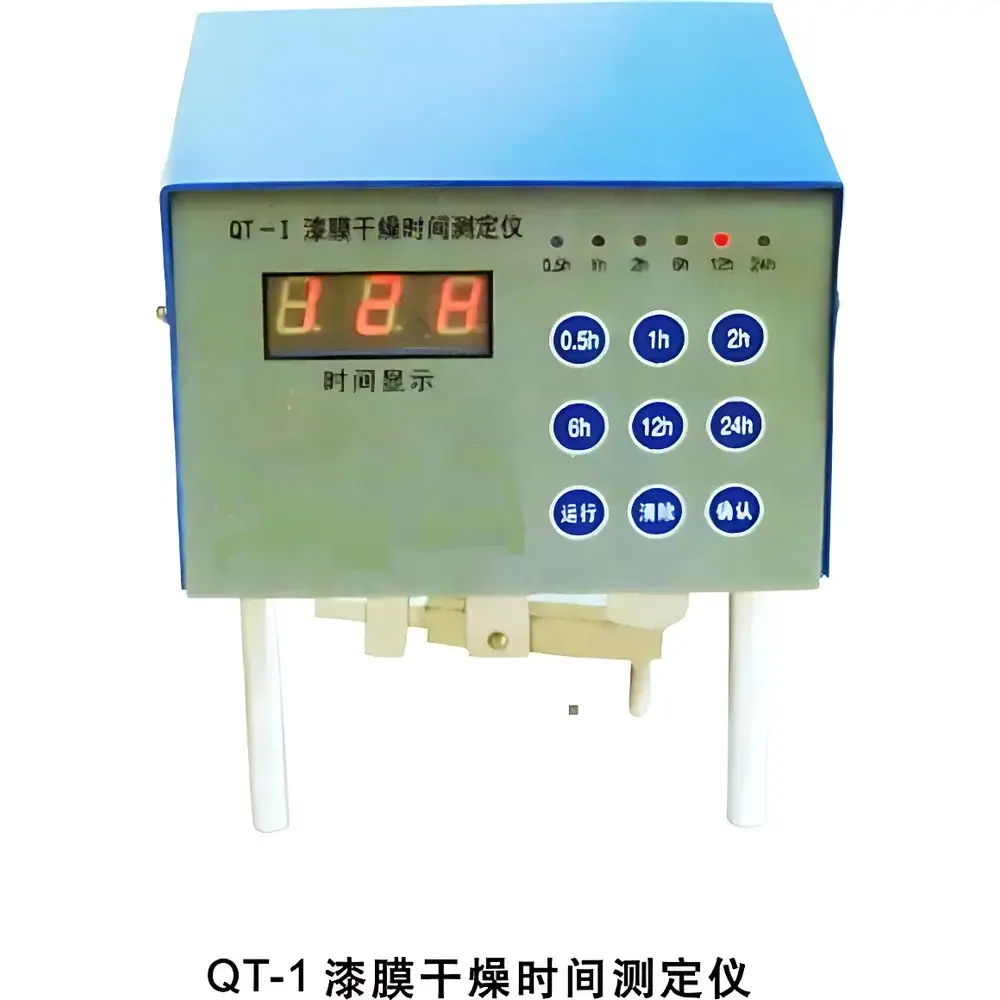
QT-I Paint Film Drying Time Tester
| Origin | Shanghai, China |
|---|---|
| Manufacturer Type | Distributor |
| Origin Category | Domestic (China-made) |
| Model | QT-I |
| Quotation | Available upon request |
| Drive Motor | 36BF02B stepper motor |
| Spherical Tip Diameter | 8 mm |
| Rotational Speed Options | 0.5, 1, 2, 6, 12, 24 h/rev |
| Applied Load | 12 g |
| Power Supply | AC 220 V, 50 Hz |
| Dimensions (L×W×H) | 140 × 140 × 156 mm |
| Test Trajectory Diameter | 80 mm |
Overview
The QT-I Paint Film Drying Time Tester is a precision mechanical instrument engineered for standardized assessment of surface coating drying kinetics in accordance with established physical testing methodologies. It operates on the principle of controlled mechanical indentation and trajectory observation: a spherical-tipped stylus (8 mm diameter), under a precisely maintained static load of 12 g, rotates at user-selectable angular velocities—ranging from 0.5 to 24 hours per revolution—tracing a consistent 80 mm diameter circular path across the freshly applied paint or varnish film. As solvent evaporation and polymer network formation progress, the viscoelastic properties of the coating evolve; the point at which the stylus-induced trace becomes imperceptible (i.e., fully “healed” or non-deformable under the test load) defines the “dry-to-touch” or “dry-through” endpoint, determined by overlaying the observed trace retention position onto a calibrated drying time chart. This method aligns conceptually with ASTM D1640 and ISO 9117-1 for drying time evaluation, emphasizing reproducible mechanical stimulus rather than subjective tactile judgment.
Key Features
- Microcontroller-driven 36BF02B high-resolution stepper motor ensures precise, repeatable rotational timing across six discrete speed settings (0.5, 1, 2, 6, 12, and 24 h/rev), enabling granular temporal resolution during early- and late-stage drying phases.
- Calibrated 12 g dead-weight loading mechanism maintains constant normal force without drift or hysteresis, critical for inter-laboratory comparability and compliance with standard test protocols.
- 8 mm spherical contact tip provides uniform stress distribution and minimizes localized plastic deformation, supporting consistent trace formation across diverse film thicknesses (typically 25–150 µm) and substrate types (metal, glass, wood, or primed panels).
- Compact benchtop footprint (140 × 140 × 156 mm) with rigid aluminum alloy housing ensures mechanical stability during operation and facilitates integration into QC laboratories, R&D facilities, and production line inspection stations.
- No software dependency or external computing hardware required—operation is fully self-contained, reducing validation burden in regulated environments where firmware simplicity supports GLP/GMP audit readiness.
Sample Compatibility & Compliance
The QT-I tester accommodates standard coated test panels per ASTM D609, ISO 1514, or GB/T 9271, including cold-rolled steel, aluminum, and glass substrates prepared with representative primer/topcoat systems. It is validated for use with solvent-borne, water-borne, UV-curable, and high-solids architectural and industrial coatings—including alkyds, epoxies, polyurethanes, acrylics, and latex formulations. While not an electronic data-logging device, its mechanical design inherently satisfies core requirements of ISO/IEC 17025 for measurement traceability when paired with certified reference panels and documented procedural controls. The 12 g load and 8 mm radius geometry conform to the mechanical boundary conditions referenced in ISO 9117-1 Annex A for “tack-free” and “hard-dry” endpoint determination.
Software & Data Management
The QT-I operates as a standalone electromechanical instrument with no embedded firmware, cloud connectivity, or proprietary software interface. All operational parameters—including selected rotation speed, elapsed time, and visual trace evaluation—are recorded manually by the operator using standardized laboratory notebooks or LIMS-integrated paper-based forms. This architecture eliminates cybersecurity risks, avoids 21 CFR Part 11 electronic signature complexities, and simplifies qualification (IQ/OQ/PQ) in pharmaceutical excipient coating labs or automotive OEM supplier facilities where regulatory auditors prioritize deterministic mechanical behavior over digital features. Traceability is maintained through operator ID, panel lot number, environmental log (temperature/humidity per ASTM D2247), and dated drying chart overlays.
Applications
- Quality control release testing of incoming raw material batches (e.g., resins, crosslinkers) and finished coatings prior to shipment.
- R&D formulation screening for drying rate optimization—comparing catalyst concentration, coalescing agent selection, or solvent blend volatility profiles.
- Process validation of curing oven dwell times, IR lamp intensities, or ambient flash-off staging in coil coating, can manufacturing, and automotive refinishing lines.
- Technical service support for field troubleshooting of premature dust pickup, blocking, or insufficient sandability in multi-layer systems.
- Educational demonstration of polymer film formation kinetics in university materials science and paint technology curricula.
FAQ
What drying stages can the QT-I instrument differentiate?
It primarily evaluates “dry-to-touch” (tack-free) and “hard-dry” endpoints, corresponding to the disappearance of the stylus trace under 12 g load at defined rotational speeds—consistent with ISO 9117-1 Stages 2 and 4.
Is calibration certification provided with the instrument?
The unit includes factory verification of motor timing accuracy and load mass tolerance (±0.2 g); users must perform periodic verification using NIST-traceable weights and stopwatch timing per internal SOP.
Can it be used for powder coatings?
No—it requires a liquid or paste-like film capable of temporary deformation; fully fused thermoset powder films lack the viscoelastic recovery needed for trace observation.
Does it comply with FDA or EU REACH requirements?
The instrument itself is not subject to REACH or FDA product regulations; however, its use supports compliance with coating migration limits (e.g., EU 10/2011) by enabling consistent drying validation that prevents under-cured layers prone to extractables.
What maintenance is required?
Biannual inspection of stylus sphericity (using optical profilometry), cleaning of guide rails with isopropyl alcohol, and verification of motor torque response—no lubrication or firmware updates are necessary.



