
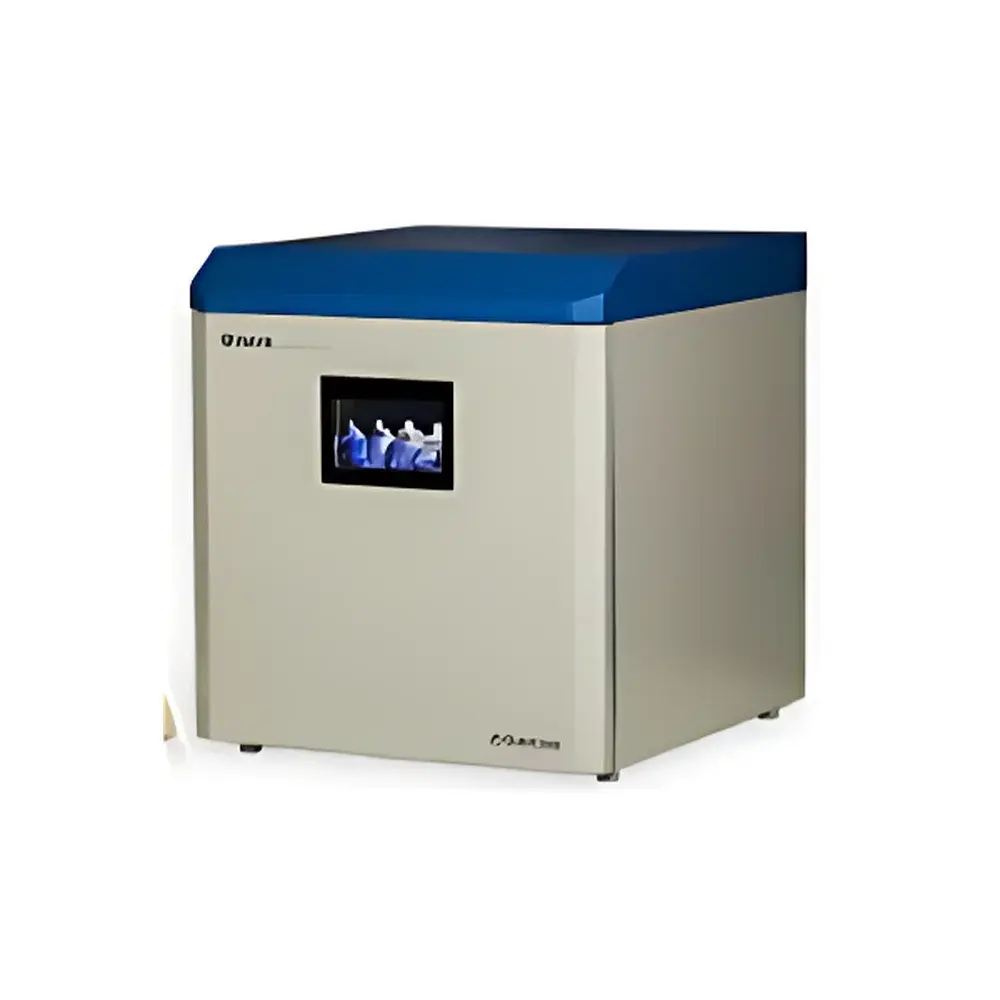
Qtechcorp QWave 2000 Microwave Digestion System
| Brand | Qtechcorp |
|---|---|
| Origin | Canada |
| Model | QWave 2000 |
| Sample Capacity | 42 vessels |
| Microwave Source | Dual magnetron |
| Maximum Temperature | 230 °C |
| Power Output | 1200 W |
| Frequency | 2450 MHz |
| Cavity Coating | PTFE-reinforced corrosion-resistant interior |
| Exhaust Flow Rate | 150 CFM |
| Safety Systems | QSens™ real-time pressure/temperature interlock, OPGuard™ active overpressure release, dual IR + fiber-optic temperature monitoring (±0.1 °C), auto-power modulation, rotating turntable + rotating microwave feed |
| Control Interface | 10.9 cm TFT-LCD touchscreen (480 × 272 px, 400 MHz processor) |
| Method Storage | 10 time-temperature, 5 time-power profiles |
| Software | QLAB Analyst™ PC application with audit trail, method synchronization, and GLP-compliant data export |
| Dimensions (W×D×H) | 58 × 61 × 64 cm |
| Weight | 75 kg |
| Electrical Supply | 220 VAC, 50 Hz, 15 A |
Overview
The Qtechcorp QWave 2000 Microwave Digestion System is a CE-marked, laboratory-grade instrument engineered for reproducible, high-throughput sample preparation in environmental, geochemical, clinical, and regulatory testing laboratories. It employs closed-vessel microwave-assisted acid digestion—based on controlled dielectric heating at 2450 MHz—to rapidly and completely decompose organic matrices and mineral lattices using HNO₃, HCl, HF, and H₂O₂ under elevated temperature (up to 230 °C) and pressure (typically ≤ 80 bar). Unlike open-vessel hotplate digestion, the QWave 2000 delivers accelerated reaction kinetics while minimizing analyte loss, contamination risk, and reagent blank contribution. Its dual-magnetron architecture, combined with synchronized cavity rotation and dynamic microwave field modulation, ensures uniform energy distribution across all 42 sample positions—critical for inter-vial precision in multi-sample workflows compliant with EPA Methods 3050B, 3051A, 3052, and ISO 11466.
Key Features
- Dual independent 600 W magnetrons with phase-synchronized emission for stable power delivery and reduced standing-wave artifacts
- QSens™ integrated safety platform: continuously cross-validates real-time cavity pressure, vessel temperature (via embedded fiber-optic probe, ±0.1 °C accuracy), and infrared surface temperature to trigger immediate magnetron shutdown, audible alarm, and visual warning upon deviation from user-defined thresholds
- OPGuard™ mechanical pressure-release system: passive rupture disc + active vent-valve cascade that initiates sequential exhaust at preset overpressure limits (configurable from 40–80 bar), followed by forced-air cooling via 150 CFM centrifugal blower
- Auto-load power adaptation: dynamically adjusts microwave output based on real-time thermal mass feedback, preventing runaway heating of low-volume or dry samples
- PTFE-coated stainless-steel cavity (39 × 34 × 30.5 cm internal) resistant to fuming acids, halogens, and condensate corrosion—validated per ASTM B117 salt-spray testing for ≥10,000 cycles
- Rotating turntable + rotating waveguide feed ensures spatially homogeneous field distribution, achieving <±1.5 °C inter-vial temperature variance at 200 °C (n=42, certified per ISO/IEC 17025 calibration protocol)
- Integrated 10.9 cm full-color TFT-LCD touchscreen with intuitive icon-driven navigation, real-time graphical plotting of T/P/time curves, and on-device method editing without external hardware
Sample Compatibility & Compliance
The QWave 2000 accommodates standard 55 mL quartz or reinforced PTFE-TFM digestion vessels (e.g., SCP Science, Milestone, CEM), supporting both single-use and reusable configurations. It meets IEC 61000-4 electromagnetic compatibility requirements and complies with CSA C22.2 No. 61010-1:2012 for laboratory equipment safety. For regulated environments, the system supports 21 CFR Part 11–compliant operation when used with QLAB Analyst™ software: electronic signatures, immutable audit trails, role-based access control, and method versioning are fully implemented. All safety-critical events—including pressure excursions, temperature overshoots, door interlock breaches, and cooling-fan failure—are timestamped and logged with device ID, operator ID, and method context. The instrument is routinely validated per USP Analytical Instrument Qualification protocols (DQ/IQ/OQ/PQ) and referenced in EPA Region 5 QA Handbook Section 4.3 for trace-metal digestion validation.
Software & Data Management
QLAB Analyst™ is a Windows-based desktop application enabling remote method deployment, real-time instrument monitoring, and post-run data analysis. It provides automated report generation conforming to ISO/IEC 17025 clause 7.8.2, with embedded metadata capture (vessel lot numbers, acid batch IDs, calibration certificates). Raw sensor data (T, P, power %, time) is stored in vendor-neutral CSV and XML formats; spectral plots support overlay comparison across batches. Audit logs retain full history of user actions—including method modifications, parameter overrides, and emergency stops—with SHA-256 hash integrity verification. Data export modules include direct integration with LIMS platforms via ASTM E1384-compliant HL7 messaging and secure SFTP transfer with TLS 1.2 encryption.
Applications
- Environmental: Total recoverable metals (As, Cd, Cr, Pb, Hg, Ni) in soils, sediments, sludges, and wastewater per EPA 6010D, 6020B, and 7000B
- Geochemical: Rare earth element (REE) and platinum-group metal (PGM) dissolution in silicate rocks and ores using HF-HNO₃-HClO₄ mixtures
- Clinical & Food: Lead, cadmium, and arsenic quantification in biological tissues, infant formula, and seafood matrices (AOAC 999.10, EN 13805:2014)
- Materials Science: Dissolution of catalysts, battery cathodes (NMC, LFP), and ceramic composites prior to ICP-MS or ICP-OES analysis
- Method Development: Controlled optimization of ramp rates, hold times, and acid stoichiometry for novel matrices including carbon nanotubes and polymer composites
FAQ
Does the QWave 2000 support EPA Method 3052 for silicate digestion?
Yes—the system’s 230 °C maximum temperature and pressure-rated vessels (≥100 bar burst tolerance) meet the thermal and containment requirements specified in EPA Method 3052 for microwave-assisted hydrofluoric acid digestion.
Can QLAB Analyst™ generate 21 CFR Part 11–compliant electronic records?
Yes—when configured with server authentication, digital certificate signing, and audit-log retention policies, QLAB Analyst™ satisfies all technical controls outlined in FDA guidance for electronic records and signatures.
What is the calibration interval recommendation for temperature and pressure sensors?
Qtechcorp recommends annual third-party calibration against NIST-traceable references, with in-house verification using certified reference materials (CRMs) before each high-stakes analytical batch.
Is the cavity accessible for cleaning without tools?
Yes—the PTFE-coated interior features seamless welds and a removable stainless-steel floor plate secured by finger-tightened clamps; no disassembly tools are required for routine maintenance.
How does the dual-magnetron design improve method robustness compared to single-source systems?
Dual magnetrons enable load-balanced power delivery and redundancy—if one unit degrades or fails mid-run, the system automatically compensates using the remaining unit while maintaining setpoint accuracy within ±3% of target power.
Related Products



