
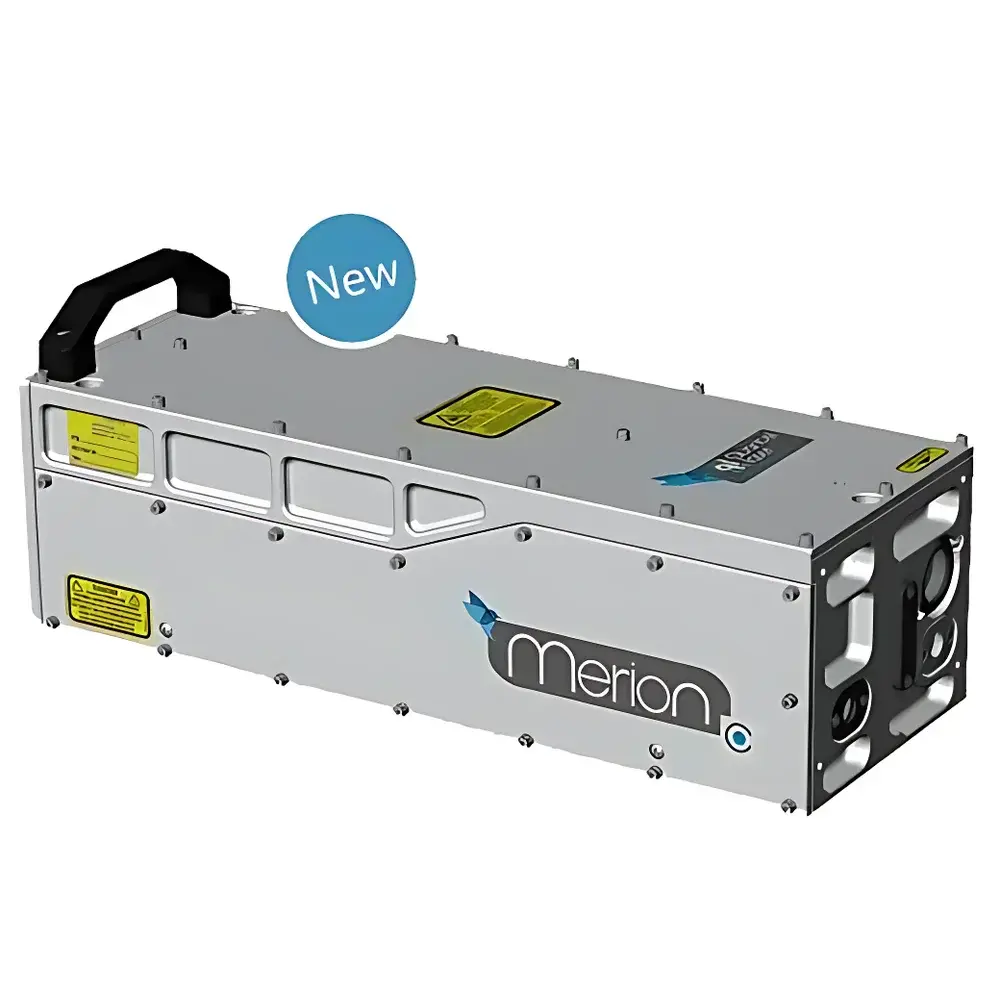
Quantel Merion C Compact Diode-Pumped Q-Switched Solid-State Laser
| Brand | Quantel |
|---|---|
| Origin | France |
| Model | Merion C |
| Type | Diode-Pumped Solid-State (DPSS) Q-Switched Laser |
| Output Wavelengths | 1064 nm, 532 nm, 355 nm |
| Repetition Rate | Up to 400 Hz |
| Pulse Energy | 100 mJ @ 1064 nm, 50 mJ @ 532 nm, 30 mJ @ 355 nm |
| Pulse Width | < 10 ns @ 1064 nm |
| Beam Divergence | < 5 mrad @ 1064 nm (S4), < 1 mrad @ 1064 nm (G4) |
| Pulse-to-Pulse Energy Stability | < 0.5% (p-p) |
| Cooling | Internal recirculating water cooling |
| Laser Head Dimensions | 120.1 × 416.1 × 150.2 mm |
| Power Supply Dimensions | 177.4 × 482.6 × 457.2 mm |
Overview
The Quantel Merion C is a compact, industrial-grade diode-pumped solid-state (DPSS) Q-switched laser engineered for high-repetition-rate, high-energy pulsed operation in demanding scientific and applied photonics environments. Unlike conventional flashlamp-pumped Nd:YAG lasers—limited by thermal loading and pump efficiency to repetition rates of 10–20 Hz—the Merion C leverages quasi-continuous-wave (QCW) high-power semiconductor diode pumping to achieve up to 400 Hz at near-joule-class pulse energies (100 mJ @ 1064 nm). This architecture overcomes the classical trade-off between pulse energy and repetition rate inherent in DPSS systems, delivering exceptional wall-plug efficiency, long-term stability, and reduced thermal lensing. The laser operates on the fundamental Nd:YAG transition at 1064 nm, with harmonics generated via integrated, motorized harmonic modules (532 nm and 355 nm). Its design reflects Quantel’s five-decade heritage in ruggedized Q-switched laser engineering, incorporating field-proven mechanical robustness, hermetically sealed optics, and deterministic alignment retention.
Key Features
- Compact, fully sealed laser head with industrial-grade aluminum housing and integrated recirculating water cooling—no external chiller required
- Two optical configurations: Merion C-S4 (standard beam quality, divergence < 5 mrad) and Merion C-G4 (Gaussian-like beam, divergence < 1 mrad)
- Plug-and-play operation with zero user alignment; factory pre-aligned harmonic generation modules with automated phase-matching
- Modular harmonic generation system supporting simultaneous or selectable 1064 nm / 532 nm / 355 nm output
- Diode pump source lifetime exceeding 1 billion shots—significantly longer than flashlamp alternatives
- Remote control via Ethernet (TCP/IP) and RS-232 interfaces; compatible with LabVIEW, Python, and MATLAB drivers
- Interchangeable laser heads for rapid maintenance or wavelength reconfiguration without system recalibration
Sample Compatibility & Compliance
The Merion C is designed for integration into OEM instrumentation platforms and regulated laboratory environments. Its stable pulse parameters and low pulse-to-pulse energy variation (< 0.5% p-p) support quantitative applications requiring traceable repeatability. The system complies with IEC 60825-1:2014 (laser safety class 4), CE marking for EMC and LVD directives, and RoHS 2011/65/EU. For GLP/GMP-compliant workflows—including LIBS-based elemental analysis or OPO-pumped spectroscopy—the laser supports optional audit-trail logging and time-stamped event records via its embedded controller. While not inherently FDA 21 CFR Part 11 compliant, its communication protocols and firmware architecture allow integration with validated third-party data acquisition systems meeting regulatory requirements.
Software & Data Management
The Merion C is managed through Quantel’s proprietary Laser Control Software (LCS), a Windows-based application providing real-time monitoring of pulse energy, repetition rate, temperature, and diode current. LCS enables full parameter scripting, trigger delay adjustment (±10 µs resolution), burst mode sequencing, and automated calibration routines. All operational logs—including timestamps, error codes, and environmental sensor readings—are exportable in CSV or XML format. For custom integration, Quantel provides a comprehensive SDK with documented C/C++, .NET, and Python APIs. Firmware updates are performed via secure HTTP upload, with version rollback capability and SHA-256 integrity verification.
Applications
- OPO Pumping: Stable 1064 nm fundamental output enables efficient nanosecond-pumped optical parametric oscillation across UV–IR spectral ranges for tunable spectroscopy
- LIDAR & Atmospheric Sensing: High pulse energy and narrow divergence support long-range elastic/inelastic backscatter measurements, including differential absorption LIDAR (DIAL)
- LIBS (Laser-Induced Breakdown Spectroscopy): Consistent ablation threshold performance across metallic, ceramic, and geological samples due to tight pulse energy stability
- Photoacoustic Imaging: Sub-10 ns pulses generate broadband acoustic waves with high signal-to-noise ratio in biological tissue and contrast agents
- Ti:Sapphire Pumping: Synchronized 1064 nm output serves as reliable pump source for femtosecond oscillator-amplifier systems
- Laser Ablation & PIV: Precise spatiotemporal control enables single-shot surface modification and dual-pulse particle image velocimetry with sub-microsecond inter-pulse timing
FAQ
What is the expected diode pump lifetime under continuous operation?
Quantel specifies a minimum diode lifetime of 1 × 10⁹ shots at rated operating conditions, corresponding to >2 years of typical lab use at 400 Hz, 8 h/day.
Can the Merion C be operated in burst mode?
Yes—LCS supports programmable burst sequences with user-defined intra-burst frequency, number of pulses per burst, and inter-burst delay.
Is external water cooling required?
No—the laser head and power supply incorporate independent internal recirculating chillers; only ambient air exchange is needed for heat dissipation.
How is beam pointing stability maintained over thermal cycles?
The monolithic, stress-free optical mount design and thermally symmetric cavity layout ensure beam pointing drift < 5 µrad/°C over the operating range (15–30 °C).
Are harmonic modules field-replaceable?
Yes—all harmonic generators are modular, pre-aligned units that can be swapped in under 15 minutes using standard Torx tools—no realignment or certification required.




