
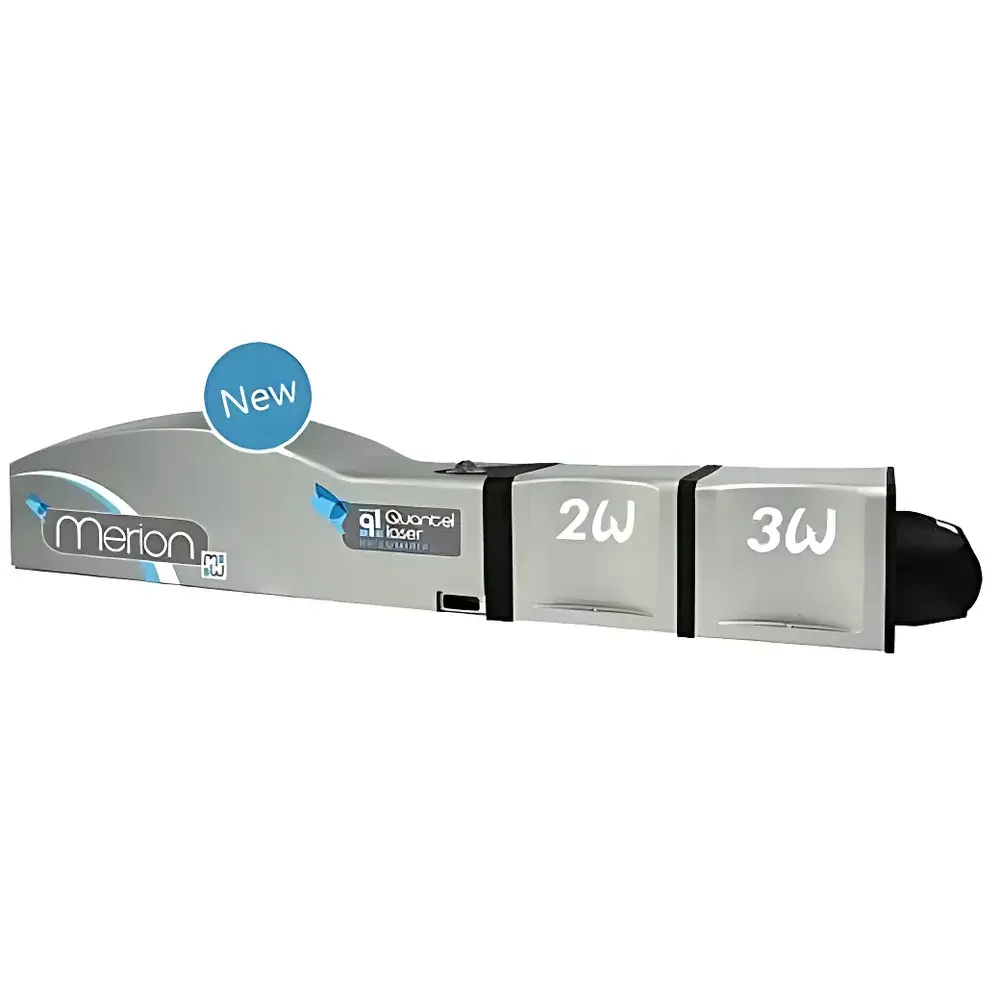
Quantel Merion MW Modular DPSS Pulsed Solid-State Laser
| Brand | Quantel |
|---|---|
| Origin | France |
| Model | Merion MW |
| Type | Diode-Pumped Solid-State (DPSS) Q-Switched Laser System |
| Wavelengths | 1064 nm (fundamental), 532 nm (SHG), 355 nm (THG), 266 nm (FHG) |
| Repetition Rate | up to 200 Hz |
| Pulse Energy (1064 nm) | up to 650 mJ |
| Pulse Width (1064 nm) | 5–9 ns |
| Beam Divergence (1064 nm) | <1 mrad |
| Polarization | Vertical, >90% polarization purity |
| Cooling | Integrated recirculating chiller (optional external chiller) |
| Dimensions (Laser Head) | 526 × 125 × 147 mm |
| Weight (Laser Head) | <8 kg |
Overview
The Quantel Merion MW is a modular, diode-pumped solid-state (DPSS) Q-switched laser system engineered for high-repetition-rate, high-energy pulsed operation in demanding scientific and industrial applications. Based on proven Nd:YAG gain media and proprietary quasi-continuous-wave (QCW) high-power semiconductor pump technology, the Merion MW bridges the performance gap between traditional flashlamp-pumped Nd:YAG lasers (high pulse energy but low repetition rate) and CW-diode-pumped systems (high repetition rate but limited pulse energy). It delivers up to 650 mJ at 1064 nm with stable 5–9 ns pulses at repetition rates up to 200 Hz—enabling orders-of-magnitude improvement in average power and duty cycle without compromising pulse-to-pulse stability or beam quality.
Key Features
- Modular harmonic generation architecture: Plug-and-play frequency conversion modules for automatic phase-matching at 532 nm (SHG), 355 nm (THG), and 266 nm (FHG), enabling rapid wavelength reconfiguration without realignment.
- Robust, field-deployable mechanical design: Compact laser head (526 × 125 × 147 mm) and lightweight harmonic modules (<4 kg each) facilitate integration into mobile platforms, airborne LiDAR systems, or space-constrained lab setups.
- Industrial-grade thermal management: Integrated recirculating water cooling system; optional external chiller support for extended duty cycles or ambient temperature fluctuations.
- High reliability and service life: Pump diodes rated for >2 billion shots — significantly exceeding industry norms for QCW DPSS lasers — reducing total cost of ownership and downtime.
- Zero-alignment operation: Factory-optimized cavity and harmonic modules eliminate user calibration; true “plug-and-play” deployment with quick-disconnect electrical and fluid interfaces.
- Optional single longitudinal mode (SLM) configuration available for applications requiring narrow linewidth and long coherence length, such as coherent LIDAR or high-resolution spectroscopy.
Sample Compatibility & Compliance
The Merion MW is designed for compatibility with standard optical tables, beam delivery optics, and OEM integration frameworks. Its output meets ISO 11146-compliant beam parameter specifications (M² < 2 typical, divergence <1 mrad), ensuring predictable propagation and focusing behavior across all harmonics. The system adheres to IEC 60825-1:2014 Class 4 laser safety requirements, with integrated interlocks, emission indicators, and key-controlled enable circuitry. For regulated environments—including GLP/GMP laboratories and FDA-regulated instrumentation—the laser supports audit-trail-capable software logging (via Quantel’s Q-Lab Suite) compliant with 21 CFR Part 11 when paired with validated configurations.
Software & Data Management
Control and monitoring are executed via Quantel’s Q-Lab software suite, a Windows-based application offering real-time pulse energy monitoring, shot counter tracking, thermal status feedback, and remote diagnostics over Ethernet or USB. All operational parameters—including repetition rate, Q-switch delay, harmonic selection, and internal temperature setpoints—are programmable and scriptable via ASCII command protocol (SCPI-compatible). Data export is supported in CSV and HDF5 formats for traceable analysis in MATLAB, Python, or LabVIEW environments. Firmware updates and calibration logs are digitally signed and version-controlled to ensure metrological integrity and compliance readiness.
Applications
- LIDAR & Atmospheric Sensing: High-energy 1064 nm and 355 nm pulses enable long-range elastic and Raman LIDAR, differential absorption LIDAR (DIAL), and aerosol profiling with high signal-to-noise ratio.
- OPO Pumping: Stable 1064 nm output serves as an efficient pump source for nanosecond OPOs generating tunable mid-IR radiation (e.g., 2–5 µm) for trace gas detection and combustion diagnostics.
- Photoacoustic Imaging: High peak power at 532 nm and 1064 nm enables deep-tissue optoacoustic excitation with improved spatial resolution and penetration depth.
- Ti:Sapphire Pumping: Synchronized 1064 nm pulses provide reliable pumping for ultrafast amplifier systems requiring precise timing and low amplitude noise.
- Material Processing & Shock Peening: Controlled ablation, surface texturing, and laser shock peening benefit from consistent pulse energy, tight beam quality, and high repetition rate scalability.
- Laser-Induced Fluorescence (LIF) & Time-Resolved Spectroscopy: Nanosecond pulse width and multi-wavelength flexibility support excitation of diverse fluorophores and transient species kinetics studies.
FAQ
What is the maximum achievable pulse energy at 355 nm?
Up to 200 mJ at 355 nm (Merion MW 9-100 configuration), with pulse-to-pulse stability (rms) better than 0.8% under nominal operating conditions.
Can the Merion MW be synchronized with external equipment?
Yes — the system provides TTL-compatible trigger input/output ports with adjustable delay (0–100 ms, 10 ns resolution) and jitter <1 ns RMS, supporting precise synchronization with cameras, scanners, or RF drivers.
Is water cooling mandatory, or can air cooling be used?
Water cooling is required. The integrated recirculating chiller maintains optimal crystal temperature; air-cooled operation is not supported due to thermal load constraints in high-duty-cycle modes.
Does the system support remote control via Ethernet?
Yes — full SCPI-compliant command set accessible over TCP/IP; no proprietary drivers required. Integration with EPICS, LabVIEW, or Python-based automation frameworks is documented and validated.
What maintenance is required during routine operation?
No periodic optical alignment or consumable replacement is needed. Recommended annual verification includes coolant conductivity check, interlock continuity test, and energy calibration using a NIST-traceable pyroelectric sensor.





