
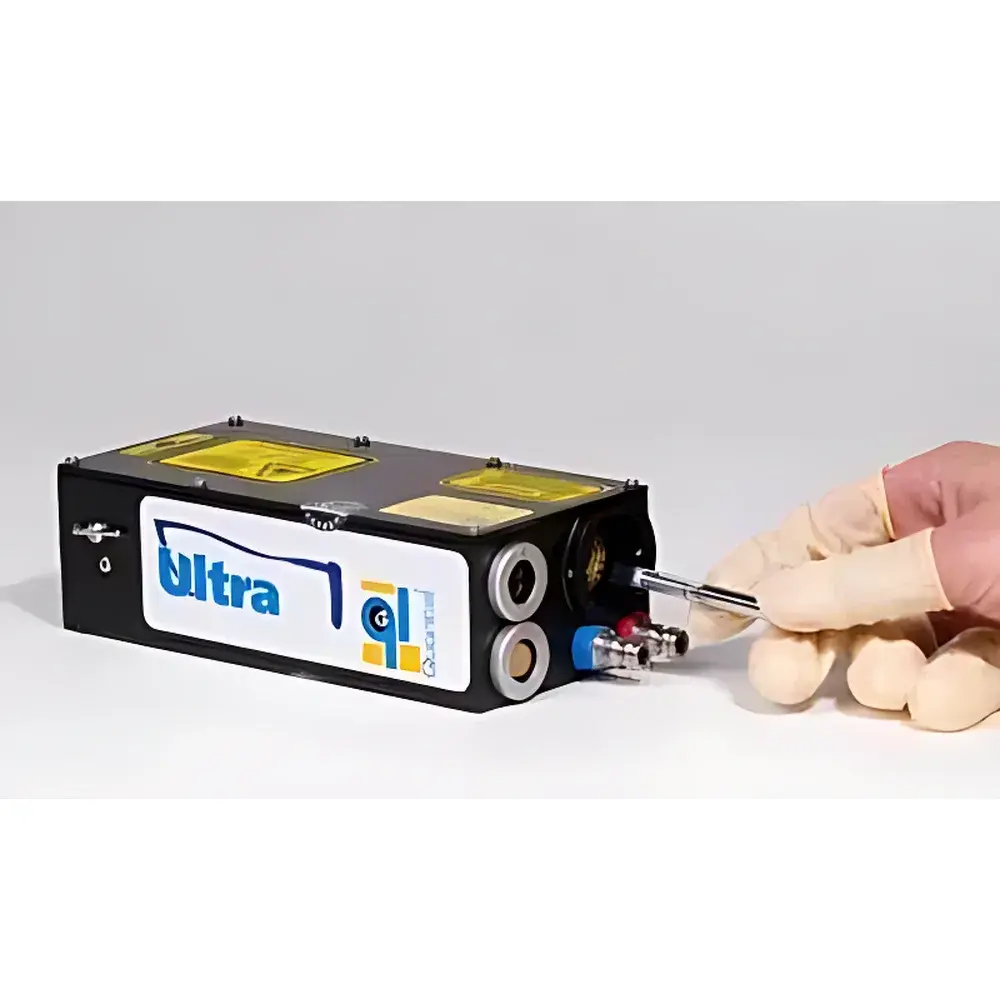
Quantel Ultra & CFR Series Nd:YAG Lasers
| Brand | Quantel |
|---|---|
| Origin | France |
| Model Series | Ultra, CFR |
| Laser Type | Flashlamp-Pumped Q-Switched Nd:YAG |
| Wavelength Options | 1064 nm, 532 nm, 355 nm, 266 nm, 213 nm, 1570 nm |
| Cooling | Air-Cooled |
| Operation Mode | Q-Switched Pulsed |
| Pulse Energy Range | Up to Several Hundred mJ (Model-Dependent) |
| Repetition Rate | 1–20 Hz (Configurable) |
| Beam Quality | TEM₀₀ (Diffraction-Limited, M² < 1.3) |
| Stability | < ±1% RMS Pulse Energy Over 8 Hours |
| Environmental Rating | IP54 Equivalent |
| Compliance | CE, RoHS, IEC 60825-1:2014 (Class 4 Laser Product) |
Overview
The Quantel Ultra and CFR Series Nd:YAG lasers represent a mature, field-proven platform of flashlamp-pumped, Q-switched solid-state lasers engineered for high-reliability operation in demanding scientific, industrial, and field-deployable applications. Based on the legacy Big Sky product line acquired by Quantel (now part of Lumibird), these systems employ a monolithic folded-resonator cavity architecture with rigidly mounted optical components—including Nd:YAG rod, Q-switch, harmonic generation crystals, and output coupler—fully integrated and permanently aligned within a hermetically sealed laser head. This design eliminates sensitivity to thermal drift and mechanical perturbation, enabling continuous unattended operation (24/7) without realignment or active stabilization. The fundamental 1064 nm output supports efficient intra-cavity or external harmonic generation to deliver discrete wavelengths at 532 nm (second harmonic), 355 nm (third), 266 nm (fourth), 213 nm (fifth), and 1570 nm (optical parametric oscillator–based eye-safe output), making the series uniquely versatile across spectroscopy, LIDAR, remote sensing, LIBS, and time-resolved fluorescence applications.
Key Features
- Monolithic folded-cavity design minimizes footprint while maximizing mechanical and thermal stability.
- Hermetically sealed laser head with all optics kinematically locked—no field alignment required throughout service life.
- Ruggedized construction validated via accelerated temperature cycling (−20 °C to +60 °C) and broadband vibration testing (5–500 Hz, 2 g RMS), supporting deployment in mobile labs, airborne platforms, and outdoor monitoring stations.
- Tool-free flashlamp replacement: lamps are accessed externally without breaking cavity seal or disturbing optical alignment.
- Integrated thermal management using passive convection and optimized heat-sink geometry—no chiller or liquid cooling required.
- Low-noise, high-stability pulse triggering with jitter < 1 ns (RMS), compatible with external synchronization for pump-probe or time-of-flight experiments.
Sample Compatibility & Compliance
These lasers are not sample-contact instruments; rather, they serve as stable, calibrated excitation sources for downstream optical measurement systems—including spectrometers, photodetectors, ICCDs, and time-correlated single-photon counting modules. Their wavelength options comply with common requirements in ASTM E2912 (LIBS calibration), ISO 11146 (laser beam parameter measurements), and EN 60825-1:2014 for Class 4 laser safety classification. Each unit is supplied with full laser safety documentation, interlock-ready connectors, and optional beam attenuation kits meeting ANSI Z136.1 standards. The 1570 nm variant satisfies IEC 60825-1 Annex D criteria for “eye-safe” operation under defined exposure conditions, facilitating use in open-path atmospheric sensing without restrictive enclosure requirements.
Software & Data Management
Quantel provides the QDrive™ control suite—a Windows-based application supporting local USB/Ethernet interface for full parameter configuration (pulse energy, repetition rate, Q-switch delay, harmonic selection). All operational parameters and diagnostic logs (lamp firings, thermal sensor readings, power supply status) are timestamped and exportable in CSV format for traceability. The software architecture supports integration into LabVIEW, MATLAB, and Python environments via documented SCPI command set and DLL libraries. Audit trails and user-access logging are configurable to meet GLP/GMP-aligned workflows where instrument usage records must be retained for regulatory review (e.g., FDA 21 CFR Part 11 compliance achievable with supplemental IT infrastructure).
Applications
- Laser-Induced Breakdown Spectroscopy (LIBS) for elemental analysis in geology, metallurgy, and nuclear safeguards.
- Differential Absorption LIDAR (DIAL) and Raman LIDAR for atmospheric profiling of H₂O, O₃, CH₄, and aerosols.
- Pump-probe transient absorption spectroscopy in photochemistry and ultrafast materials science.
- Time-resolved fluorescence lifetime imaging (FLIM) and upconversion microscopy requiring precise nanosecond gating.
- Calibration source for radiometric and photometric transfer standards in national metrology institutes.
- Industrial marking, micromachining, and thin-film ablation where pulse-to-pulse stability directly impacts process yield.
FAQ
What is the typical pulse width for Ultra and CFR series lasers?
Standard Q-switched pulse widths range from 4–8 ns FWHM at 1064 nm, depending on model configuration and operating energy level.
Can these lasers operate continuously for extended periods without intervention?
Yes—designed for 24/7 operation with 10⁶ lamp shot lifetime under nominal conditions.
Is harmonic generation internal or external?
Harmonic modules are integrated into the laser head for 532 nm, 355 nm, and 266 nm outputs; 213 nm and 1570 nm configurations use external OPO or SHG stages optimized for those wavelengths.
Do these lasers support external triggering and synchronization?
Yes—TTL-compatible sync input/output ports enable precise master-slave timing with sub-nanosecond jitter relative to external event triggers.
What maintenance is required beyond lamp replacement?
None—optical alignment, cavity tuning, and crystal repositioning are permanently fixed; only periodic flashlamp replacement (every 10⁶ shots) and basic exterior cleaning are recommended.




