
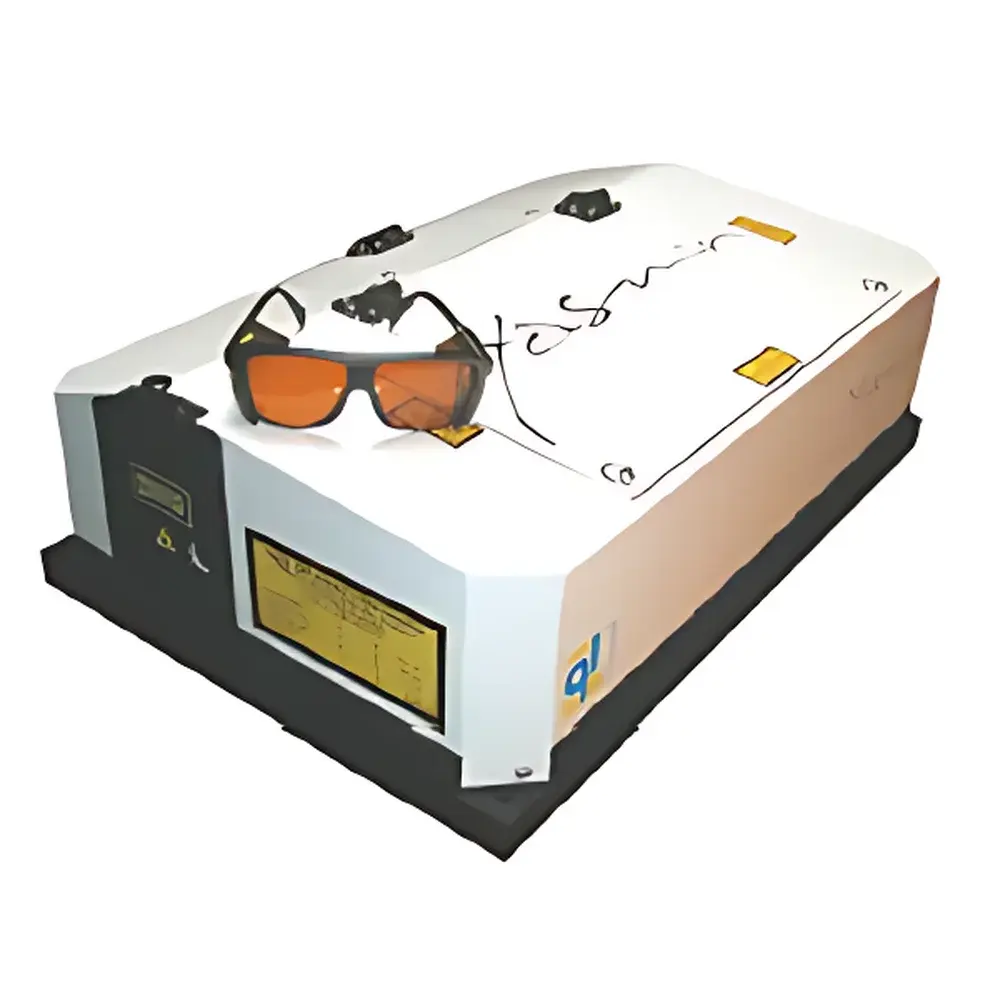
Quantel Yasmin Industrial High-Energy Pulsed Laser System
| Brand | Quantel |
|---|---|
| Origin | France |
| Model | Yasmin |
| Laser Type | Flashlamp-Pumped Q-Switched Nd:YAG Laser |
| Repetition Rate | ≥100 Hz |
| Pulse Energy | >100 mJ @ 1064 nm |
| Lamp Lifetime | >200 million shots |
| Operation Mode | Continuous 24/7 industrial duty cycle |
| Beam Quality | TEM₀₀ (M² < 1.3) |
| Cooling | Forced-air or closed-loop chiller compatible |
| Dimensions | Compact benchtop footprint (< 600 × 400 × 250 mm) |
| Compliance | CE, RoHS, IEC 60825-1:2014 Class 4 Laser Product |
Overview
The Quantel Yasmin is a high-reliability, flashlamp-pumped, Q-switched Nd:YAG laser system engineered for demanding industrial material processing applications requiring both high single-pulse energy and sustained high repetition rate operation. Unlike diode-pumped solid-state (DPSS) lasers optimized for average power, the Yasmin leverages mature lamp-pumped architecture to deliver >100 mJ pulse energy at 1064 nm with stable temporal profile and excellent spatial coherence—enabling efficient ablation, drilling, surface texturing, and thin-film removal across metals, ceramics, and composites. Its design prioritizes robustness for factory-floor integration: sealed optical cavity, vibration-damped mechanical housing, and thermally stabilized resonator ensure consistent beam pointing stability (< 5 µrad/°C) and pulse-to-pulse energy stability (< ±1.5% RMS over 8 hours). The system operates at repetition rates up to 200 Hz—significantly exceeding conventional lamp-pumped lasers—without compromising pulse energy or lifetime, making it uniquely suited for high-throughput manufacturing where throughput scales linearly with rep rate under fixed fluence constraints.
Key Features
- Industrial-grade flashlamp with proven >200 million shot lifetime—validated under continuous 24/7 operation at full specification
- Integrated thermal management architecture supporting forced-air or external chiller cooling, enabling stable output in ambient temperatures from 15 °C to 35 °C
- Compact monolithic chassis (< 600 mm × 400 mm × 250 mm) designed for OEM integration into automated workcells or gantry-mounted processing stations
- TEM₀₀-dominated output beam (M² < 1.3) with near-diffraction-limited focusability—critical for achieving sub-50 µm feature sizes in precision micromachining
- Full internal diagnostics suite including lamp voltage/current monitoring, cavity temperature logging, and pulse energy feedback via integrated photodiode
- Compliance-ready control interface supporting TTL, RS-232, and Ethernet (TCP/IP) for synchronization with motion controllers, galvanometers, and PLCs
Sample Compatibility & Compliance
The Yasmin is compatible with standard industrial beam delivery optics—including F-theta scan lenses, fiber-coupled articulated arms (with optional harmonic generation modules), and custom vacuum-compatible beam paths. It supports fundamental (1064 nm), second-harmonic (532 nm), and third-harmonic (355 nm) outputs via optional external harmonic generators, expanding applicability to polymers and transparent substrates sensitive to UV wavelengths. From a regulatory standpoint, the system conforms to IEC 60825-1:2014 (Class 4 laser product), CE marking per 2014/35/EU (Low Voltage Directive) and 2014/30/EU (EMC Directive), and RoHS 2011/65/EU. Built-in interlock circuitry meets EN 61496-1 requirements for laser safeguarding integration. Optional FDA-compliant documentation packages—including DHF, DMR, and risk analysis per ISO 14971—are available for medical device manufacturing environments subject to 21 CFR Part 820.
Software & Data Management
The Yasmin ships with Quantel’s LaserLink™ control software—a Windows-based application supporting real-time parameter adjustment (pulse energy, rep rate, Q-switch delay), waveform capture, and automated calibration routines. All operational data—including shot count, cumulative lamp usage, thermal history, and pulse energy logs—is timestamped and stored in SQLite format with configurable export to CSV or industry-standard HDF5. Audit trail functionality complies with GLP/GMP data integrity requirements: user access levels, change tracking, and electronic signatures are enforced per ALCOA+ principles. Remote monitoring via OPC UA or MQTT enables integration into MES platforms (e.g., Siemens Opcenter, Rockwell FactoryTalk) for predictive maintenance scheduling based on lamp degradation trends.
Applications
- High-speed via drilling in PCB and flex-circuit substrates (FR-4, polyimide, ceramic LTCC)
- Surface structuring of turbine blades and orthopedic implants for enhanced biointegration
- Thin-film removal (ITO, SiNₓ, DLC) in display manufacturing without substrate thermal damage
- Laser-induced forward transfer (LIFT) of functional nanomaterials in printed electronics
- Marking and engraving of aerospace-grade titanium alloys under NADCAP-approved processes
- Pre-processing of battery electrode foils prior to coating to improve adhesion uniformity
FAQ
What is the typical warm-up time required to achieve specified pulse energy stability?
Less than 15 minutes from cold start; full specification stability (±1.5% pulse energy) is achieved within 10 minutes after reaching nominal operating temperature.
Can the Yasmin be operated in burst mode with variable intra-burst frequencies?
Yes—via external TTL triggering with programmable burst envelopes (up to 16 pulses/burst) and adjustable inter-pulse delays from 10 µs to 10 ms.
Is harmonic generation included as standard or optional?
Fundamental 1064 nm output is standard; 532 nm and 355 nm harmonic modules are field-installable options with factory alignment certification.
Does the system support external energy regulation via closed-loop feedback?
Yes—integrated photodiode signal is accessible via BNC output and can be fed to external PID controllers for active pulse energy stabilization.
What maintenance intervals are recommended for industrial 24/7 operation?
No scheduled maintenance is required; lamp replacement is the sole consumable, with service life monitored continuously and predicted via embedded algorithm—typically 12–18 months depending on rep rate and average power loading.





