
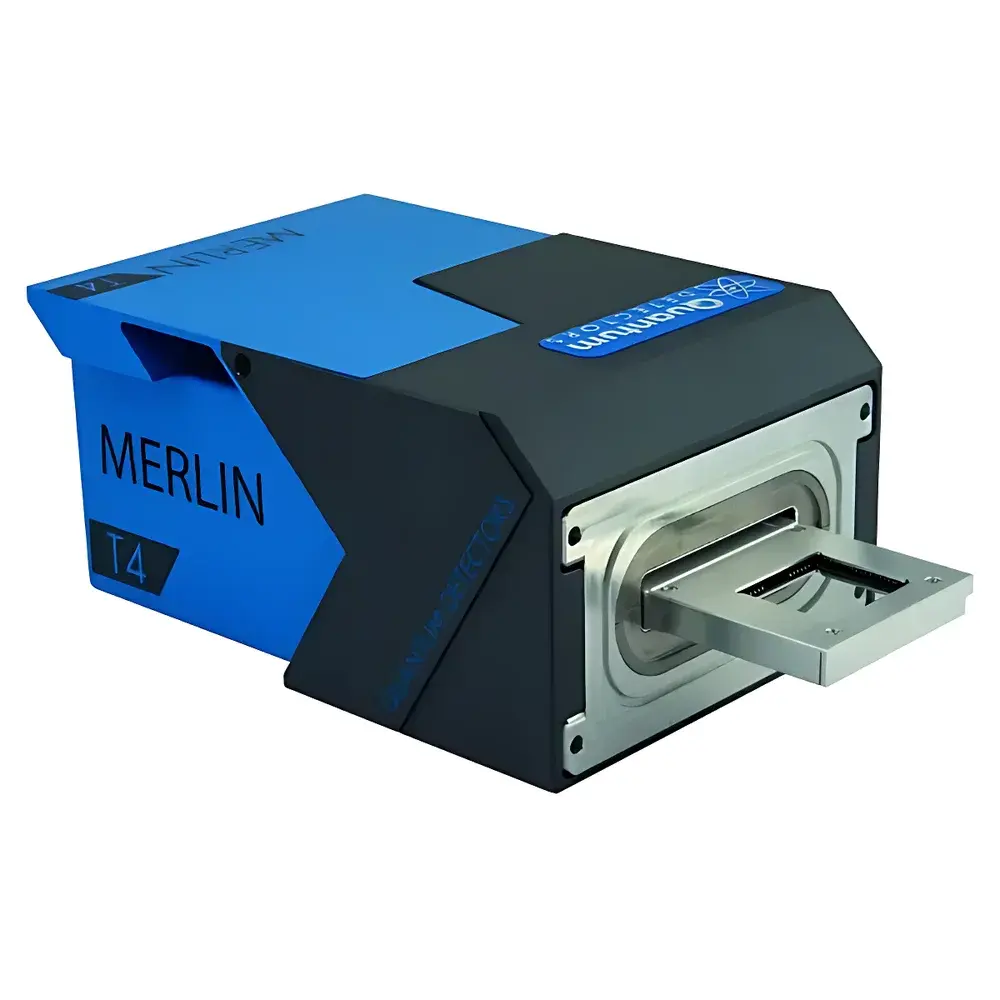
Quantum Detectors MERLIN T4 Hybrid Pixel Direct Electron Detector
| Brand | Quantum Detectors |
|---|---|
| Origin | United Kingdom |
| Manufacturer Type | Authorized Distributor |
| Origin Category | Imported |
| Model | MERLIN T4 |
| Pricing | Upon Request |
Overview
The Quantum Detectors MERLIN T4 is a next-generation hybrid pixel direct electron detector engineered for high-speed, low-dose, and time-resolved transmission electron microscopy (TEM). Built upon the CERN-developed Timepix4 ASIC fabricated in 65 nm CMOS technology, the MERLIN T4 eliminates analog signal conversion stages—replacing traditional scintillator-based detection with monolithic silicon sensor architecture. This enables true single-electron sensitivity, zero readout noise, and event-driven acquisition with 200 ps temporal resolution. Unlike CCD or indirect CMOS detectors that suffer from light spread, afterglow, and quantum efficiency loss, the MERLIN T4 captures incident electrons directly in silicon, preserving spatial fidelity, energy discrimination, and timing accuracy across the full operational range of 30–300 keV. Its fully data-driven readout architecture supports sustained throughput exceeding 40,000 fps in frame-driven mode and >10⁶ equivalent frames per second in event-driven mode—making it uniquely suited for 4D-STEM, ultrafast electron diffraction, ptychography, MicroED, and dose-limited cryo-EM workflows.
Key Features
- Event-driven acquisition with 200 ps timestamp precision per electron, enabling time-resolved structural dynamics studies
- Frame-driven operation at >40,000 fps (full-frame, 512 × 448 pixels) with sub-microsecond exposure control
- Direct electron detection without scintillator or fiber optic coupling—ensuring 100% quantum detection efficiency (QDE) and no point-spread degradation
- Hybrid pixel architecture with multi-chip tiling, delivering 694 mm² active area and 55 µm pixel pitch
- Radiation-hardened CMOS design qualified for continuous operation at 30–300 keV, eliminating need for beam stoppers even at 300 kV
- Integrated hardware scan engine for seamless synchronization with Thermo Fisher, JEOL, and NanoMEGAS TEM platforms
- Fiber-optic data interface supporting up to 10 m cable length without signal attenuation or timing jitter
- Compact, vacuum-compatible mechanical design with retractable mounting and passive thermal management—no liquid cooling required
Sample Compatibility & Compliance
The MERLIN T4 is validated for use with beam-sensitive specimens including 2D materials (e.g., graphene, TMDCs), zeolites, organic thin films, and frozen-hydrated biological samples. Its sub-single-electron dose capability enables quantitative imaging at doses below 1 e⁻/Ų—critical for preserving structural integrity during tilt-series acquisition or serial section tomography. The detector complies with international TEM instrumentation standards for vacuum interface dimensions (CF-100 or CF-150 flange options), electrical safety (IEC 61010-1), and electromagnetic compatibility (EN 61326-1). Firmware and acquisition software support audit trails, user access controls, and electronic signatures in accordance with GLP and GMP-aligned laboratory practices. While not FDA-certified as a medical device, its data integrity features—including deterministic timestamping, lossless event logging, and non-volatile metadata embedding—are aligned with 21 CFR Part 11 principles for regulated research environments.
Software & Data Management
Acquisition and processing are managed via Quantum Detectors’ proprietary Merlin Control Software (v5.x), which provides real-time visualization, ROI-based histogramming, energy thresholding, and on-the-fly event clustering. Raw data is stored in HDF5 format with embedded metadata (beam energy, magnification, stage position, exposure mode, timestamp calibration), ensuring FAIR (Findable, Accessible, Interoperable, Reusable) compliance. The software SDK supports Python and C++ APIs for integration into custom analysis pipelines—including Py4DSTEM, HyperSpy, and TomoJ. All firmware, FPGA logic, and host drivers are developed in-house by Quantum Detectors, guaranteeing full stack traceability and long-term maintenance. Continuous acquisition sessions exceeding 24 hours have been demonstrated in national lab settings without memory leakage or timing drift.
Applications
- 4D-STEM: Full diffraction pattern acquisition at every probe position, enabling strain mapping, electric/magnetic field reconstruction, and differential phase contrast (DPC) with sub-nanometer spatial and picosecond temporal fidelity
- MicroED / 3D Electron Diffraction: High-dynamic-range, zero-noise counting for ab initio structure solution from nanocrystals <100 nm in size, with complete preservation of weak high-resolution reflections
- Ptychography: Coherent diffractive imaging using oversampled far-field patterns; MERLIN T4’s single-electron sensitivity ensures accurate modulation transfer function (MTF) characterization down to Nyquist-limited resolution
- Ultrafast Electron Diffraction (UED): Time-resolved pump-probe experiments leveraging 200 ps event stamping to resolve lattice dynamics, phonon propagation, and photoinduced phase transitions
- Cryo-EM Dose Fractionation: Adaptive exposure control and per-frame dose monitoring for optimal signal-to-noise ratio in single-particle analysis without ice contamination or beam-induced motion
FAQ
What vacuum interfaces does the MERLIN T4 support?
Standard configurations include CF-100 and CF-150 flanges compatible with JEOL, Thermo Fisher, and Hitachi TEM columns. Custom vacuum feedthroughs are available upon request.
Is the MERLIN T4 compatible with existing TEM control software?
Yes—native plugins are provided for FEI/TFS Avizo, DigitalMicrograph (Gatan), and JEOL JEMS. API-level integration with custom LabVIEW or Python-based control systems is also supported.
Does the detector require liquid nitrogen or external cooling?
No. Passive thermal management via optimized copper heat sinking and low-power FPGA architecture eliminates need for cryogenic or chiller-based cooling.
How is radiation damage mitigated in the sensor?
The Timepix4 ASIC incorporates radiation-tolerant design techniques—including guard rings, enclosed layout transistors, and hardened gate oxides—validated for >10¹⁵ e⁻/cm² fluence at 300 keV.
Can the MERLIN T4 operate in both event and frame modes simultaneously?
No—acquisition mode is selected prior to run initiation. However, rapid reconfiguration (<500 ms) allows alternating between modes within a single session for hybrid experiments.



