
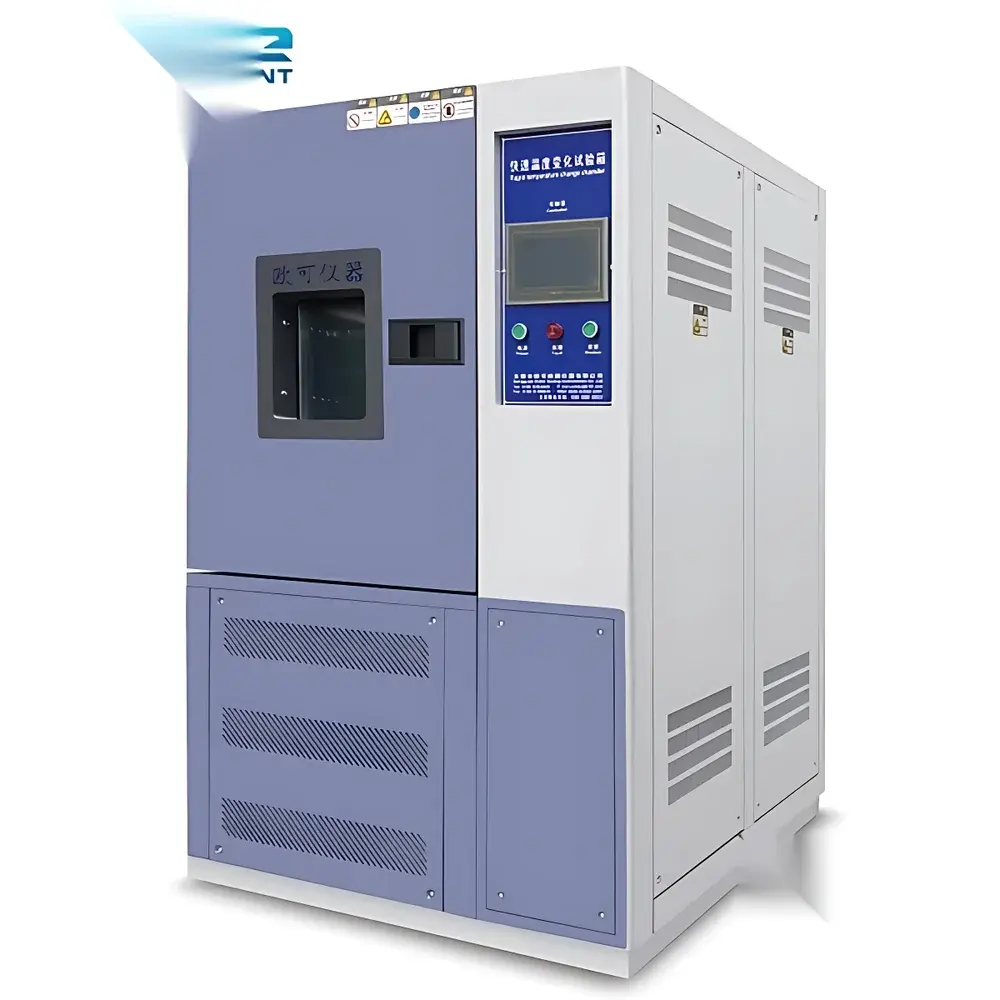
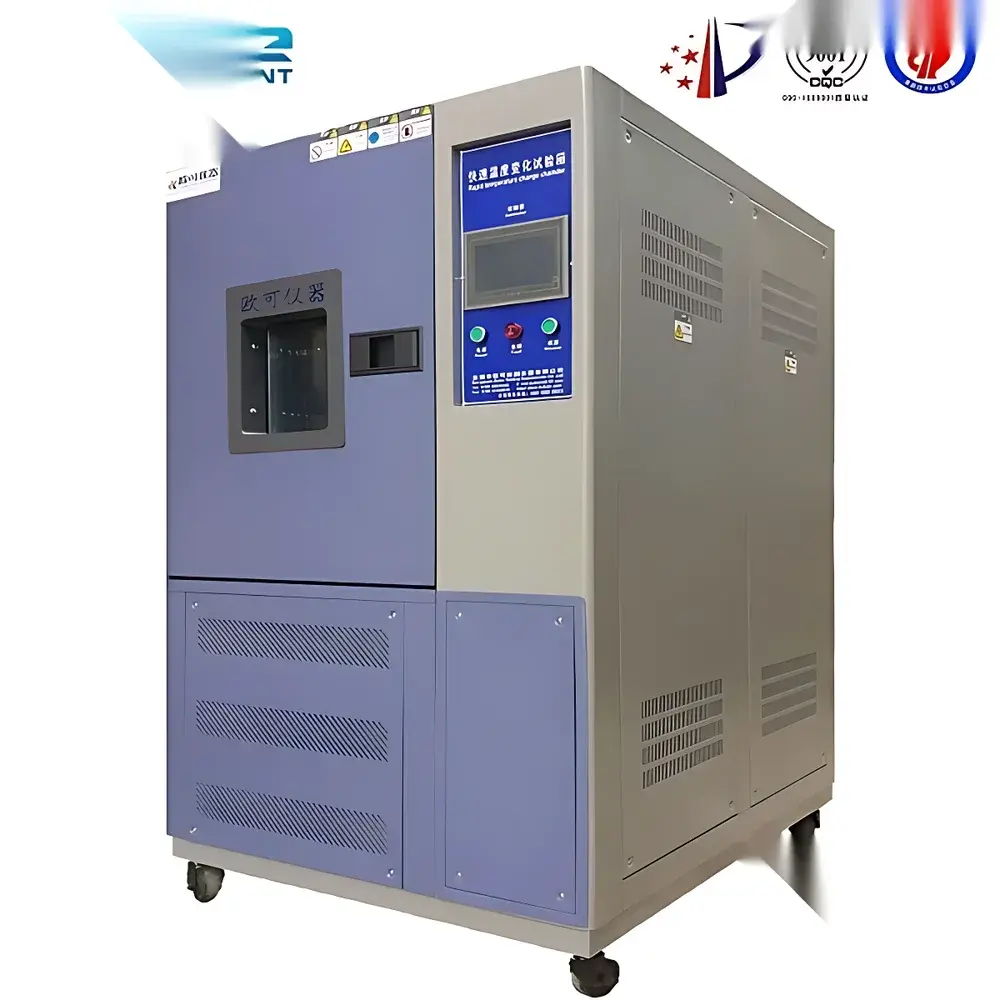
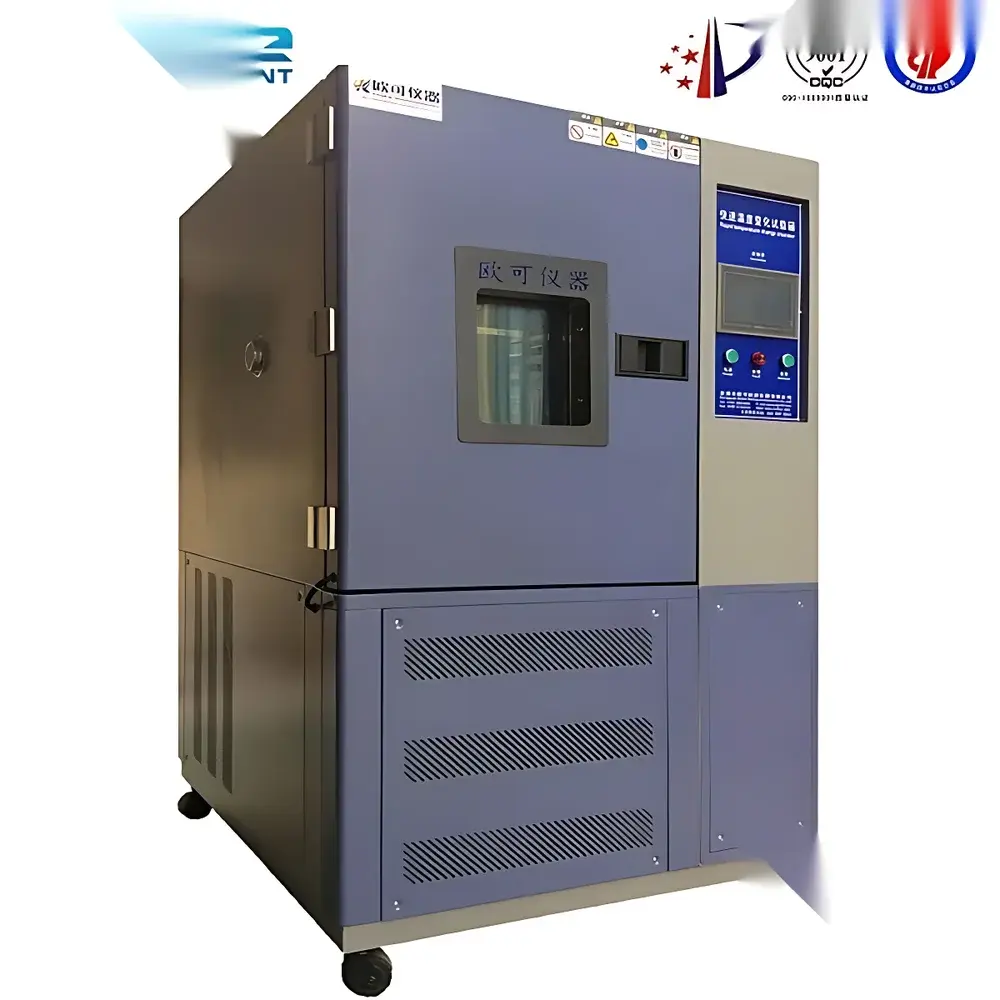
Quick-Cycle Thermal Shock Test Chamber
| Brand | Other Brands |
|---|---|
| Origin | Imported |
| Manufacturer Type | Authorized Distributor |
| Price | USD 2,650 (FOB) |
| Temperature Range | -70°C to +150°C |
| Rapid Thermal Cycling Range | -45°C to +85°C |
| Max Linear Ramp Rate | 15°C/min |
| Humidity Range (Optional) | 5–98% RH |
| Temp. Resolution/Accuracy | 0.1°C / ±0.5°C |
| Humidity Resolution/Accuracy | 0.1% RH / ±2.5% RH |
| Internal Construction | SUS304 Stainless Steel (Matte Finish) |
| Insulation | High-Density Polyurethane Foam with Closed-Cell Structure |
| Cooling System | Air-Cooled or Water-Cooled Configurations Available |
| Compressor | Tecumseh (France) |
| Refrigerant | R-404A & R-501 (EPA-Compliant, Ozone-Safe) |
| Controller | LCD Touchscreen Interface with Multi-Step Programmable Profiles (Ramp/Soak, Quick Jump, Slope Control) |
| Viewing Window | Double-Layer Tempered Glass with Anti-Condensation Heater & Fluorescent Illumination |
| Sealing | Dual-Gasket Door Seal with Positive-Pressure Compression |
| Mobility | Integrated Casters with Locking Brakes |
| Test Port | Ø50 mm Standard Penetration Port (Sealed Grommet Included) |
| Compliance | Designed per IEC 60068-2-14, MIL-STD-810H Method 503.7, JIS Z 8702, and ASTM D4329 Annex A3 for Accelerated Environmental Stress Screening (ESS) |
Overview
The Quick-Cycle Thermal Shock Test Chamber is an engineered environmental stress screening (ESS) system designed for high-fidelity simulation of rapid thermal transients encountered in aerospace, automotive electronics, semiconductor packaging, and military-grade component qualification. Operating on the principle of forced-air convection combined with dual-stage refrigeration and precision PID-controlled heating, this chamber delivers tightly regulated, repeatable thermal profiles across a broad operational envelope. Its core capability lies in achieving linear ramp rates up to 15°C/min within the accelerated cycling range (−45°C to +85°C), enabling accelerated life testing, solder joint reliability assessment, and failure mode identification under extreme thermal gradients. Unlike conventional temperature chambers, it integrates real-time profile interpolation and dynamic compressor modulation to maintain linearity without overshoot—critical for validating thermal expansion coefficient mismatches in multi-material assemblies.
Key Features
- High-speed linear thermal ramp control (3–15°C/min adjustable in 0.1°C/min increments) with closed-loop feedback from redundant Pt100 sensors mounted at multiple internal locations
- Dual-gasketed, pressure-sealed door assembly with silicone elastomer seals rated for continuous operation at −70°C and +150°C
- Double-glazed observation window featuring integrated anti-condensation heating film and UV-stable fluorescent illumination (PL-type, 2,800 lm output)
- Tecumseh (France) hermetic scroll compressors paired with EPA-approved R-404A/R-501 refrigerant blend—compliant with Montreal Protocol Phase-Out Schedule and EU F-Gas Regulation (EU No 517/2014)
- LCD touchscreen controller supporting up to 99 programmable steps per profile, including ramp/soak, slope-defined transitions, and quick-jump commands with user-definable dwell times
- Standard Ø50 mm test port with removable rubber grommet for external signal/power feedthrough; optional RF-shielded or fiber-optic variants available
- Full SUS304 stainless steel interior and exterior housing with matte electropolished finish (Ra ≤ 0.8 µm) and corrosion-resistant hardware
- Mobility system with four heavy-duty polyurethane casters (two with mechanical locking brakes) and adjustable leveling feet for ISO Class 5 cleanroom-compatible placement
Sample Compatibility & Compliance
This chamber accommodates test specimens up to 600 × 600 × 600 mm (W×D×H) with maximum payload mass of 50 kg. It supports standard sample trays, PCB carriers, and custom fixture mounting via M6 threaded inserts on the base plate. The system meets essential requirements for environmental testing standards including IEC 60068-2-14 (Change of Temperature), MIL-STD-810H Method 503.7 (Temperature Shock), JIS Z 8702 (Environmental Testing Methods), and ASTM D4329 Annex A3 (Accelerated Weathering of Plastics). Optional humidity control (5–98% RH) extends applicability to combined environmental stress screening (CESS) per IPC-9701A and JEDEC JESD22-A104F. All models are supplied with factory calibration certificates traceable to NIST standards and include GLP-compliant audit trails for temperature/humidity logging.
Software & Data Management
The embedded controller firmware supports USB export of time-stamped CSV data logs (temperature, humidity, setpoint, alarm status) at user-selectable intervals (1 s to 60 min). Optional Ethernet connectivity enables remote monitoring and control via industry-standard Modbus TCP or HTTP REST API interfaces. For regulated environments, optional software packages provide 21 CFR Part 11 compliance—including electronic signatures, role-based access control, and immutable audit trails with timestamped operator actions. Data integrity is preserved through cyclic redundancy checking (CRC-32) and automatic backup to internal flash memory upon power interruption.
Applications
- Thermal shock validation of automotive ECUs, ADAS sensors, and battery management systems (BMS) per ISO 16750-4
- Solder joint fatigue analysis in surface-mount assemblies using JEDEC JESD22-A104F-defined profiles
- Qualification of MEMS devices, optical modules, and ceramic capacitors subjected to rapid ambient excursions
- Material compatibility testing of conformal coatings, potting compounds, and thermal interface materials (TIMs)
- Reliability screening of avionics components prior to DO-160G Section 4.4 (Temperature Variation) certification
- Accelerated aging studies for medical device housings and implantable electronics per ISO 10993-12
FAQ
What is the difference between linear and non-linear ramp modes?
Linear mode enforces constant rate control with active compensation for thermal inertia; non-linear mode prioritizes minimum transition time and may exhibit slight overshoot—ideal for pass/fail screening rather than metrology-grade profiling.
Can the chamber operate continuously at −70°C or +150°C?
Yes—full-range static operation is supported for extended durations; however, sustained extremes require water-cooled configuration and periodic maintenance of condensate drainage paths.
Is humidity control mandatory for thermal shock testing?
No—humidity is an optional subsystem. Most thermal shock protocols (e.g., MIL-STD-810H) specify dry cycling; humidity integration is reserved for combined stress applications requiring condensation or hygroscopic swelling evaluation.
How is traceability ensured during calibration?
Each unit ships with a certificate of calibration performed using Fluke 1524 thermometers and Rotronic HC2-S probes, with uncertainty budgets documented per ISO/IEC 17025:2017 Annex C guidelines.
What safety interlocks are implemented?
Dual independent over-temperature cutoffs (mechanical and digital), door-open inhibition, refrigerant pressure monitoring, and emergency stop circuit compliant with EN 60204-1 Category 3 PLd requirements.



