
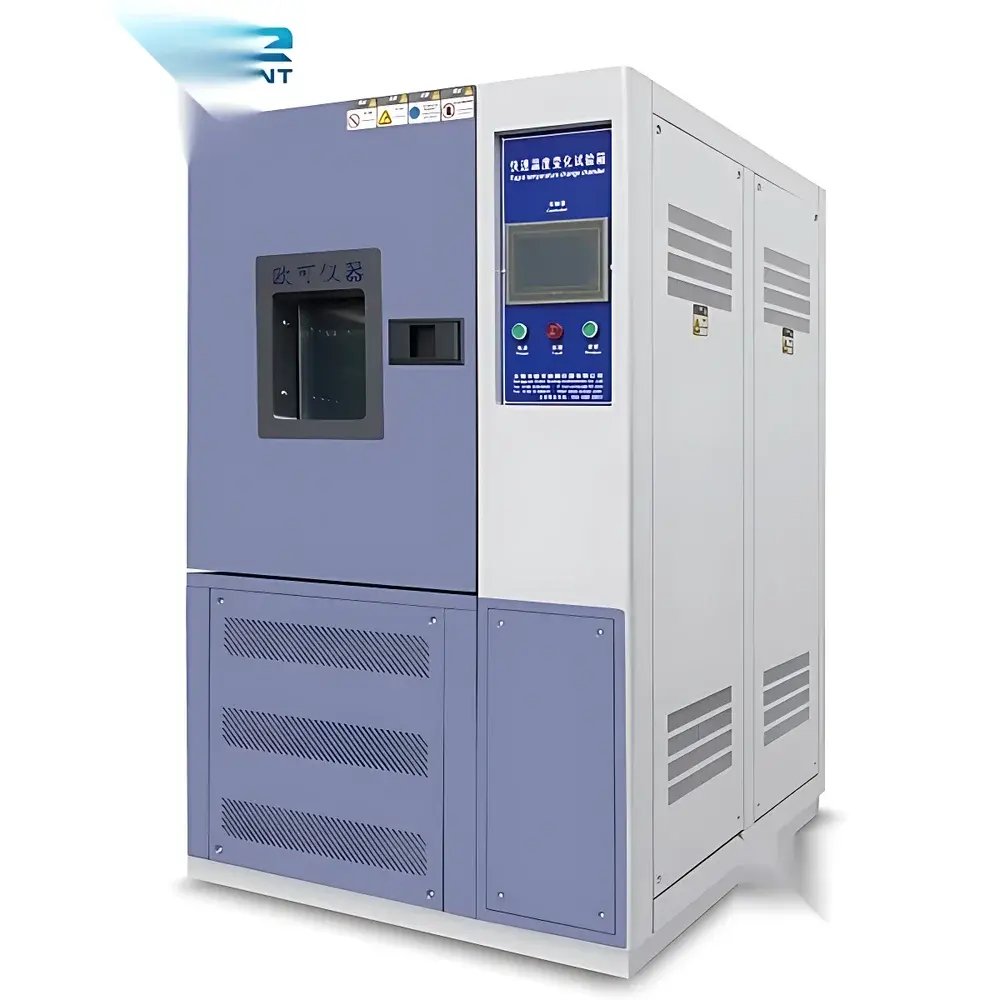
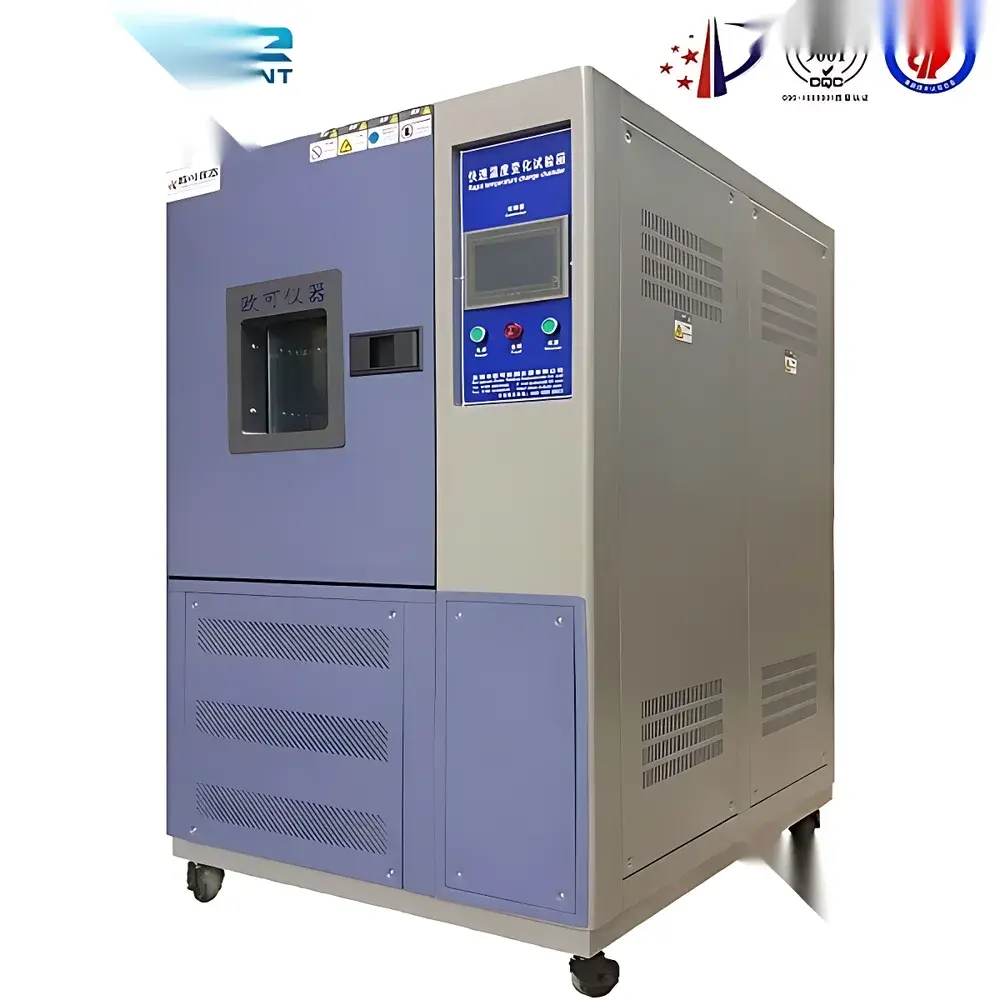
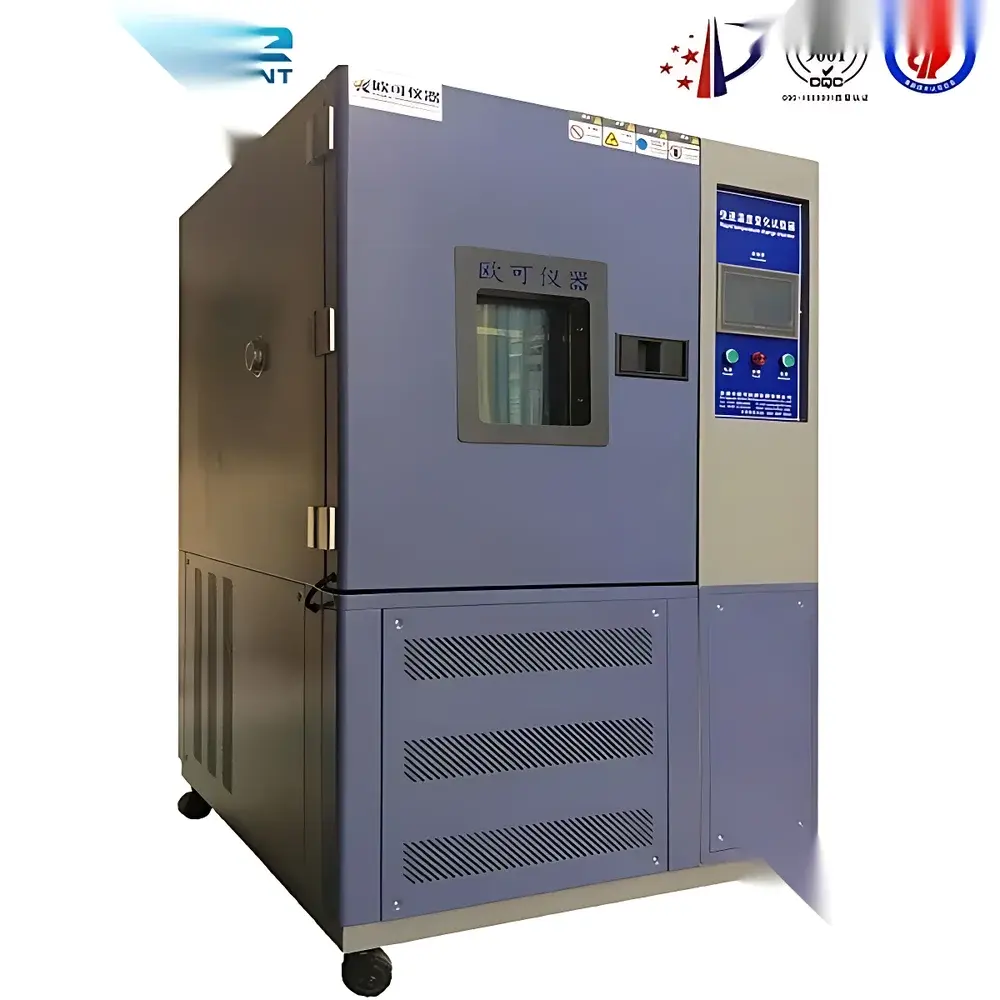
Quick Temperature Change Environmental Test Chamber
| Brand | Other Brands |
|---|---|
| Origin | Imported |
| Manufacturer Type | General Distributor |
| Price | USD 2,650 (approx.) |
| Internal Dimensions (W×H×D, mm) | 500×600×500 / 600×750×500 / 600×850×800 / 1000×1000×800 / 1000×1000×1000 |
| External Dimensions (W×H×D, mm) | 1750×2250×2350 / 1850×2350×2350 / 1850×2500×2750 / 2300×2750×2800 / 2350×2800×3000 |
| Temperature Range | −70 °C to +150 °C |
| Humidity Range (optional) | 20–98 %RH |
| Rapid Temperature Transition Range | −45 °C to +85 °C |
| Rapid Temperature Transition Rate Options | 5 / 10 / 15 / 20 / 25 / 30 °C/min (linear or non-linear programmable) |
| Temperature Control Accuracy | ±0.5 °C |
| Humidity Control Accuracy (optional) | ±2.5 %RH |
| Temperature Uniformity | ±2.0 °C |
| Humidity Uniformity (optional) | ±3.0 %RH |
| Temperature Resolution | 0.1 °C |
| Humidity Resolution (optional) | 0.1 %RH |
| Cooling System | Water-cooled |
| Compressor | Tecumseh (France) or Bitzer (Germany) |
| Power Supply | AC 380 V, 3-phase 5-wire, 50/60 Hz |
| Weight | 950–2300 kg |
| Controller | 7-inch true-color LCD touchscreen (800×480), 1000 stored programs (100 steps each, up to 999 cycles per program), Ethernet interface (10/100 Mbps), data logging with 1–60 s sampling interval, 600-day storage capacity at 60 s interval |
| Construction | Inner chamber – SUS304 stainless steel |
Overview
The Quick Temperature Change Environmental Test Chamber is an engineered thermal stress test system designed for accelerated reliability evaluation of electronic components, automotive modules, aerospace subsystems, and industrial control units under dynamically varying temperature conditions. It operates on a forced-air convection principle with dual-stage refrigeration and precision PID-controlled heating, enabling reproducible linear or non-linear thermal transitions across a wide operational envelope. Unlike standard thermal chambers, this system prioritizes rapid thermal ramping capability—critical for environmental stress screening (ESS), HALT/HASS pre-screening, and qualification testing per MIL-STD-810H Method 503.7 and IEC 60068-2-14. Its architecture supports both dry thermal cycling and optional humidity integration, making it suitable for combined temperature-humidity stress profiles in compliance with JEDEC JESD22-A104E and IPC-9701A standards.
Key Features
- Programmable rapid temperature transition rates from 5 °C/min to 30 °C/min, selectable by model variant (A–F), with user-defined linearity control
- Wide operating range: −70 °C to +150 °C (standard); extended rapid transition zone: −45 °C to +85 °C with ±3.0 °C transition accuracy
- High-fidelity 7-inch color touchscreen controller with intuitive Chinese/English bilingual interface, supporting complex multi-step profile nesting and inter-program linking (up to 10 sequential programs)
- Robust thermal insulation using CFC-free, high-density polyurethane foam (≥100 mm thickness) and double-wall construction to minimize thermal leakage and ensure uniform chamber performance
- Water-cooled dual-stage refrigeration system with industrial-grade compressors (Tecumseh or Bitzer), optimized for continuous high-cycle operation and low maintenance intervals
- Comprehensive safety architecture: high/low pressure cutouts, overtemperature/overhumidity protection, phase failure detection, water flow monitoring, and real-time fault diagnostics with audible/visual alerts
Sample Compatibility & Compliance
The chamber accommodates test specimens ranging from PCB assemblies and sensor modules to full automotive ECUs and medical device enclosures. Internal dimensions scale from 150 L to 1000 L, allowing flexibility for single-unit validation or batch-level ESS campaigns. All models meet structural and operational requirements for ISO/IEC 17025-accredited laboratories conducting environmental testing. Optional humidity functionality complies with ASTM E1822 for hygrothermal cycling and supports GLP-compliant audit trails when integrated with validated data acquisition software. The system’s thermal uniformity (±2.0 °C) and stability (±0.5 °C) are verified per IEC 60068-3-5 and routinely documented during IQ/OQ protocols.
Software & Data Management
Embedded controller firmware supports native Ethernet connectivity (10/100 Mbps), enabling remote monitoring and control via web-based server interface—no proprietary client software required. Data logging resolution is configurable from 1 second to 60 seconds; at the maximum interval, internal memory retains 600 days of timestamped temperature (and humidity, if equipped) records. Export formats include CSV and PDF for traceability in FDA 21 CFR Part 11–aligned environments. Optional integration with third-party LIMS or MES platforms is supported through Modbus TCP or HTTP API endpoints. All parameter changes, alarm events, and cycle completions are time-stamped with microsecond precision and retained in non-volatile memory for post-test forensic analysis.
Applications
- Environmental Stress Screening (ESS) of electronic assemblies to expose latent defects prior to field deployment
- Thermal cycling qualification per AEC-Q200 for automotive passive and active components
- Process validation of conformal coating adhesion, solder joint integrity, and encapsulant delamination resistance
- Accelerated life testing of battery management systems (BMS) and power electronics under dynamic thermal loads
- Pre-compliance testing for IEC 60950-1, UL 62368-1, and EN 61000-4-21 climatic immunity requirements
- Material compatibility studies involving thermal expansion mismatch in multi-layer packaging structures
FAQ
Is humidity control standard or optional?
Humidity functionality is optional and specified separately; standard configurations operate in dry thermal cycling mode only. When selected, humidity range is 20–98 %RH with ±2.5 %RH control accuracy.
Can the chamber perform non-linear ramping profiles?
Yes—the controller supports both linear and non-linear (custom slope) temperature transitions within a single program step, with independent rate definition per segment.
What refrigerant is used in the cooling system?
The system uses environmentally compliant R-404A or R-507 refrigerant, selected based on regional regulatory requirements and compressor configuration.
Is remote firmware update supported?
Firmware updates are performed via USB drive or secure HTTPS upload through the embedded web interface; version history and digital signature verification are maintained in audit logs.
Does the chamber support automated report generation?
While the base controller provides raw data export, automated PDF report generation with pass/fail criteria and statistical summaries requires optional PC-based analysis software compliant with ISO/IEC 17025 documentation requirements.



