
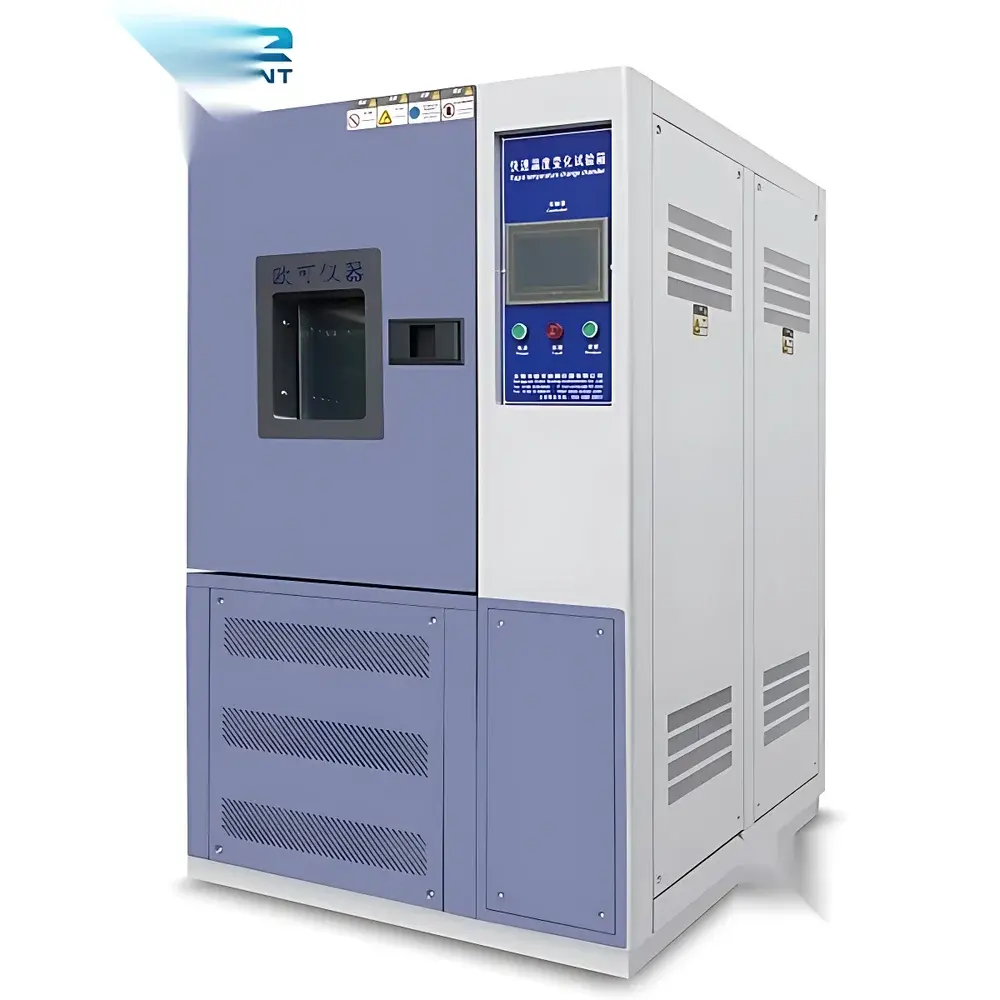
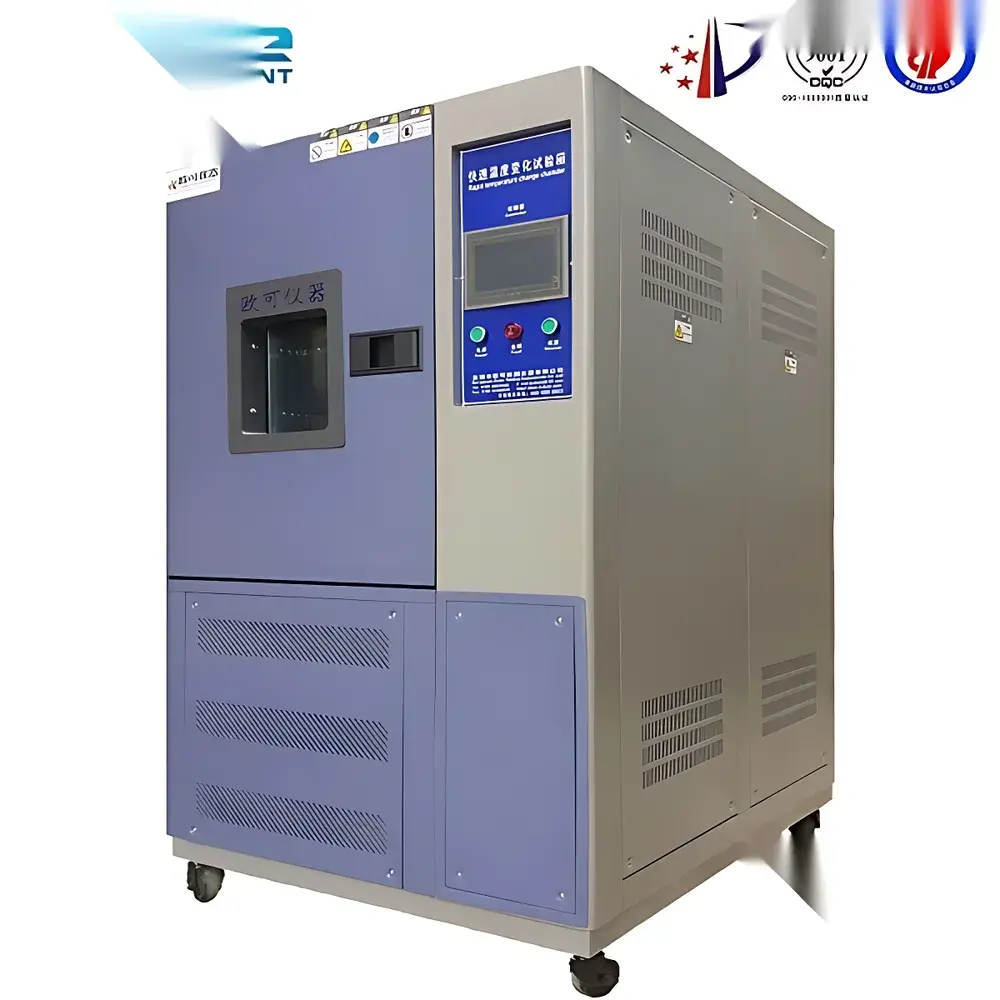
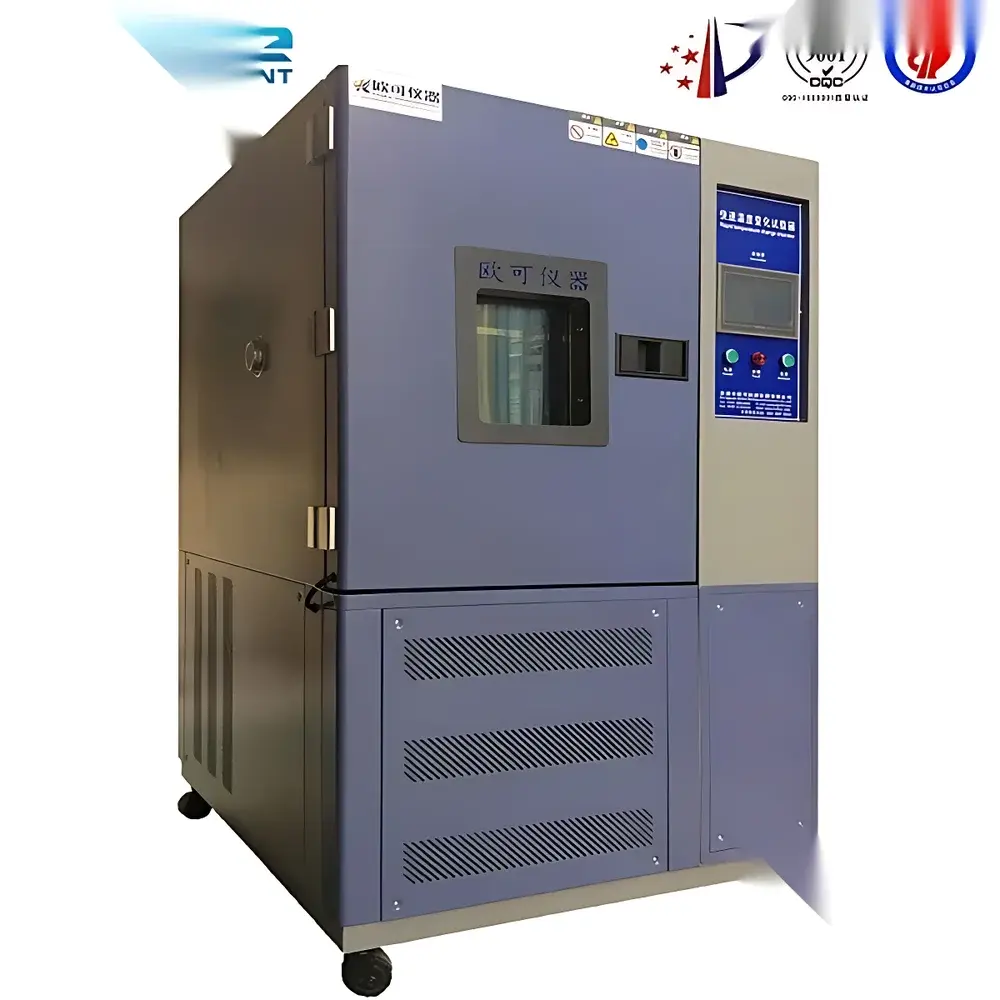
Quick-Temperature-Change Environmental Test Chamber – KS-TH Series
| Brand | KS |
|---|---|
| Model | KS-TH-225 / KS-TH-408 / KS-TH-800 / KS-TH-1000 |
| Temperature Range | −70 °C to +150 °C |
| Humidity Range | 20–98% RH (optional: 5–98% RH) |
| Rapid Temperature Transition Ranges | A: −45 °C to +85 °C |
| B | −20 °C to +85 °C |
| Ramp Rates | 5–25 °C/min (customizable) |
| Temperature Uniformity | ±2 °C |
| Temperature Fluctuation | ±0.5 °C |
| Humidity Uniformity | ±3.0% RH (at ≥75% RH) |
| Humidity Fluctuation | ±2.5% RH |
| Interior Construction | SUS#304 Stainless Steel |
| Refrigeration System | Hermetic, low-noise, dual-stage compressor with eco-friendly refrigerants (R404A/R23) |
| Controller | Touchscreen LCD with bilingual (English/Chinese) interface |
| Power Supply | AC 380 V ±5%, 50 Hz ±0.5 Hz, 3-phase 5-wire |
| Compliance | GJB 150.3, GJB 150.4, GJB 150.9, GB/T 2423.1–2008, GB/T 2423.2–2008, GB/T 2423.3–2006, GB 11158, GB 10589–89, GB 10592–89, GB/T 10586–89 |
Overview
The KS-TH Series Quick-Temperature-Change Environmental Test Chamber is an engineered thermal stress screening system designed for accelerated reliability validation of electronic components, aerospace subsystems, automotive modules, and precision mechanical assemblies. It operates on the principle of controlled, high-rate thermal cycling—inducing repeated expansion and contraction in materials to activate latent defects such as interfacial delamination, solder joint microcracking, coefficient-of-thermal-expansion (CTE) mismatch failures, and die-attach void propagation. Unlike standard temperature chambers, the KS-TH series delivers programmable ramp rates up to 25 °C/min across a wide operational envelope (−70 °C to +150 °C), enabling precise replication of real-world thermal shock profiles defined in MIL-STD-810H Method 503.5 and IEC 60068-2-14. Its robust chamber architecture minimizes thermal lag and ensures high reproducibility between test runs—critical for qualification testing under GLP and GMP-aligned quality systems.
Key Features
- Multi-stage rapid thermal transition capability with selectable ramp rates (5, 10, 15, 20, or 25 °C/min) across two standard transition ranges: A (−45 °C ↔ +85 °C) and B (−20 °C ↔ +85 °C)
- Configurable cycle parameters: up to 999 cycles per test sequence; individual dwell times adjustable from 1 minute to 999 hours 59 minutes
- Integrated touchscreen controller with real-time graphing, data logging, and bilingual (English/Chinese) UI—supports user-defined test profiles and alarm-triggered event capture
- Dual-refrigerant, hermetically sealed cascade refrigeration system using R404A (low-temp stage) and R23 (ultra-low-temp stage), compliant with EU F-Gas Regulation (EU) No 517/2014
- SUS#304 stainless steel interior with non-reflective finish, seamless welding, and insulated double-wall construction for minimal thermal leakage and long-term corrosion resistance
- Automated start/stop scheduling with calendar-based execution, power-failure recovery mode, and configurable safety interlocks (over-temperature, over-humidity, compressor overload)
Sample Compatibility & Compliance
The KS-TH chamber accommodates samples ranging from PCB subassemblies and sensor housings to full ECUs and avionics enclosures. Internal dimensions span from 225 L (50 × 75 × 60 cm) to 1000 L (100 × 100 × 100 cm), with custom cavity configurations available upon request. All models meet national and defense-standard environmental test requirements including GJB 150.3 (high-temperature exposure), GJB 150.4 (low-temperature exposure), GJB 150.9 (combined temperature/humidity), and GB/T 2423.1–2008 (cold), GB/T 2423.2–2008 (dry heat), and GB/T 2423.3–2006 (damp heat). The system’s temperature uniformity (±2 °C) and stability (±0.5 °C) are verified per ISO 17025-accredited calibration procedures traceable to NIM (National Institute of Metrology, China). Optional humidity control extends compliance to IEC 60068-2-78 (damp heat, steady state) and IPC-J-STD-020D (moisture sensitivity level profiling).
Software & Data Management
Equipped with embedded firmware supporting CSV export of time-stamped temperature/humidity logs at user-defined intervals (1 s to 60 min resolution). The controller supports audit trail functionality—including operator ID, parameter changes, and alarm history—with optional USB or Ethernet connectivity for integration into centralized LIMS or MES platforms. While native software does not include FDA 21 CFR Part 11 electronic signature capabilities, third-party validated extensions are available for regulated pharmaceutical and medical device environments requiring ALCOA+ data integrity principles. All logged data is timestamped with internal RTC synchronized to NTP servers when network-enabled, ensuring traceability during regulatory audits.
Applications
- Thermal shock qualification per MIL-STD-810H, Method 503.5 and JEDEC JESD22-A106B
- Process validation for reflow soldering, conformal coating, and potting compound curing
- Failure analysis root cause identification via accelerated defect activation
- Reliability growth testing (RGT) for automotive ADAS modules subjected to under-hood thermal transients
- Environmental stress screening (ESS) in high-mix electronics manufacturing prior to burn-in or final shipment
- Material compatibility assessment for elastomers, adhesives, and composite laminates under cyclic thermal load
FAQ
What is the difference between a quick-temperature-change chamber and a standard thermal shock chamber?
Standard thermal shock chambers use separate hot/cold zones with sample transfer mechanisms, whereas the KS-TH series achieves rapid transitions within a single chamber via high-capacity cascade refrigeration and optimized airflow—eliminating mechanical transfer latency and reducing thermal inertia-related overshoot.
Can the KS-TH series perform combined temperature/humidity cycling?
Yes—models equipped with humidity option support programmable temperature-and-humidity profiles per GB/T 2423.3–2006 and IEC 60068-2-78, with independent control of dew point and relative humidity across the full operating range.
Is calibration documentation included with delivery?
Each unit ships with a factory calibration certificate covering temperature and humidity sensors, traceable to national standards. On-site IQ/OQ protocol execution and annual recalibration services are available through authorized service partners.
How is safety ensured during ultra-rapid ramping?
The system implements redundant hardware limiters (mechanical and electronic), real-time compressor discharge temperature monitoring, and automatic ramp rate derating if thermal load exceeds design thresholds—ensuring safe operation even during extended 25 °C/min cycles.
Does the controller support remote monitoring and control?
Standard Ethernet port enables Modbus TCP communication for SCADA integration; optional web server module provides browser-based status viewing, log download, and limited parameter adjustment via secure HTTPS session.
Related Products



