
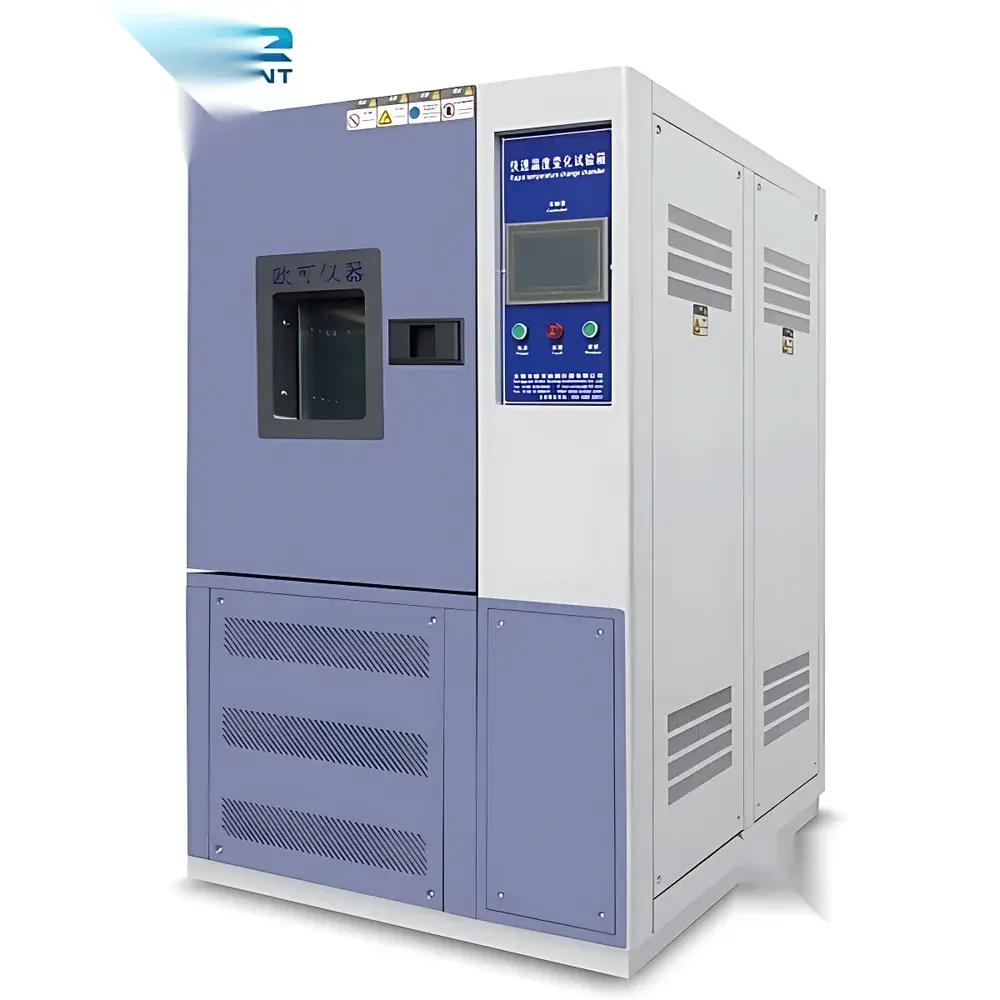
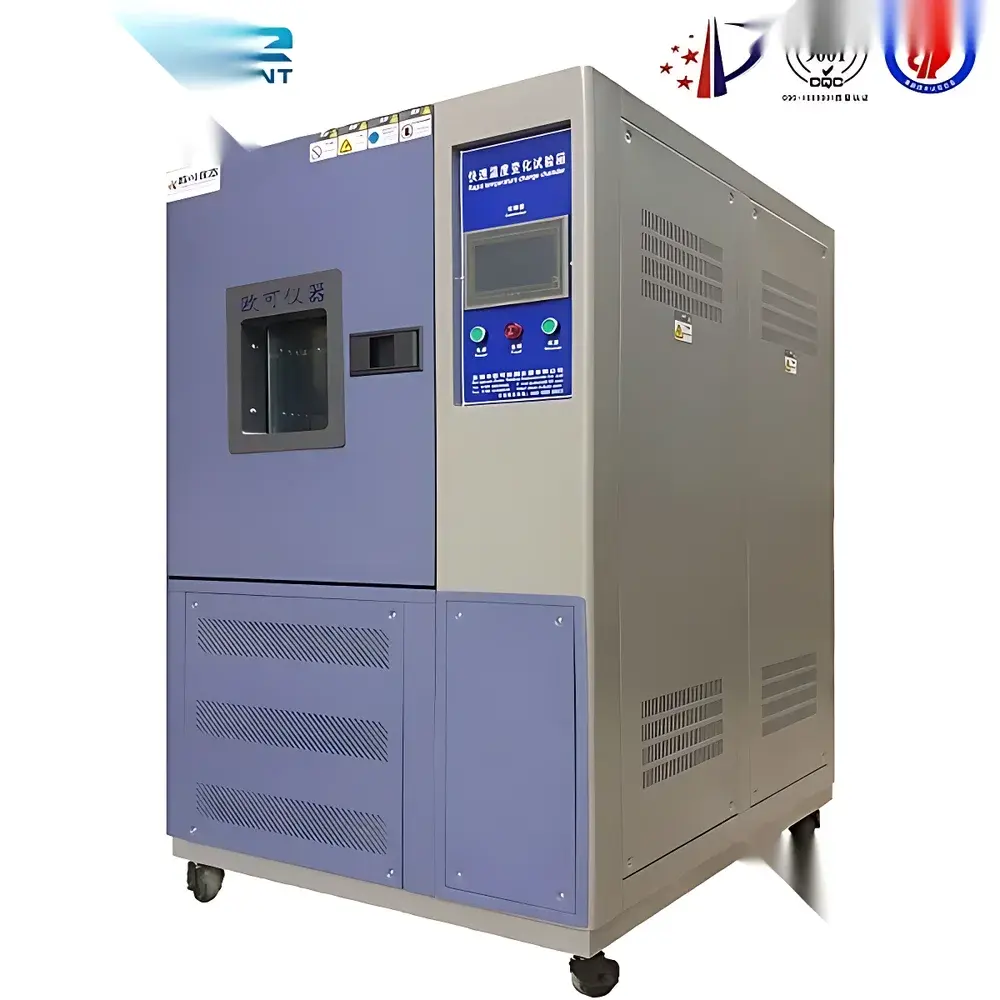
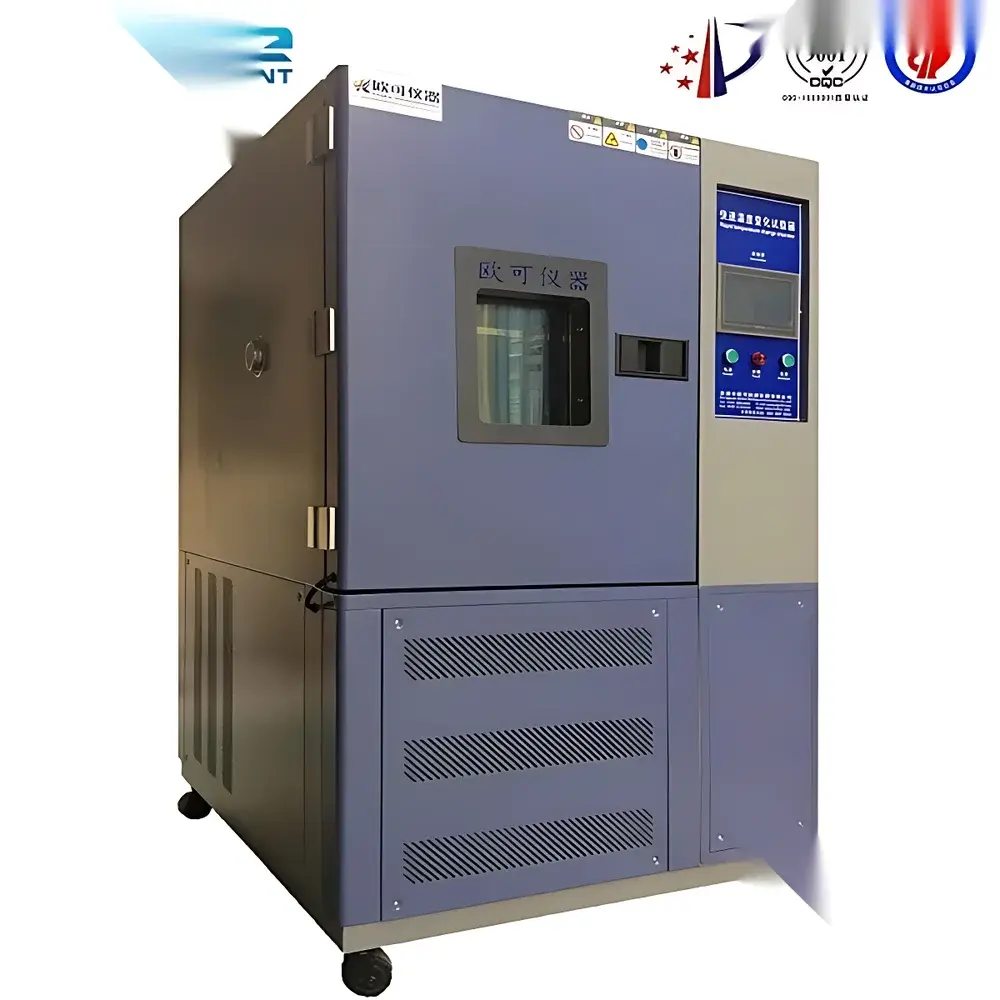
Quick Temperature Change Test Chamber
| Brand | Custom OEM |
|---|---|
| Origin | Imported |
| Manufacturer Type | Authorized Distributor |
| Price | USD 14,200 (FOB) |
| Temperature Range | −70 °C to +150 °C |
| Humidity Range | 20–98% RH (optional: 5–98% RH) |
| Rapid Temp. Transition Rates | 5–25 °C/min (selectable) |
| Temp. Uniformity | ±2 °C |
| Humidity Uniformity | ±3.0% RH (≥75% RH) |
| Temp. Stability | ±0.5 °C |
| Humidity Stability | ±2.5% RH |
| Internal Dimensions (W×H×D, cm) | 50×75×60 / 60×85×80 / 100×100×80 / 100×100×100 |
| Test Port | Ø50 mm (left side) |
| Refrigeration | Hermetic dual-stage cascade system with R404A/R23 eco-refrigerants |
| Controller | Full-color LCD touch HMI with bilingual (EN/CN) interface, PID auto-tuning, programmable ramp/soak profiles |
| Power Supply | AC 380 V ±5%, 50 Hz ±0.5 Hz, 3-phase 5-wire, 2.5 m cable |
Overview
The Quick Temperature Change Test Chamber is an engineered environmental stress screening (ESS) system designed to accelerate thermal fatigue and reveal latent defects in electronic components, automotive modules, aerospace assemblies, and precision mechanical systems. Operating on the principle of controlled, high-rate thermal cycling between extreme temperature limits (−70 °C to +150 °C), it induces repeated expansion and contraction in materials—generating thermally driven mechanical stress and strain gradients across heterogeneous interfaces (e.g., solder joints, encapsulants, PCB substrates, and adhesive bonds). Unlike standard thermal shock chambers, this chamber supports continuous, programmable ramp-and-soak profiles with precisely regulated transition rates (5–25 °C/min), enabling compliance with industry-standard ESS protocols including MIL-STD-810H Method 503.7, IEC 60068-2-14, and JEDEC JESD22-A104F. Its architecture integrates a dual-stage cascade refrigeration system using environmentally compliant R404A/R23 refrigerants, ensuring stable low-temperature performance without liquid nitrogen dependency.
Key Features
- Full-color 7-inch LCD touch HMI controller with real-time graphical curve display, bilingual (English/Chinese) interface, and intuitive drag-and-drop profile programming.
- Programmable multi-segment thermal cycles: independent high-temperature, low-temperature, and rapid transition phases—with selectable two-zone or three-zone shock modes.
- High-fidelity thermal control via adaptive PID algorithms with auto-tuning; temperature stability maintained at ±0.5 °C and uniformity within ±2 °C across full working volume.
- Robust internal construction using brushed SUS#304 stainless steel; seamless welds and insulated double-wall structure minimize thermal leakage and condensation risk.
- Dedicated Ø50 mm test port on left chamber wall, fitted with silicone gasket and clamping flange—enabling real-time signal monitoring, power feedthrough, or external sensor integration under operational conditions.
- Energy-efficient hermetic compressor system with oil return management and low-noise operation (<65 dB[A] at 1 m), suitable for ISO Class 7 cleanroom-adjacent installation.
Sample Compatibility & Compliance
This chamber accommodates test specimens up to 100 cm × 100 cm × 100 cm (KS-TH-1000 model), supporting both bare PCBs and fully assembled enclosures with active cooling or biasing requirements. It meets structural and operational requirements for GLP-compliant reliability labs and fulfills hardware-level prerequisites for ISO/IEC 17025 accreditation. The controller logs all operational parameters—including setpoints, actual chamber values, alarm events, and system status—with timestamped, non-volatile storage. Audit trails comply with FDA 21 CFR Part 11 when paired with validated user access controls and electronic signature modules (available as optional firmware upgrade). All electrical safety design conforms to IEC 61010-1; refrigerant handling follows ISO 5149 and EPA SNAP guidelines.
Software & Data Management
The embedded controller supports USB export of CSV-formatted test data (temperature, humidity, time, alarms) with millisecond-resolution timestamps. Optional Ethernet connectivity enables remote monitoring via Modbus TCP or OPC UA protocols—integrating seamlessly into MES platforms such as Siemens Opcenter or Rockwell FactoryTalk. Advanced software packages (sold separately) provide statistical process control (SPC) overlays, Weibull failure analysis templates, and automated report generation aligned with AIAG CQI-23 and IPC-9701 standards. All firmware updates are digitally signed and verified during installation to ensure integrity and traceability.
Applications
- Qualification testing of avionics modules per RTCA DO-160G Section 4 (Temperature Variation).
- Screening solder joint integrity in high-reliability PCBAs used in medical imaging systems (IEC 62304 Class C).
- Validating thermal interface material (TIM) performance under cyclic loading in EV battery pack prototypes.
- Accelerated life testing of MEMS sensors and optical housings subjected to diurnal ambient extremes.
- Process validation for conformal coating adhesion and potting compound delamination resistance.
FAQ
What is the minimum dwell time achievable between temperature transitions?
The system supports dwell times as short as 1 minute at target extremes, configurable per segment in the test profile.
Can humidity be controlled simultaneously with rapid temperature changes?
Yes—humidity control (20–98% RH) is fully decoupled and synchronized with thermal ramps; however, rate-limited transitions are recommended above 85% RH to prevent condensation.
Is third-party calibration certification included with shipment?
NIST-traceable calibration certificates for temperature and humidity sensors are available upon request (ISO/IEC 17025 accredited lab report, additional fee applies).
Does the chamber support custom protocol scripting (e.g., MIL-STD-2164A)?
Yes—the controller accepts ASCII-based script files defining complex multi-step sequences, including conditional branching based on sensor feedback.
What maintenance intervals are recommended for the refrigeration system?
Compressor oil analysis and filter dryer replacement are advised every 2,000 operating hours or biannually—whichever occurs first—per manufacturer service manual Rev. 4.2.



